
Years
1977 in History
1977 is remembered above all for 27 March, when two Boeing 747s collided in fog on the runway at Los Rodeos, Tenerife, killing 583 people in the deadliest accident in aviation history — a disaster caused not by mechanical failure but by a conversation that went wrong. The same year opened the Star Wars era at the cinema, closed Elvis Presley's life at Graceland, and launched Voyager 2 toward all four giant planets.
At a Glance
- Defining event
- Tenerife airport disaster, 27 March 1977 — 583 people killed in a runway collision
- Film landmark
- Star Wars opens in cinemas on 25 May, beginning a vast franchise
- Death of an icon
- Elvis Presley found dead at Graceland, Memphis, aged 42, on 16 August
- Space launch
- NASA launches Voyager 2 on 20 August, bound for all four giant planets
- Democratic first
- Spain votes in its first free general election since 1936, 15 June
- Closed the year
- Charlie Chaplin dies in Switzerland at 88, on 25 December
The defining story: the deadliest day in aviation history
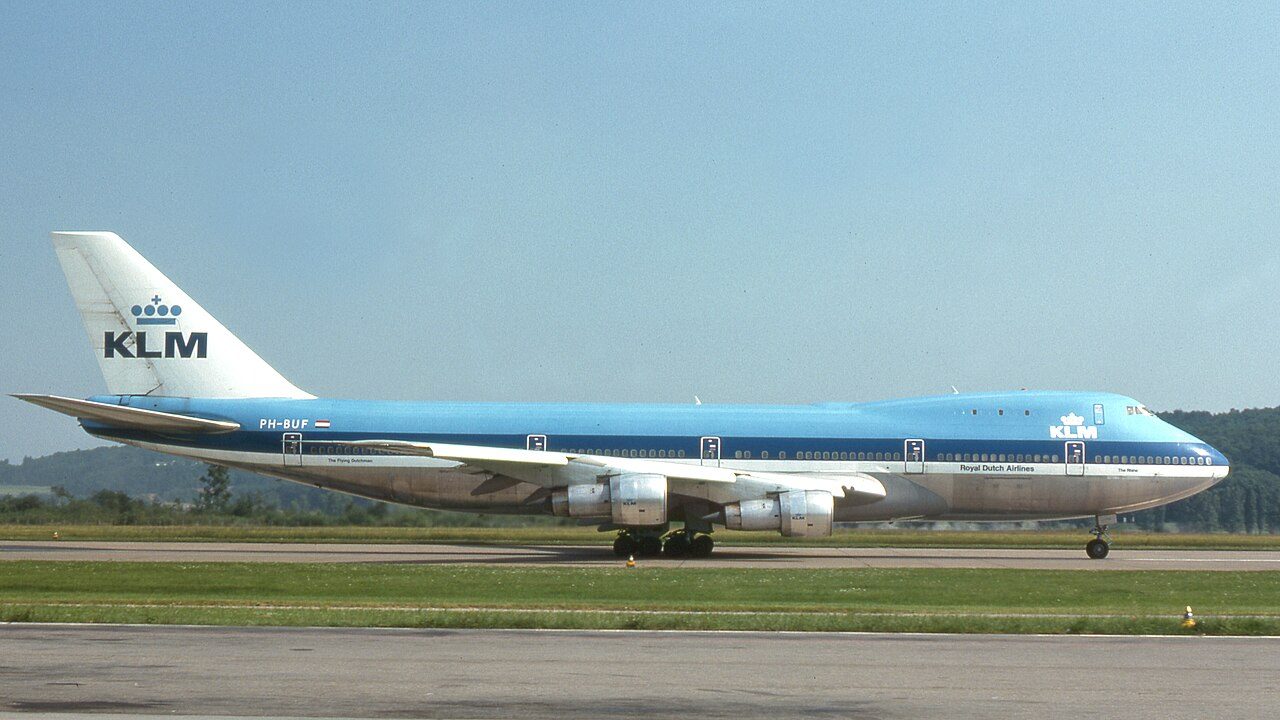
Neither aircraft belonged at Los Rodeos. On the afternoon of Sunday 27 March 1977 a bomb planted by a Canary Islands separatist group exploded at Gran Canaria airport, the destination of both flights, and the threat of a second bomb closed it. Dozens of holiday flights were diverted to Los Rodeos, the small airport serving Tenerife — a single runway, no ground radar, taxiways soon jammed with parked jumbos. Among them were KLM flight 4805, a charter from Amsterdam whose 248 passengers and crew were bound for a cruise, and Pan Am flight 1736 from Los Angeles and New York, with 396 people aboard. The KLM jet in this page's photograph, PH-BUF, photographed in 1975, was the aircraft that would be destroyed that evening.
When Gran Canaria reopened, the scramble to leave created the trap. Los Rodeos had no taxiway running beside its runway for much of its length, so aircraft had to taxi along the runway itself and turn around at the end. The KLM jet, refuelled and anxious about its crew's duty-time limits, taxied out first and turned into takeoff position. The Pan Am jet followed behind it on the same runway, instructed to leave by an exit the crew, in thickening fog, could not confidently identify. Fog closed in until the control tower could see nothing at all; everything now depended on radio voices, and the radio failed them — non-standard phraseology and simultaneous transmissions masking the warnings that might have stopped the roll.
Believing he had been cleared, the KLM captain — the airline's chief of flight training — opened the throttles. His 747 accelerated through the fog toward a Pan Am jet still on the runway, unseen until seconds before impact. The KLM crew hauled their aircraft up early; it struck the Pan Am's upper deck, lost its tail and engines, and crashed in fire. All 248 people aboard the KLM aircraft died, and 335 of the 396 aboard the Pan Am; the 61 survivors, including its flight crew, escaped from the front section of the Clipper Victor.
Tenerife rebuilt how flying talks to itself. After 1977 the industry imposed standard phraseology worldwide — reserving the word takeoff for the clearance itself — tightened read-back discipline, and developed crew resource management: the doctrine that a junior officer must challenge a captain, born in part from the silence on that flight deck. The deadliest accident in aviation history involved no mechanical failure and no aircraft ever properly leaving the ground. Around that catastrophe, 1977 turned cultural corners: Star Wars opened on 25 May, Spain voted on 15 June in its first free general election since 1936, and on 16 August Elvis Presley was found dead at Graceland, aged 42.
Timeline of 1977
- 17 January
Gary Gilmore is executed by firing squad in Utah, the first execution in the United States after a ten-year halt.
- 23 January
The television miniseries Roots premieres in the United States and becomes a national event.
- 10 March
Astronomers discover the rings of Uranus, the first ring system found around a giant planet since Saturn's.
- 27 March
Two Boeing 747s collide on the runway at Los Rodeos, Tenerife, killing 583 people.
- 25 May
Star Wars opens in cinemas, beginning one of the most successful film franchises in history.
- 15 June
Spain votes in its first free general election since 1936, two years after Franco's death.
- 27 June
France grants independence to Djibouti, its last African colony.
- 16 August
Elvis Presley, the King of Rock and Roll, is found dead at Graceland in Memphis, aged 42.
- 20 August
NASA launches Voyager 2, which goes on to visit all four giant planets and enter interstellar space in 2018.
- 7 September
President Carter and Panama's Omar Torrijos sign the treaties transferring the Panama Canal to Panama at the end of 1999.
- 10 September
Hamida Djandoubi is executed by guillotine at Marseille — the last use of the guillotine in France.
- 12 September
Steve Biko, South African anti-apartheid activist, dies of injuries suffered in police custody.
- 19 November
Egypt's President Anwar Sadat arrives in Israel, the first Arab leader to visit the Jewish state.
- 25 December
Charlie Chaplin, the Little Tramp, dies in Switzerland at 88.
Why 1977 still matters
Tenerife's reforms are the year's most literal legacy: every pilot who now reads back a clearance, and every first officer trained to challenge a captain, is working inside rules written after 583 people died in fog. Aviation has been re-engineering that conversation ever since, and the accident remains its founding case — proof that the most dangerous failure in a complex system can be a sentence misunderstood.
The year's diplomacy pointed just as far forward. Sadat's arrival in Israel on 19 November — the first visit by an Arab leader to the Jewish state — prepared the Camp David Accords of the following year, and the Panama Canal treaties signed on 7 September set the canal's transfer for the end of 1999. Spain's free election closed the Franco era by ballot, completing a democratic transition watched across Europe.
Culturally, 1977 drew a line between eras: Star Wars began the blockbuster age that still structures cinema, Roots made a family's passage from West Africa through slavery into a national television event, and the deaths of Presley, Groucho Marx on 19 August and Chaplin on Christmas Day closed the careers of three defining entertainers of the century. Voyager 2, launched in August, outlasted them all — it visited all four giant planets and entered interstellar space in 2018, still carrying 1977 outward.
1977 on The History Trail
The Tenerife disaster carries this year's featured story on The History Trail.
- March 27 in History — Two 747s collide at Los Rodeos, Tenerife, killing 583 people.
- May 25 in History — Star Wars opens in cinemas.
- August 16 in History — Elvis Presley dies at Graceland, aged 42.
- November 19 in History — Anwar Sadat arrives in Israel, the first Arab leader to visit.
- Apple Inc. — The company founded in 1976, rising through this era of personal computing.
- World Health Organization — The global health body whose work runs through this period.
Sources
- HISTORY — This Day in History: March 27
- HISTORY — This Day in History: May 25
- Encyclopaedia Britannica — On This Day: August 16
- Encyclopaedia Britannica — On This Day: November 19
- Encyclopaedia Britannica — On This Day: June 15
- Encyclopaedia Britannica — On This Day: September 7
- Encyclopaedia Britannica — On This Day: January 23
The facts on this page were checked against these sources on 19 November 2026. The History Trail's permanent pages are researched and written for this site; the live profiles elsewhere on The History Trail are assembled automatically from Wikipedia and Wikidata.
About the Author
Researched and written by the The History Trail Editorial Team — the accountable editorial function behind this site's permanent story pages. The team works from the published sources cited on each page; it does not invent historians, reviewers or credentials, and it corrects errors openly.
Fact Check
Every load-bearing fact on this page traces to one of the sources listed above, and significant claims link to their source in the text. Our checking method is described on the methodology page; errors can be reported via the corrections page.
Sources & Citations
Cite this page as: The History Trail Editorial Team, The History Trail — this article's title, publication and update dates are shown beneath its headline. The full source list appears under Sources above; the site's source standards are on the sources page.