
Years
1957 in History
1957 is remembered as the year the Space Age began. On 4 October the Soviet Union launched Sputnik 1, the first artificial satellite, and on 3 November Sputnik 2 carried the dog Laika into orbit, the first living creature to circle the Earth. Weeks earlier, on 24 September, President Eisenhower had sent federal troops to Little Rock to enforce school desegregation, and in March the Treaties of Rome founded the communities that became the European Union.
At a Glance
- Defining event
- Sputnik 1 launched 4 October 1957 — the first artificial satellite
- First creature in orbit
- Laika orbits Earth aboard Sputnik 2 on 3 November
- At Little Rock
- Eisenhower sends federal troops on 24 September to enforce desegregation at Central High School
- Europe unites
- Treaties of Rome signed 25 March, creating the European Economic Community and Euratom
- Independence
- Ghana becomes independent on 6 March; Malaya follows on 31 August
- First meeting
- John Lennon, 16, meets Paul McCartney, 15, in Liverpool on 6 July
The defining story: the beep that started the Space Age
The object that opened the Space Age was almost absurdly simple: a polished metal sphere, 58 centimetres across and weighing 83.6 kilograms, carrying a radio transmitter and little else. On 4 October 1957 a Soviet R-7 rocket lifted Sputnik 1 from the Baikonur Cosmodrome in Kazakhstan and set it circling the Earth once every 96 minutes or so, its transmitter chirping a steady beep that any radio amateur could pick up as it passed overhead. Sputnik, the name means simply fellow traveller, was the first artificial satellite, and its beeping was heard around the world in every sense.
The launch was the work of Sergei Korolev, the Soviet Union's anonymous chief designer, whose R-7 had been built as the world's first intercontinental ballistic missile. That dual purpose was precisely what made Sputnik so unsettling in the West: a rocket that could put a satellite over Washington could put a warhead there too. In the United States the news landed as a national shock, the Sputnik crisis, feeding fears that America had fallen behind in science, education and missile technology all at once. The satellite's batteries ran down after about three weeks and the beeping stopped on 26 October; the sphere itself burned up on re-entry on 4 January 1958.
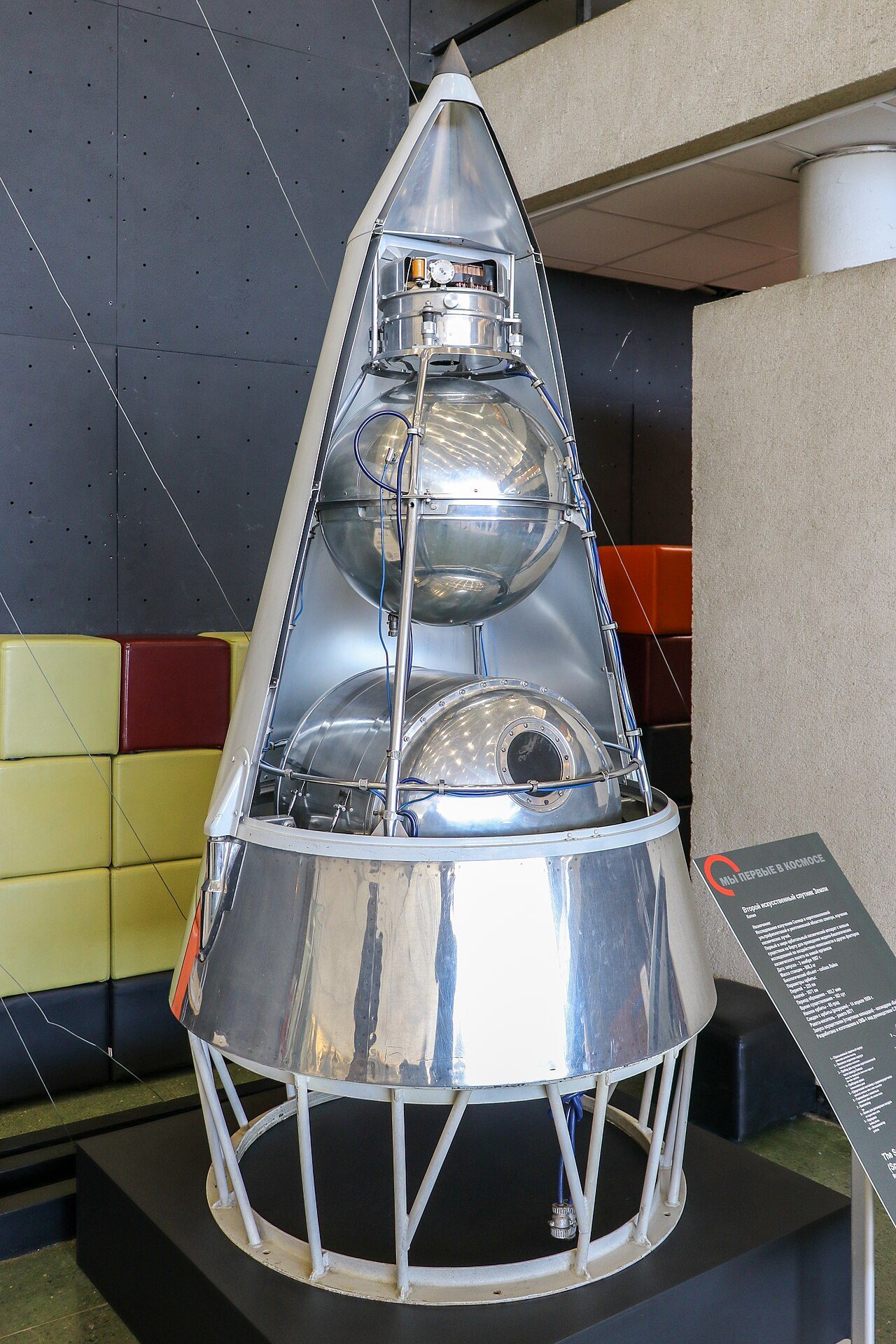
One month after Sputnik 1, Nikita Khrushchev demanded another spectacular in time for the 40th anniversary of the Bolshevik Revolution. Soviet engineers had perhaps four weeks to build Sputnik 2, and this time it would carry a passenger, with no technology and no time to bring her back. The passenger was a small Moscow stray, part Samoyed and terrier, renamed Laika. On 3 November she was sealed into Sputnik 2's pressurised cabin and launched; her heart rate tripled, and she reached orbit alive, the first living creature to do so, circling the Earth in about 103 minutes. Soviet broadcasts claimed she survived for days; in fact a thermal-control failure let the cabin overheat, and she died within hours, a truth revealed only decades later.
While the satellites flew, the year's other confrontation unfolded on the ground. Three years after Brown, Little Rock set out to integrate Central High School with nine carefully chosen Black students; Governor Orval Faubus called out the National Guard to keep them out, and on 23 September the Nine slipped in through a side door before police removed them for their safety as a mob surged outside. On 24 September Eisenhower federalised the Arkansas National Guard and sent about a thousand paratroopers of the 101st Airborne to Little Rock. The next morning the Nine entered Central High properly, each with a soldier escort.
Timeline of 1957
- 9 January
Anthony Eden resigns as British prime minister, broken by the Suez Crisis.
- 6 March
Ghana becomes independent of Britain, the first sub-Saharan African colony to win freedom after the Second World War.
- 25 March
The Treaties of Rome are signed, creating the European Economic Community and Euratom.
- 2 May
Joseph McCarthy, whose campaigns gave the language the word McCarthyism, dies at 48.
- 6 July
Althea Gibson becomes the first Black player to win a Wimbledon singles title.
- 6 July
John Lennon meets Paul McCartney for the first time at a church fete in Liverpool.
- 26 August
The Soviet Union announces a successful intercontinental ballistic missile test.
- 29 August
Senator Strom Thurmond ends his record 24-hour filibuster against the Civil Rights Act of 1957.
- 31 August
The Federation of Malaya gains independence from Britain.
- 5 September
Jack Kerouac's novel On the Road is published in New York.
- 24 September
Eisenhower sends federal troops to Little Rock to enforce desegregation.
- 29 September
An explosion at the Soviet Mayak plant contaminates the region around Kyshtym; it is concealed for nearly two decades.
- 4 October
The Soviet Union launches Sputnik 1, the first artificial satellite.
- 3 November
Sputnik 2 carries Laika into orbit, the first creature to circle the Earth.
Why 1957 still matters
Sputnik's consequences were anything but brief. The United States answered with a crash programme: Explorer 1 in January 1958, a new emphasis on science and mathematics teaching, and, on 1 October 1958, the creation of NASA, the agency that would take Americans to the Moon eleven years later. The space race, the defining technological contest of the Cold War, began with that small sphere. Sputnik also changed the rules of the sky: no nation protested its overflight, establishing in practice the principle that space above the atmosphere is free for all to cross, a precedent every reconnaissance satellite since has relied upon. Laika's flight proved a living organism could survive launch and weightlessness, data the Soviet programme needed before risking a human; Gagarin followed in 1961.
Little Rock set the companion precedent on Earth: when a state government interposed itself between citizens and a federal court order, the United States would, in the end, send the Army. It was the first time since Reconstruction that a president had sent federal troops into a southern state to protect the rights of Black citizens. Faubus answered in 1958 by closing Little Rock's public high schools altogether for a year, but the precedent of 24 September stood.
The Treaties of Rome worked on the longest fuse of all: the European Economic Community and Euratom they created on 25 March are the founding charters of today's European Union. Ghana's independence on 6 March began sub-Saharan Africa's postwar decolonisation, Malaya followed on 31 August, and the International Atomic Energy Agency was established on 29 July. In Liverpool, two teenagers met at a church fete on 6 July; the century's most famous partnership had begun, unnoticed, in the year of the satellite.
1957 on The History Trail
Satellites and soldiers fill 1957 on The History Trail.
- October 4 in History — Sputnik 1 is launched, told in full.
- November 3 in History — Laika becomes the first creature to orbit Earth.
- September 24 in History — Federal troops are sent to Little Rock.
- March 25 in History — The Treaties of Rome are signed.
- March 6 in History — Ghana becomes independent.
- July 6 in History — Lennon meets McCartney, and Gibson wins Wimbledon.
Sources
- NASA — 65 Years Ago: Sputnik Ushers in the Space Age
- Encyclopaedia Britannica — On This Day: October 4
- Encyclopaedia Britannica — On This Day: November 3
- Smithsonian Magazine — The Sad, Sad Story of Laika, the Space Dog
- Encyclopaedia Britannica — On This Day: September 24
- Encyclopaedia Britannica — On This Day: March 25
- HISTORY — This Day in History: July 6
The facts on this page were checked against these sources on 19 November 2026. The History Trail's permanent pages are researched and written for this site; the live profiles elsewhere on The History Trail are assembled automatically from Wikipedia and Wikidata.
About the Author
Researched and written by the The History Trail Editorial Team — the accountable editorial function behind this site's permanent story pages. The team works from the published sources cited on each page; it does not invent historians, reviewers or credentials, and it corrects errors openly.
Fact Check
Every load-bearing fact on this page traces to one of the sources listed above, and significant claims link to their source in the text. Our checking method is described on the methodology page; errors can be reported via the corrections page.
Sources & Citations
Cite this page as: The History Trail Editorial Team, The History Trail — this article's title, publication and update dates are shown beneath its headline. The full source list appears under Sources above; the site's source standards are on the sources page.