
On This Day
November 3 in History
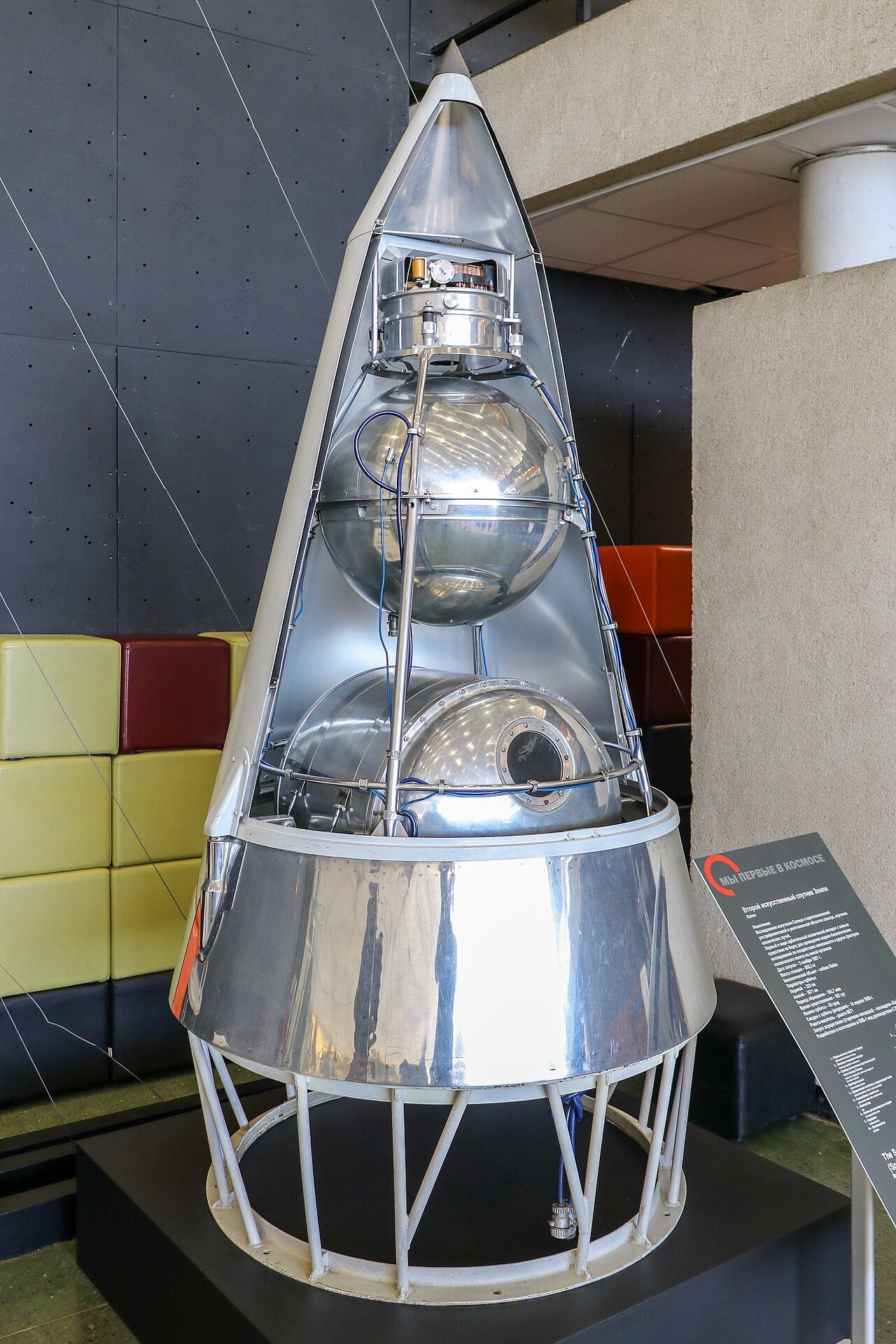
On 3 November 1957 the Soviet Union launched Sputnik 2 with a Moscow stray named Laika aboard, making her the first living creature to orbit the Earth — on a mission designed with no way home. November 3 is also the day Panama separated from Colombia, The Wizard of Oz first reached television, and the Chicago Cubs finally won a World Series after 108 years.
Choose another date: open the On This Day calendar to browse events, births and deaths for any day of the year.
At a Glance
- The order
- Khrushchev demands a second Sputnik for the 40th anniversary of the Revolution, weeks after Sputnik 1
- The passenger
- Laika, a Moscow stray of about three, originally named Kudryavka; chosen for calmness and hardiness
- The launch
- 3 November 1957; Laika reaches orbit alive, circling Earth in about 103 minutes
- The truth
- A thermal failure overheated the cabin; she died within hours, though Soviet reports claimed she lived for days
- The end
- Sputnik 2 burns up on re-entry on 14 April 1958 after 2,570 orbits
- The legacy
- First proof a living organism could survive orbit — the data path to Gagarin's flight in 1961
Events on this day
- 1793French playwright and feminist Olympe de Gouges is guillotined in Paris for her political writings (also in today's deaths).
- 1903Panama separates from Colombia with United States encouragement, clearing the way for the Panama Canal treaty.
- 1956The Wizard of Oz is shown on American television for the first time, beginning its journey to becoming a beloved annual broadcast.
- 1957The Soviet Union launches Sputnik 2, carrying the dog Laika into orbit — the featured story above.
- 1964Residents of Washington, D.C. vote in a presidential election for the first time, under the recently ratified Twenty-third Amendment.
- 1978The Caribbean island of Dominica becomes independent from Britain, with Patrick John as its first prime minister.
- 1979Five anti-Klan demonstrators are shot dead by Klansmen and neo-Nazis at a rally in Greensboro, North Carolina.
- 1982A fuel truck explodes inside Afghanistan's Salang Tunnel; casualty estimates range from the hundreds into the thousands.
- 1992Bill Clinton is elected president of the United States, defeating the incumbent George H. W. Bush.
- 1992Carol Moseley Braun is elected to the U.S. Senate from Illinois, the first African American woman senator, in the 'Year of the Woman'.
- 1998Former professional wrestler Jesse Ventura is elected governor of Minnesota, defeating two mainstream candidates.
- 2014One World Trade Center officially opens in New York, on the site of the towers destroyed in 2001.
- 2016The Chicago Cubs win Game 7 to take their first World Series since 1908, in the early hours of this day.
Born on this day
- 1500Benvenuto Cellini — Florentine goldsmith and sculptor, whose autobiography is a classic of the Italian Renaissance.
- 1618Aurangzeb — the last of the great Mughal emperors of India, whose long reign extended the empire to its greatest size.
- 1793Stephen F. Austin — American empresario who led the first legal Anglo-American settlement of Texas.
- 1921Charles Bronson — American actor, the granite-faced star of the Death Wish films.
- 1949Anna Wintour — British American editor who ran Vogue for nearly four decades and reshaped fashion publishing.
Died on this day
- 1584Charles Borromeo — Italian cardinal and Counter-Reformation reformer, later canonised.
- 1793Olympe de Gouges — French writer executed for her politics, author of the Declaration of the Rights of Woman (1791).
- 1954Henri Matisse — French artist, leader of Fauvism and one of the most important painters of the 20th century.
- 2002Lonnie Donegan — Scottish skiffle musician whose hits inspired a generation of British rock musicians.
- 2024Quincy Jones — American producer and composer whose career ran from Count Basie to Michael Jackson's Thriller.
The featured story: Laika, the first earthling in orbit, 3 November 1957
One month after Sputnik 1 stunned the world, Nikita Khrushchev demanded another space spectacular in time for the 40th anniversary of the Bolshevik Revolution, only days away. Soviet engineers had perhaps four weeks to build Sputnik 2 — and this time it would carry a passenger. There was no technology, and no time, to bring her back: no re-entry capsule, no recovery plan. The passenger was a small stray dog, part Samoyed and terrier, found on the streets of Moscow and renamed Laika, 'Barker'. Her original name was Kudryavka, 'Little Curly'.
Stray dogs were chosen because they were thought hardy, used to cold and hunger. Laika, about three years old and six kilograms, was picked for her calm temperament after training that included confinement in ever-smaller cages, centrifuge spins and jellied food like the meals she would eat in orbit. On the morning of 3 November 1957 she was sealed into Sputnik 2's pressurised cabin with a harness, an air-regeneration system and one meal, and launched with forces reaching five times gravity. Her heart rate tripled; her breathing rate quadrupled. She reached orbit alive — the first living creature to do so — circling the Earth in about 103 minutes.
What happened next was hidden for decades. Soviet broadcasts claimed Laika survived for days, and the official story had her painlessly euthanised after about a week. In fact a thermal-control failure let the cabin overheat, and, as the scientist Oleg Gazenko — who had trained her — revealed in the 1990s, she died within hours of reaching orbit, probably on her fourth circuit. Sputnik 2 itself orbited for five more months, making 2,570 circuits before burning up on re-entry on 14 April 1958.
The flight proved that a living organism could survive launch and weightlessness, data the Soviet programme needed before risking a human — Yuri Gagarin followed in 1961. It also fixed Laika in world culture: songs, stamps, novels and a statue at the Moscow cosmonaut training centre, unveiled in 2008, keep her story alive, and the mission remains the standard example in arguments about animals in research. She was, as Gazenko said in later life, a dog he came to regret sending: 'The more time passes, the more I'm sorry about it.'
Why this date matters
November 3 is a date of thresholds crossed in public: a dog in orbit, a rebuilt tower opening over Ground Zero, a wrestler in a governor's office, a curse of 108 years broken at a baseball stadium in the small hours. Its deepest entry is Laika's, because it joins triumph and cost in a single image — the first earthling in orbit was a passenger who could not consent and was never meant to return. The day asks, more plainly than most, what progress is allowed to spend.
Sources
- Encyclopaedia Britannica — On This Day: November 3
- HISTORY — What Happened on November 3
- Smithsonian Magazine — The Sad, Sad Story of Laika, the Space Dog
- Wikimedia — On This Day feed: November 3
The facts on this page were checked against these sources on 19 November 2026. The History Trail's permanent pages are researched and written for this site; the live profiles elsewhere on The History Trail are assembled automatically from Wikipedia and Wikidata.
About the Author
Researched and written by the The History Trail Editorial Team — the accountable editorial function behind this site's permanent story pages. The team works from the published sources cited on each page; it does not invent historians, reviewers or credentials, and it corrects errors openly.
Fact Check
Every load-bearing fact on this page traces to one of the sources listed above, and significant claims link to their source in the text. Our checking method is described on the methodology page; errors can be reported via the corrections page.
Sources & Citations
Cite this page as: The History Trail Editorial Team, The History Trail — this article's title, publication and update dates are shown beneath its headline. The full source list appears under Sources above; the site's source standards are on the sources page.