
Years
1812 in History
1812 is the year two wars began and an empire broke. In June the United States declared war on Britain, opening the War of 1812, and days later Napoleon led the Grande Armée across the Niemen into Russia. By October he was retreating from a burned and empty Moscow, in the catastrophe that destroyed his army and began his fall — while Charles Dickens was born in England and the Brothers Grimm published their first fairy tales.
At a Glance
- Defining event
- Napoleon's invasion of Russia — the Grande Armée crosses the Niemen on 24 June 1812
- The catastrophe
- Napoleon enters Moscow on 14 September and begins the retreat on 19 October; the retreat becomes a catastrophe
- The other war
- President Madison signs the U.S. declaration of war on Britain, 18 June — the War of 1812 begins
- A word is born
- The Boston Gazette prints the 'Gerry-mander' cartoon on 26 March, giving politics the word gerrymander
- An assassination
- Prime Minister Spencer Perceval is assassinated in the House of Commons, 11 May — the only British premier ever assassinated
- A storyteller born
- Charles Dickens is born on 7 February
The defining story: the march into Russia
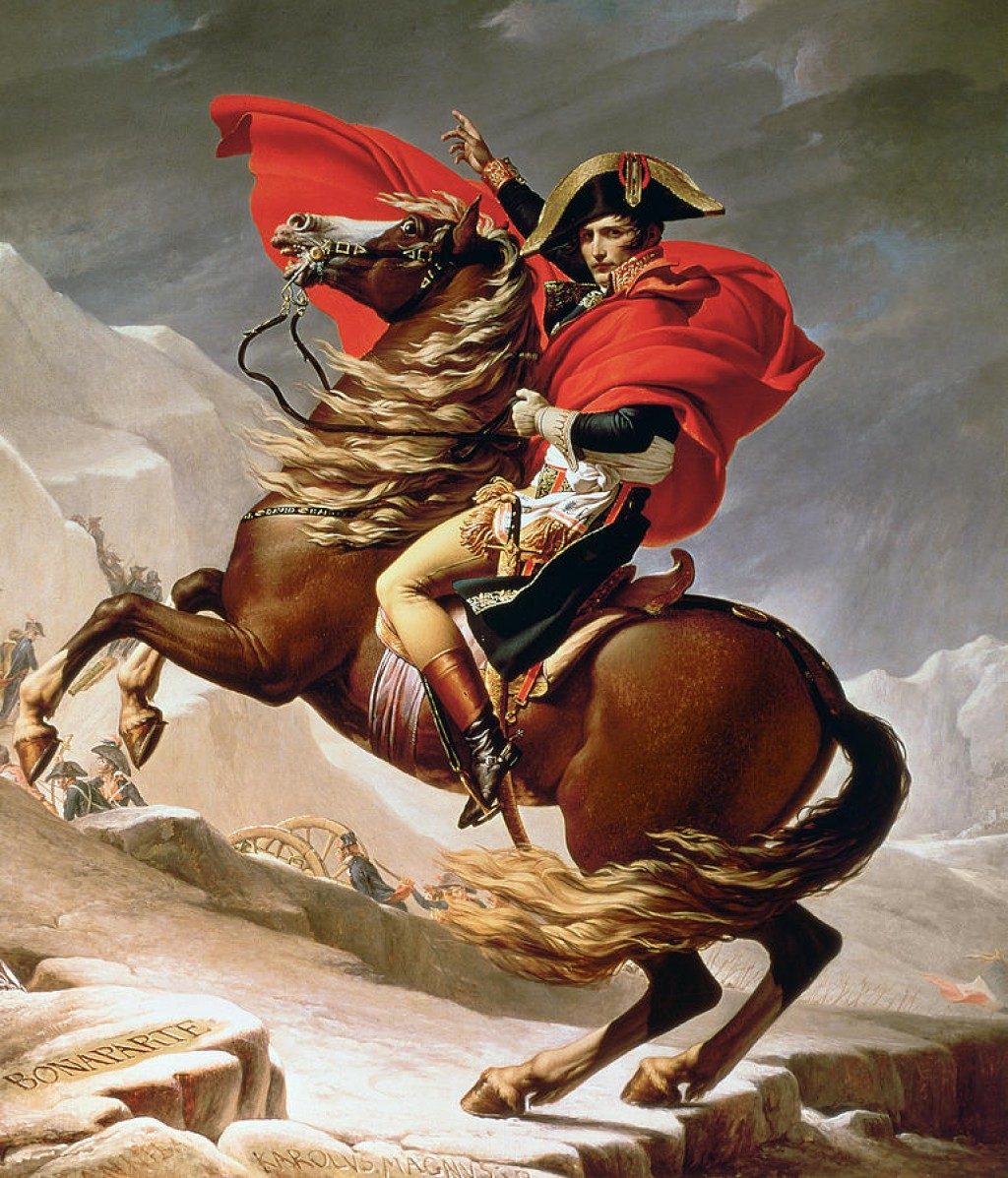
The portrait above is Jacques-Louis David's staged image of Bonaparte crossing the Alps — the carefully manufactured likeness of the man whose armies had kept Europe at war since 1803. By 1812 Napoleon ruled or dominated most of the continent, and his remaining great enemy on land was Russia, whose defiance of his system drew him east. Across the Atlantic, a younger quarrel matured in the same month: on 18 June President James Madison signed the United States' declaration of war on Britain, beginning the War of 1812.
On 24 June Napoleon led the Grande Armée across the Niemen river, beginning his invasion of Russia. The pack's entry puts the force at some 600,000 troops; the site's Napoleonic Wars record describes roughly half a million men crossing into Russia — in either telling, the largest army yet assembled in Europe. The Russians traded space for time, and the French advanced through an emptied landscape toward a battle and a capital that kept receding.
In America the new war opened with humiliation and glory in the same week. On 16 August American forces under William Hull surrendered Fort Detroit to the British without a serious fight. Three days later, on 19 August, the frigate USS Constitution defeated HMS Guerrière, earning the nickname 'Old Ironsides' when British shot were seen to bounce off her hull. On the Niagara frontier on 13 October, British and Indigenous forces repelled an American invasion of Canada at Queenston Heights, where their commander Isaac Brock was killed.
In Russia the campaign reached its hollow prize. On 14 September the Grande Armée entered Moscow a week after Borodino, finding the city largely evacuated; fires soon consumed much of it. Napoleon waited five weeks for a negotiation that never came, and on 19 October he began the retreat from Moscow, abandoning the occupied city. The retreat became a catastrophe: the great majority of the army's losses came not in battle but from hunger, disease, desertion and cold. The empire that had marched in with the largest army of the age marched out with a remnant, and the turning point of the Napoleonic Wars had passed.
Timeline of 1812
- 7 February
The most violent of the New Madrid earthquakes shakes the Mississippi Valley; Charles Dickens is born in England the same day.
- 26 March
The Boston Gazette prints the 'Gerry-mander' cartoon, giving American politics the word gerrymander.
- 30 April
Louisiana enters the Union as the 18th state, the first carved from the Louisiana Purchase territory.
- 11 May
British prime minister Spencer Perceval is assassinated in the House of Commons by John Bellingham.
- 18 June
President James Madison signs the U.S. declaration of war on Britain, beginning the War of 1812.
- 24 June
Napoleon leads the Grande Armée across the Niemen river, beginning his invasion of Russia.
- 16 August
American forces under William Hull surrender Fort Detroit to the British without a serious fight.
- 19 August
The frigate USS Constitution defeats HMS Guerrière, earning the nickname 'Old Ironsides'.
- 11 September
Russian settlers dedicate Fort Ross on the California coast, Russia's first stronghold in California.
- 14 September
Napoleon's Grande Armée enters Moscow, finding the city largely evacuated; fires soon consume much of it.
- 13 October
At Queenston Heights, British and Indigenous forces repel an American invasion of Canada; Isaac Brock is killed.
- 19 October
Napoleon begins his retreat from Moscow; the retreat becomes a catastrophe.
- 20 December
The Brothers Grimm publish the first edition of Grimm's Fairy Tales in Berlin.
Why 1812 still matters
1812 still matters because it is the hinge of the Napoleonic Wars. The destruction of the Grande Armée in Russia — the site's record names it the wars' turning point — made Napoleon's final defeat possible: the coalitions that beat him in 1814 and at Waterloo in 1815 formed in the shadow of the Russian catastrophe. An empire that had seemed structurally unbeatable was beaten, in the record's phrase, less by generals than by logistics and weather.
The War of 1812, the year's second war, decided less territory and more identity. It ended in 1814 with the map restored, but it gave the United States its 'Old Ironsides' legend, Canada its founding defence story at Queenston Heights, and both countries the last war they would ever fight against each other. The gerrymander cartoon of 26 March proved more durable than any battle: the word it coined still names the manipulation of electoral districts two centuries on.
Culturally, the year seeded the century's imagination. Dickens, born on 7 February, became the great storyteller of Victorian England; Robert Browning, born on 7 May, remade English poetry; and the Grimms' tales, published on 20 December, fixed the folk canon of Europe. Sacagawea, the Shoshone guide of the Lewis and Clark expedition, is generally believed to have died on 20 December at about 24 — the same day the fairy tales appeared.
1812 on The History Trail
Russia, 'Old Ironsides' and the gerrymander — 1812 day by day.
- June 24 in History — Napoleon crosses the Niemen and invades Russia.
- June 18 in History — The United States declares war on Britain.
- September 14 in History — The Grande Armée enters Moscow.
- October 19 in History — Napoleon begins the retreat from Moscow.
- August 19 in History — USS Constitution defeats HMS Guerrière.
- Napoleonic Wars — The wars of 1803–1815, whose turning point came in Russia in 1812.
Sources
- Encyclopaedia Britannica — On This Day: June 24
- HISTORY — What Happened on June 24
- Encyclopaedia Britannica — On This Day: September 14
- Encyclopaedia Britannica — On This Day: August 19
- Encyclopaedia Britannica — On This Day: May 11
- Encyclopaedia Britannica — On This Day: March 26
The facts on this page were checked against these sources on 19 November 2026. The History Trail's permanent pages are researched and written for this site; the live profiles elsewhere on The History Trail are assembled automatically from Wikipedia and Wikidata.
About the Author
Researched and written by the The History Trail Editorial Team — the accountable editorial function behind this site's permanent story pages. The team works from the published sources cited on each page; it does not invent historians, reviewers or credentials, and it corrects errors openly.
Fact Check
Every load-bearing fact on this page traces to one of the sources listed above, and significant claims link to their source in the text. Our checking method is described on the methodology page; errors can be reported via the corrections page.
Sources & Citations
Cite this page as: The History Trail Editorial Team, The History Trail — this article's title, publication and update dates are shown beneath its headline. The full source list appears under Sources above; the site's source standards are on the sources page.