
On This Day
August 19 in History
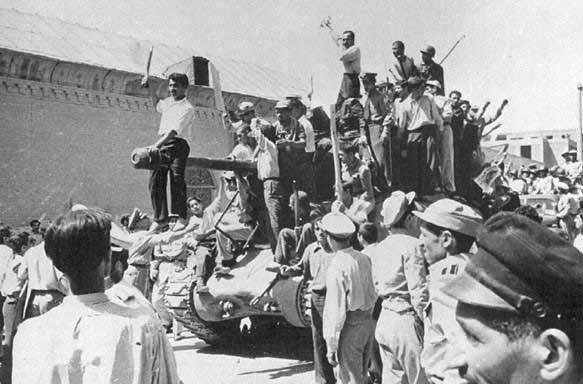
On 19 August 1953, crowds and soldiers organised and paid for by the CIA and MI6 seized control of Tehran and overthrew Iran's prime minister, Mohammad Mosaddegh — the coup that restored the Shah, handed Western companies a share of Iran's oil, and poisoned relations between Iran and the West for generations. August 19 is also the day the USS Constitution earned her nickname 'Old Ironsides', and the day Google went public.
Choose another date: open the On This Day calendar to browse events, births and deaths for any day of the year.
At a Glance
- The target
- Mohammad Mosaddegh, Iran's prime minister, whose government had nationalised the British-owned Anglo-Iranian Oil Company in 1951
- The planners
- The CIA (Operation Ajax) and Britain's MI6 (Operation Boot), acting with supporters of the Shah
- The first attempt
- A coup on 15 August failed when the officer delivering the dismissal decree was arrested; the Shah fled the country on 16 August
- The day itself
- On 19 August, military units and CIA-financed crowds seized Tehran's key points; Mosaddegh fell and General Fazlollah Zahedi took power
- The cost
- An estimated 200–300 people were killed in the fighting in Tehran
- The aftermath
- The Shah returned and ruled for 26 more years; American companies received 40 per cent of Iran's oil fields
Events on this day
- 43 BCThe 19-year-old Octavian, the future emperor Augustus, marches on Rome and is made consul, seizing a place at the centre of Roman power.
- 1791Benjamin Banneker, a free Black astronomer and surveyor, writes to Thomas Jefferson challenging him on slavery and enclosing his newly printed almanac.
- 1812The frigate USS Constitution defeats HMS Guerrière in the War of 1812, earning the nickname 'Old Ironsides' when British shot are seen to bounce off her hull.
- 1900The only cricket match ever played at the Olympic Games begins in Paris, between Britain and France; Britain takes the gold medal.
- 1909The first automobile race is held at the newly built Indianapolis Motor Speedway.
- 1919President Woodrow Wilson argues the case for the Treaty of Versailles before the Senate Foreign Relations Committee.
- 1934Germans vote in a plebiscite to confirm Adolf Hitler as Führer, merging the offices of president and chancellor after Hindenburg's death; about 90 per cent vote yes.
- 1953A coup backed by the CIA and MI6 overthrows Iran's prime minister, Mohammad Mosaddegh, and restores the Shah's power — the featured story above.
- 1960U-2 pilot Francis Gary Powers is sentenced in Moscow to ten years' imprisonment for espionage.
- 1964The Beatles open their first full American tour at the Cow Palace in San Francisco.
- 1991Soviet hardliners announce that Mikhail Gorbachev has been removed from power, beginning the August Coup that hastens the Soviet Union's end.
- 2004Google's shares begin trading in New York, in one of the most watched stock-market debuts of the internet age.
- 2011The 'West Memphis Three', imprisoned as teenagers for murders many believed they did not commit, are released in Arkansas after 18 years.
Born on this day
- 1871Orville Wright — American aviation pioneer who, with his brother Wilbur, made the first powered flight.
- 1883Coco Chanel — French fashion designer, creator of the little black dress and of Chanel No. 5.
- 1919Malcolm Forbes — American publisher of Forbes magazine, famous for his wealth and his parties.
- 1921Gene Roddenberry — American television writer, the creator of Star Trek.
- 1946Bill Clinton — the 42nd president of the United States.
Died on this day
- 14Augustus — first emperor of Rome, dead at Nola at the age of 75, having ruled for more than four decades.
- 1895John Wesley Hardin — American outlaw of the Wild West, shot dead in an El Paso saloon.
- 1977Groucho Marx — American comedian, the wisecracking star of the Marx Brothers films.
- 1994Linus Pauling — American chemist, winner of two Nobel Prizes, in Chemistry and in Peace.
- 2017Dick Gregory — American comedian and civil rights activist, dead at 84.
The featured story: the coup that overthrew Mosaddegh in Iran, 19 August 1953
Mohammad Mosaddegh, Iran's prime minister, had committed what Britain regarded as an unforgivable act: in 1951 his government nationalised the Anglo-Iranian Oil Company, the British-controlled firm that pumped Iran's oil and paid Tehran a pittance for it. Britain blockaded Iran's oil exports and plotted his removal; the United States, fearing that chaos in Iran would open the country to communism, joined the plot. The CIA's operation — codenamed Ajax, run in parallel with MI6's Operation Boot — aimed to replace Mosaddegh with a government friendly to the young Shah, Mohammad Reza Pahlavi, and to the West.
The first attempt failed. On the night of 15 August 1953 an officer of the Imperial Guard delivered the Shah's decree dismissing Mosaddegh — and was promptly arrested by troops loyal to the prime minister. The Shah, his nerve gone, fled the country on 16 August. The plotters went into hiding, and for three days Tehran belonged to Mosaddegh's supporters, who tore down statues of the Shah and demanded a republic. The coup seemed dead, and its organisers in the CIA's station were close to abandoning it.
Instead they tried again. On 19 August, crowds — many of them organised and financed by the CIA, as the agency's own later history records — poured into the streets alongside military units loyal to the Shah. They seized the radio station, army headquarters and key ministries, fought Mosaddegh's supporters in the streets at a cost estimated at 200 to 300 lives, and by evening had shelled and stormed the prime minister's house. Mosaddegh escaped over a garden wall but was arrested soon after; his government was finished, and General Fazlollah Zahedi, the Shah's nominee, took power in his place.
The Shah returned to Tehran on 22 August and ruled Iran for another 26 years as an increasingly autocratic ally of the United States, which under the settlement that followed received a 40 per cent share of Iran's oil fields for its companies. Mosaddegh was imprisoned for three years and then held under house arrest until his death in 1967. The coup of 19 August 1953 achieved everything its planners wanted — and its success shadowed everything that followed: the revolution that toppled the Shah in 1979 was fuelled in part by Iranian memories of 1953, and the event is still the foundation of Iran's distrust of Britain and America.
Why this date matters
August 19 is a day when power changes hands by force or by vote, and the two keep trading places. Octavian marches on Rome in 43 BC; Germans vote Hitler absolute power in 1934; a superpower's intelligence service removes a prime minister in 1953; Soviet hardliners try the same trick in 1991 and fail. Around those seizures sit the day's gentler firsts — a frigate earning her nickname, the Beatles opening a tour, Google opening on the stock market. The date's lesson is about how thin the membrane is between politics and conspiracy, and how long a single day's plotting can echo.
Sources
- Encyclopaedia Britannica — On This Day: August 19
- HISTORY — This Day in History: August 19
- HISTORY — CIA-assisted coup overthrows government of Iran
- Wikimedia — On This Day feed: August 19
The facts on this page were checked against these sources on 19 November 2026. The History Trail's permanent pages are researched and written for this site; the live profiles elsewhere on The History Trail are assembled automatically from Wikipedia and Wikidata.
About the Author
Researched and written by the The History Trail Editorial Team — the accountable editorial function behind this site's permanent story pages. The team works from the published sources cited on each page; it does not invent historians, reviewers or credentials, and it corrects errors openly.
Fact Check
Every load-bearing fact on this page traces to one of the sources listed above, and significant claims link to their source in the text. Our checking method is described on the methodology page; errors can be reported via the corrections page.
Sources & Citations
Cite this page as: The History Trail Editorial Team, The History Trail — this article's title, publication and update dates are shown beneath its headline. The full source list appears under Sources above; the site's source standards are on the sources page.