
Years
1793 in History
1793 is the year the French Revolution executed its king and queen. Louis XVI, tried as Citizen Capet and convicted of treason, was guillotined on 21 January; Marie Antoinette followed him to the scaffold on 16 October. Between those bookends Charlotte Corday murdered Marat in his bath, the Louvre opened as a public museum, Washington laid the Capitol's cornerstone, and Alexander Mackenzie completed the first recorded crossing of North America north of Mexico.
At a Glance
- Defining event
- Execution of Louis XVI, 21 January 1793, at the Place de la Révolution in Paris
- The verdict
- Death carried by 387 votes to 334 in the National Convention; a reprieve was rejected
- The queen
- Marie Antoinette is guillotined on 16 October, nine months after her husband
- The assassination
- Charlotte Corday murders Jean-Paul Marat in his bath, 13 July; she is executed on 17 July
- A museum born
- The Louvre opens as a public museum in Paris, 10 August
- A continent crossed
- Alexander Mackenzie reaches the Pacific at Bella Coola, 22 July
The defining story: the executions of 1793
Louis XVI had been a prisoner since the storming of the Tuileries in August 1792, and a private citizen — 'Citizen Capet' — since the monarchy's abolition that September. In December the National Convention put him on trial itself, its deputies acting as judges, on charges of treason: conspiring against the Revolution, corresponding with foreign enemies and shedding French blood. The votes in mid-January were counted name by name, each deputy mounting the tribune to pronounce. Guilt was near-unanimous; the sentence was not. Death carried by 387 votes to 334 — a margin that included the king's own cousin, Philippe d'Orléans, voting for death — and a final vote rejected any reprieve by 380 to 310.
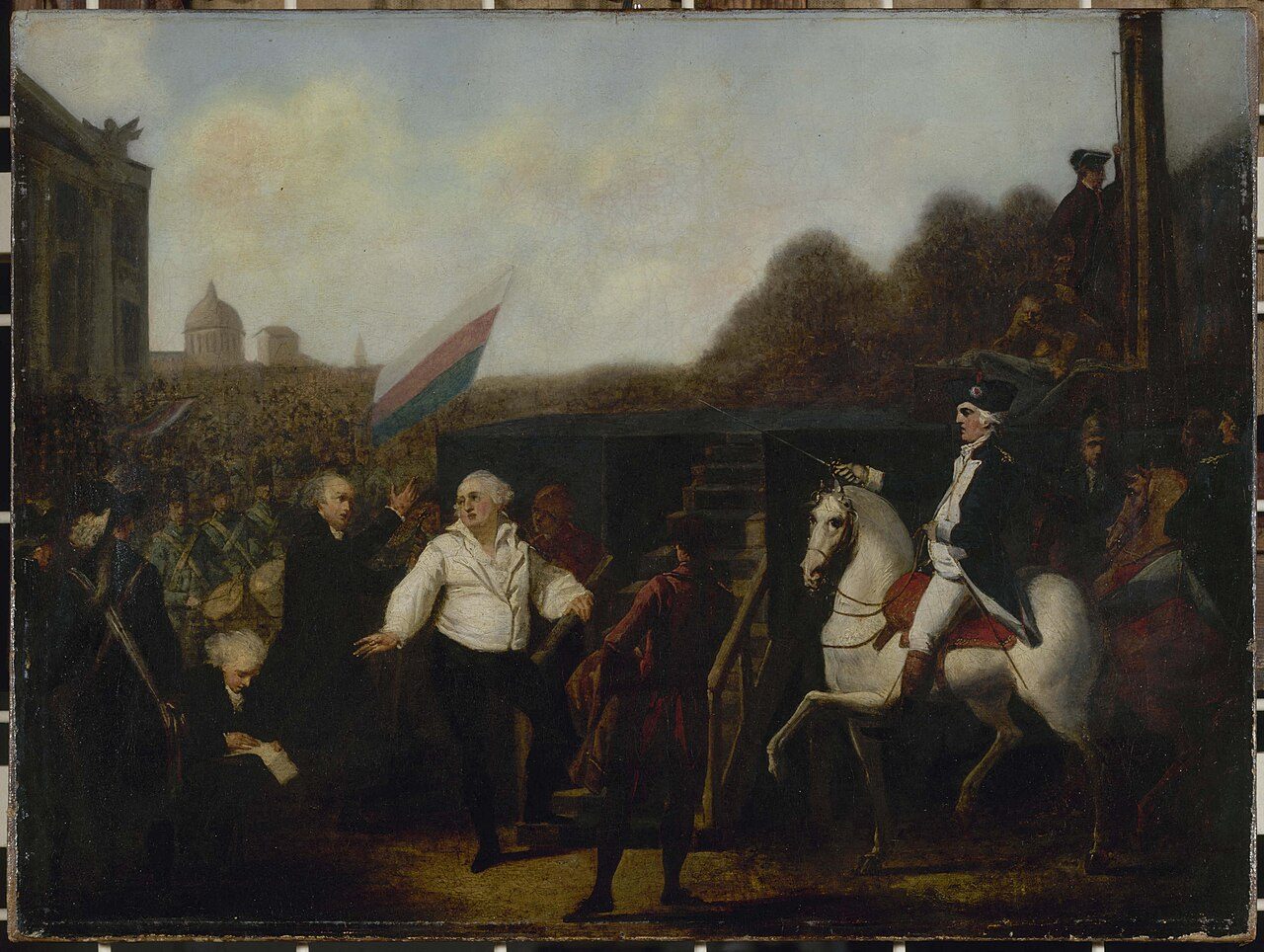
On the morning of 21 January 1793 Louis was driven through Paris in a closed carriage, past streets lined with troops, to the Place de la Révolution, where the guillotine stood. Charles Benazech's painting of about that year shows him at the foot of the scaffold with his confessor, the Abbé Edgeworth. He was executed at 10:22 a.m. by contemporary accounts, by Charles-Henri Sanson, the former royal executioner. A king whom the Revolution insisted on trying as an ordinary citizen died as one, in public, before the capital.
The year radicalised around the scaffold. On 13 July Charlotte Corday murdered the revolutionary journalist and politician Jean-Paul Marat in his bath in Paris; she was guillotined four days later, on 17 July. On 3 November the playwright and feminist Olympe de Gouges, author of the Declaration of the Rights of Woman, was guillotined for her political writings. And on 16 October Marie Antoinette — the 'Widow Capet' to her jailers, tried before the Revolutionary Tribunal on charges of treason and conspiracy with foreign powers — was guillotined at the Place de la Révolution, aged 37, nine months after her husband.
Yet 1793 was not only an executioner's year. On 22 July the Scottish explorer Alexander Mackenzie reached the Pacific coast at Bella Coola, completing the first recorded crossing of North America north of Mexico. On 10 August the Louvre opened in Paris as a public museum, installed in the palace of the French kings — the revolution turning a royal residence into a people's gallery in the very weeks of the Terror's approach. And on 18 September President George Washington, in Masonic regalia, laid the cornerstone of the United States Capitol in Washington, the other republic building in stone while France built in decrees and scaffolds.
Timeline of 1793
- 21 January
Louis XVI is executed by guillotine in Paris, tried as Citizen Capet and convicted of treason.
- 11 April
Ferdinand I, the future emperor of Austria whose reign ends in abdication in 1848, is born.
- 13 July
Charlotte Corday murders French revolutionary leader Jean-Paul Marat in his bath in Paris.
- 17 July
Charlotte Corday is executed by guillotine in Paris, four days after murdering Marat.
- 22 July
Alexander Mackenzie reaches the Pacific coast at Bella Coola, completing the first recorded crossing of North America north of Mexico.
- 10 August
The Louvre opens as a public museum in Paris, in the palace of the French kings.
- 18 September
President George Washington, in Masonic regalia, lays the cornerstone of the United States Capitol.
- 16 October
Marie Antoinette is guillotined at the Place de la Révolution in Paris, nine months after Louis XVI.
- 3 November
Olympe de Gouges, author of the Declaration of the Rights of Woman, is guillotined in Paris for her political writings.
- 3 November
Stephen F. Austin, who will lead the first legal Anglo-American settlement of Texas, is born.
Why 1793 still matters
1793 matters because it crossed the line from which revolutions do not return. Executing a king after a public trial by the nation's deputies announced that sovereignty had moved, irreversibly, and that no anointed head stood above it. The votes' closeness — 387 to 334 — shows how contested that step was even among revolutionaries; the execution of the queen nine months later, and of critics such as Olympe de Gouges, showed how quickly the instrument turned inward.
The year's violence also mobilised Europe. What followed the king's execution, as the record of the day notes, was war with Britain and Spain and the Terror at home: the republic, fighting for survival against most of Europe, made emergency government permanent and the guillotine its emblem. Marat's murder and Corday's execution within four July days compress the cycle — assassination answered by scaffold, scaffold breeding martyrs on both sides.
Against that stands the year's other legacy. The Louvre's opening on 10 August converted the palace of kings into a public museum, a founding act of modern cultural democracy that has outlasted every regime since. Mackenzie's crossing and the Capitol's cornerstone mark the same year on another continent: exploration completed and a legislature housed, while Paris demonstrated both the power and the price of remaking a state by decree.
1793 on The History Trail
A king, a queen and a museum — the revolution's hardest year, day by day.
- January 21 in History — Louis XVI is executed — the featured story of the scaffold.
- October 16 in History — Marie Antoinette is executed.
- July 13 in History — Charlotte Corday murders Marat in his bath.
- August 10 in History — The Louvre opens as a public museum.
- September 18 in History — Washington lays the cornerstone of the U.S. Capitol.
- July 22 in History — Mackenzie reaches the Pacific coast of North America.
Sources
- Encyclopaedia Britannica — On This Day: January 21
- HISTORY — What Happened on January 21
- Encyclopaedia Britannica — Louis XVI
- Encyclopaedia Britannica — On This Day: October 16
- Encyclopaedia Britannica — Marie-Antoinette, queen of France
- Encyclopaedia Britannica — On This Day: July 13
The facts on this page were checked against these sources on 19 November 2026. The History Trail's permanent pages are researched and written for this site; the live profiles elsewhere on The History Trail are assembled automatically from Wikipedia and Wikidata.
About the Author
Researched and written by the The History Trail Editorial Team — the accountable editorial function behind this site's permanent story pages. The team works from the published sources cited on each page; it does not invent historians, reviewers or credentials, and it corrects errors openly.
Fact Check
Every load-bearing fact on this page traces to one of the sources listed above, and significant claims link to their source in the text. Our checking method is described on the methodology page; errors can be reported via the corrections page.
Sources & Citations
Cite this page as: The History Trail Editorial Team, The History Trail — this article's title, publication and update dates are shown beneath its headline. The full source list appears under Sources above; the site's source standards are on the sources page.