
Vehicles
Saturn V
Thirteen flights, twenty-four astronauts carried to the Moon, six landings, and not one crew or payload lost. The Saturn V was the most powerful rocket ever flown — and NASA retired it after less than six years, leaving its records to stand for half a century.
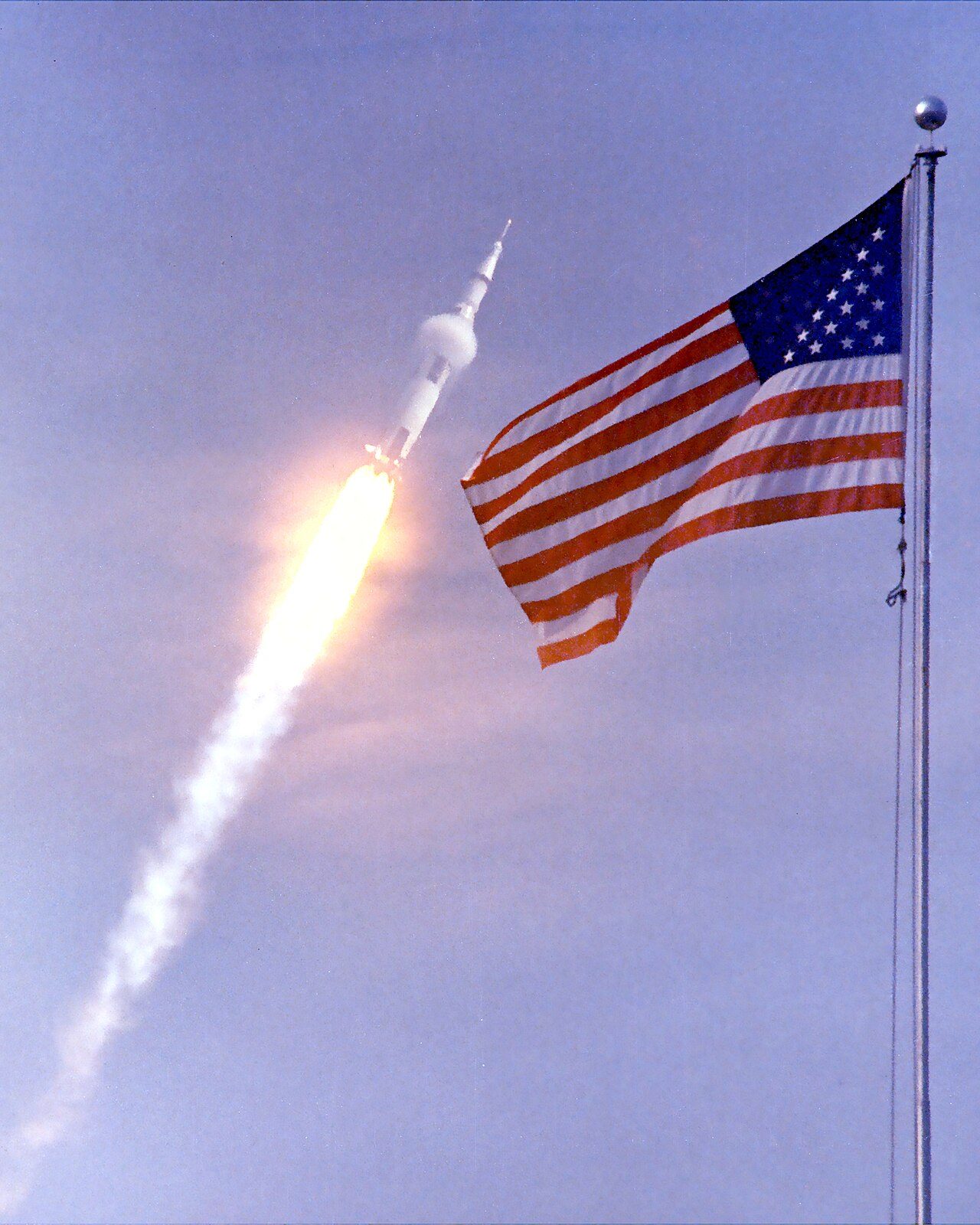
At a Glance
- Height
- 363 feet (111 metres) — as tall as a 36-storey building
- Weight
- 6.2 million pounds (2.8 million kilograms) fully fuelled
- Thrust
- 7.6 million pounds (34.5 million newtons) at launch
- Developed at
- NASA's Marshall Space Flight Center, Huntsville, Alabama; design led by Wernher von Braun
- Stages
- Three — S-IC (Boeing), S-II (North American Aviation), S-IVB (Douglas); instrument unit by IBM
- Launches
- 13, all from Kennedy Space Center, 1967–1973 — no crew or payload ever lost
- Moon record
- Nine flights carried 24 astronauts to the Moon; six crews landed
- Final flight
- 14 May 1973 — launched the Skylab space station in two-stage form
Introduction
The Saturn V was built to do one thing no machine had ever done: throw human beings off the Earth and onto another world. NASA's answer to the Moon race stood 363 feet tall — the height of a 36-storey building, 60 feet taller than the Statue of Liberty — weighed 6.2 million pounds fully fuelled, and generated 7.6 million pounds of thrust at liftoff, more power than 85 Hoover Dams. It was, and in its era remained, the most powerful rocket ever flown successfully.
It flew only thirteen times, between 1967 and 1973, and its record is the astonishing part: no crew lost, no payload lost. Nine of its flights carried 24 astronauts to the Moon; six crews landed. Every Apollo astronaut who walked on the Moon rode this rocket, and its final flight launched Skylab, America's first space station. Then, its work barely finished, the Saturn V was retired — a machine so capable that half a century later, returning humans to the Moon still means measuring new rockets against it.
Background
The Saturn V was developed at NASA's Marshall Space Flight Center in Huntsville, Alabama, where Wernher von Braun's team designed the largest of the Saturn family. The rocket was a three-stage stack built by industry under Marshall's direction: Boeing built the first stage, the S-IC, whose five F-1 engines burned kerosene and liquid oxygen to lift the whole vehicle to about 42 miles; North American Aviation built the second stage, which carried it almost to orbit; Douglas Aircraft built the third, the S-IVB, which finished the climb to Earth orbit and then fired again to push the Apollo spacecraft towards the Moon. IBM built the instrument unit, the ring of guidance electronics that flew the stack.
The testing philosophy was as bold as the hardware. Rather than proving each stage separately, NASA adopted 'all-up' testing: the very first Saturn V flight, Apollo 4 in November 1967, flew the complete three-stage rocket. It worked. A second uncrewed test, Apollo 6, exposed engine vibration problems that engineers fixed before any crew flew. From Apollo 8 onwards, every Saturn V carried people — and every one of them came home.
Timeline
- 1960–1962
NASA's Marshall Space Flight Center designs the Saturn family of rockets, from Earth-orbit vehicles to the giant lunar launcher.
- Early 1963
The C-5 design is confirmed as the Apollo programme's choice and given its name: Saturn V.
- 9 November 1967
Apollo 4 — the first Saturn V flight, an uncrewed 'all-up' test of all three stages together. It performs as designed.
- 4 April 1968
Apollo 6, the second uncrewed test, reveals engine vibration problems; engineers resolve them before crewed flight.
- 21 December 1968
Apollo 8 — the first crewed Saturn V carries Borman, Lovell and Anders to orbit the Moon: the first humans to leave Earth's gravitational sphere.
- 16 July 1969
Apollo 11 lifts off; four days later Armstrong and Aldrin land on the Moon while Collins orbits above.
- 11 April 1970
Apollo 13 — the Saturn V performs flawlessly; an oxygen-tank failure in the spacecraft, not the rocket, forces the famous rescue.
- December 1972
Apollo 17, the last crewed Moon mission, closes the Saturn V's lunar programme.
- 14 May 1973
The final Saturn V, flying with two stages, launches the Skylab space station — the rocket's last flight.
Significance
The Saturn V remains the only launch vehicle ever to carry human beings beyond low Earth orbit. That single sentence is its significance: for four years, from Apollo 8 in December 1968 to Apollo 17 in December 1972, this one design was humanity's entire capability for leaving its home planet's neighbourhood, and it never failed the people who rode it. It could put about 118,000 kilograms into Earth orbit and send some 43,500 kilograms — four school buses' worth — to the Moon.
It also set the pattern for big-spaceflight engineering: a national centre directing, giant contractors building stages in different states, final assembly and launch from a dedicated complex — Kennedy Space Center's Launch Complex 39, built for this rocket and used by every Saturn V flight. The programme's structured approach to flight dynamics and control, refined through Saturn I and IB, became the template American heavy-lift design still studies.
Legacy
Fifteen flight-ready Saturn Vs were built; thirteen flew, and the programme ended not with failure but with cancellation — the last planned Moon landings were cut in 1970, and two flight rockets never left the ground. Three Saturn Vs assembled from leftover stages are on display today, at Johnson Space Center in Houston, at Kennedy Space Center in Florida and at the US Space & Rocket Center in Huntsville, lying on their sides like beached whales, each of them longer than an American football field.
Its shadow is longer still. The Saturn V remains the tallest, heaviest and most powerful rocket ever brought to operational status, and every heavy-lift vehicle since — the Shuttle, and NASA's Space Launch System built for the Artemis return to the Moon — has been designed, argued about and judged in its terms. The Moon rocket flew for less than six years. It has been the standard for more than fifty.
Sources
- NASA — What Was the Saturn V?
- The Space Atlas — Saturn V (drawn from NASA and the Smithsonian National Air and Space Museum)
- Wikipedia — Saturn V (corroboration)
The facts on this page were checked against these sources on 19 November 2026. The History Trail's permanent pages are researched and written for this site; the live profiles elsewhere on The History Trail are assembled automatically from Wikipedia and Wikidata.
About the Author
Researched and written by the The History Trail Editorial Team — the accountable editorial function behind this site's permanent story pages. The team works from the published sources cited on each page; it does not invent historians, reviewers or credentials, and it corrects errors openly.
Fact Check
Every load-bearing fact on this page traces to one of the sources listed above, and significant claims link to their source in the text. Our checking method is described on the methodology page; errors can be reported via the corrections page.
Sources & Citations
Cite this page as: The History Trail Editorial Team, The History Trail — this article's title, publication and update dates are shown beneath its headline. The full source list appears under Sources above; the site's source standards are on the sources page.