
Trails
Christmas Through the Centuries
Christmas was not born on a single night. It was assembled over seventeen centuries — dated in Rome, crowned in Westminster, banned in London, rewritten by poets, printed on cards, lit by electricity and carried around the world. Ten stops tell the story.
The trail at a glance
Every stop, in chronological order:
- c. 336 Rome Fixes the Date
- 1066 A Christmas Day Coronation
- The Middle Ages Twelve Days of Feasting and Misrule
- 1647 Parliament Bans Christmas
- 1823 A Poem Remakes the Night
- 1843 Dickens and the First Christmas Card
- 1848 The Royal Tree Goes Public
- 1882 Electric Light on the Tree
- 1914 The Truce
- Today A Global Festival
A Festival Assembled Over Centuries
Every December the same festival fills streets from Rome to Manila, but almost nothing about it is original or inevitable. Its date was fixed in the fourth century, a king was crowned on it in the eleventh, its celebration was outlawed in the seventeenth, and its modern shape — the tree, the card, the stocking, the lights — is largely a nineteenth-century invention. Ten stops follow the moments when Christmas changed.
Ten stops, in chronological order
- c. 336
Rome Fixes the Date
Why 25 December? No Gospel gives a date for Jesus's birth, but by 336 the church in Rome was formally celebrating Christmas on 25 December, during the reign of Constantine. One theory works by calculation: Sextus Julius Africanus had identified the date as early as 221, reasoning from a conception at the Annunciation on 25 March, nine months before. The date stuck and spread, and by the ninth century Christmas ranked among the great feasts of the Christian year.
- 1066
A Christmas Day Coronation
Christmas Day was already a stage for power when William of Normandy chose it for his coronation. Crowned in Westminster Abbey on 25 December 1066 by Ealdred, Archbishop of York, the Conqueror wrapped his contested seizure of England in the most sacred theatre the calendar offered: a king anointed while the Church celebrated the birth of its own king. The date's prestige — part feast, part royal showcase — would mark Christmas for centuries.
- The Middle Ages
Twelve Days of Feasting and Misrule
Medieval Christmas ran for twelve days, from 25 December to Twelfth Night on 5 January, after the fasting month of Advent. Lords were expected to give tenant farmers the twelve days off and a festive meal; mummers in animal masks went door to door singing and joking; and in the bean cake of Twelfth Night a dried bean made its finder king for the night — the Lord of Misrule, licensed to upend the household's hierarchy until the feast ended.
- 1647
Parliament Bans Christmas
To England's Puritan Parliament, Christmas was popish and disorderly. An ordinance of 8 June 1647 abolished the Feast of the Nativity along with Easter and Whitsun, and shops were ordered to open on Christmas Day as on any other; three years earlier Parliament had even sat through a fast day that fell on 25 December rather than excuse it. Defiance and riots followed, and the ban lasted only until the Restoration in 1660 — but English Christmas never fully recovered its medieval scale.
- 1823
A Poem Remakes the Night
On 23 December 1823 a New York newspaper, the Troy Sentinel, published an anonymous poem: 'Account of a Visit from St. Nicholas'. Clement Clarke Moore later claimed it as his, and its jolly, plump, reindeer-driving St Nick — arriving by sleigh, filling stockings, vanishing up the chimney — quietly replaced the sterner gift-bringers of the old world. In North America the poem's St Nicholas transformed into Santa Claus, and Christmas Eve became a night of children, stockings and anticipation.
- 1843
Dickens and the First Christmas Card
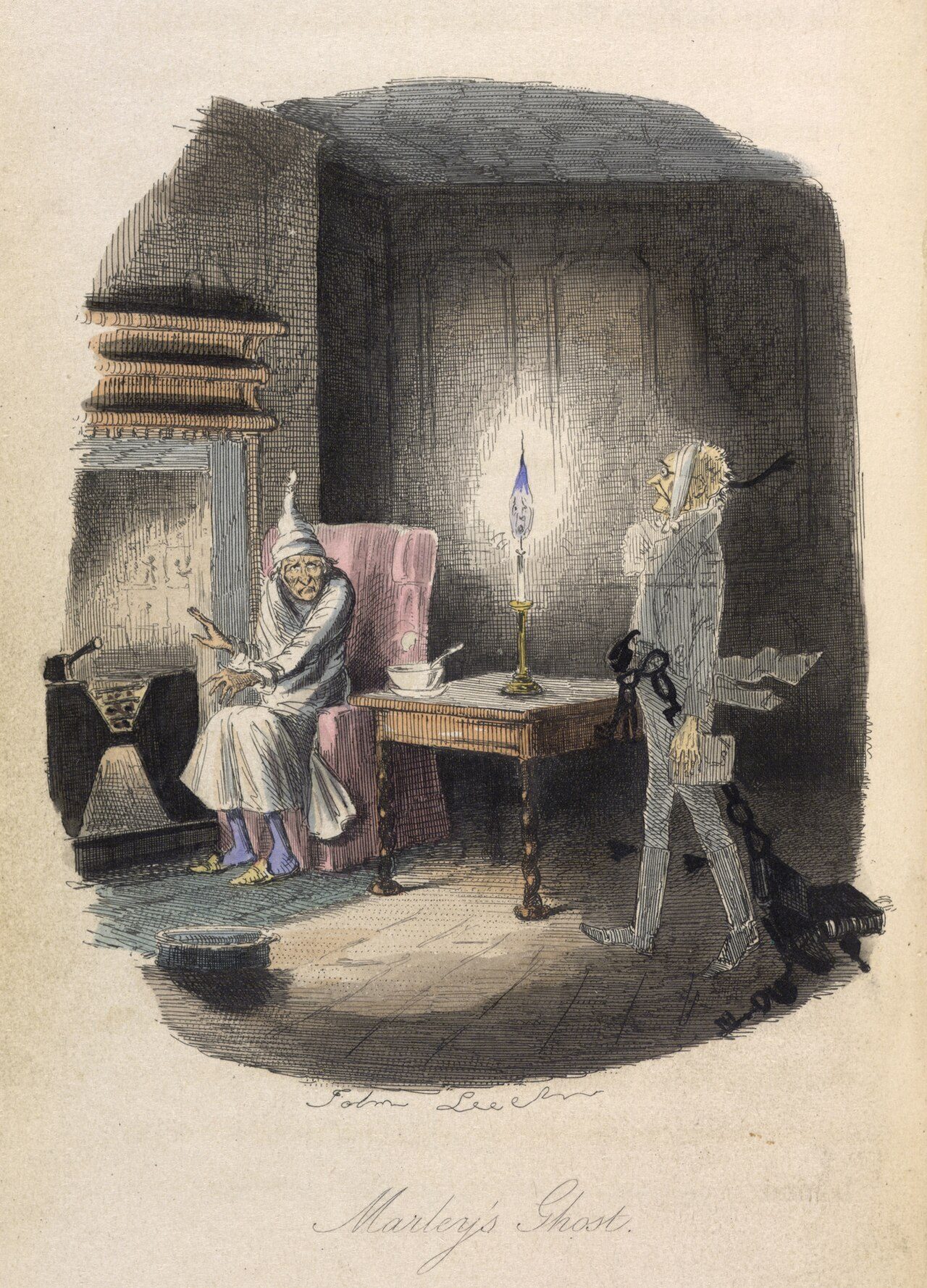
Two inventions of one Victorian December fixed the modern Christmas. On 19 December 1843 Charles Dickens published A Christmas Carol, the ghost story of Scrooge's redemption that recast the festival as a test of generosity to the poor. The same year, Henry Cole commissioned the artist John Callcott Horsley to design the first commercial Christmas card — a family raising glasses of wine, flanked by scenes of charity. Story and card together taught the Victorians what Christmas feeling was supposed to look like.
Read the full story of Dickens and the First Christmas Card →
- 1848
The Royal Tree Goes Public
Decorated fir trees were an old German custom — trees dressed with apples are recorded in Strasbourg in 1605, candles by 1611 — but Britain adopted the tree when it saw its queen with one. In December 1848 the Illustrated London News published J. L. Williams's engraving of Victoria, Albert and their children around a candlelit tree at Windsor Castle. Reprinted in America in 1850 with Victoria's tiara and Albert's moustache discreetly removed, the picture carried the tree into middle-class homes on both sides of the Atlantic.
- 1882
Electric Light on the Tree
Candlelit trees were beautiful and dangerous. In 1882 Edward H. Johnson, a vice-president of Edison's electric light company, wired the tree in his New York home with eighty hand-made bulbs in red, white and blue — the first Christmas tree lit by electricity. The display was a publicity stunt for the new technology, and for decades electric lights stayed a rich family's luxury; but the stunt pointed the way from open flame to the strings of lights that now outline whole streets.
- 1914
The Truce
Five months into the First World War, Christmas produced its most unlikely scene. Along much of the British–German front, soldiers who had been shooting at each other sang carols across no man's land — 'Stille Nacht' answered by 'The First Noel' — then met unarmed between the trenches to exchange food and gifts, bury the dead, and in places kick a football about. The high commands forbade any repeat, and the attempts of 1915 were suppressed; the truce of 1914 stands alone.
- Today
A Global Festival
Christmas now belongs to the world. Ethiopian Christians keep Genna on 7 January by the Julian calendar; Filipinos begin in September and light parol lanterns through a four-month season; Japan, barely one per cent Christian, queues for Christmas cake and fried chicken; Australians sing carols by candlelight in midsummer. The festival Rome dated in 336 has become a global season of light in the darkest weeks — northern-hemisphere weeks, at least — kept in ways its inventors would not recognise.
What the trail shows
Read in order, the stops tell one story twice. Christmas is ancient — a fourth-century feast, a medieval season of feasting and misrule — and it is also strikingly new: the Christmas of trees, cards, stockings, Santa and electric light is a creation of the years between 1823 and 1882, assembled by a poem, a novella, a card, a magazine engraving and a light-bulb stunt. The festival survived a parliamentary ban and a world war; what changed it most was print, commerce and electricity.
That double nature is why Christmas keeps spreading. A festival repeatedly remade — by Romans, Normans, Puritans, poets and advertisers — can be remade again by each culture that adopts it, from Manila's lanterns to Melbourne's beaches. The trail ends where it began, with light deliberately kindled in midwinter; only the hands lighting it have changed.
Sources
- Encyclopaedia Britannica — Christmas
- HISTORY — How Christmas Was Celebrated in the Middle Ages
- Imperial War Museums — The Real Story Of The Christmas Truce Of 1914
- Smithsonian Magazine — The Story of the WWI Christmas Truce
The facts on this page were checked against these sources on 19 November 2026. The History Trail's permanent pages are researched and written for this site; the live profiles elsewhere on The History Trail are assembled automatically from Wikipedia and Wikidata.
About the Author
Researched and written by the The History Trail Editorial Team — the accountable editorial function behind this site's permanent story pages. The team works from the published sources cited on each page; it does not invent historians, reviewers or credentials, and it corrects errors openly.
Fact Check
Every load-bearing fact on this page traces to one of the sources listed above, and significant claims link to their source in the text. Our checking method is described on the methodology page; errors can be reported via the corrections page.
Sources & Citations
Cite this page as: The History Trail Editorial Team, The History Trail — this article's title, publication and update dates are shown beneath its headline. The full source list appears under Sources above; the site's source standards are on the sources page.