
Things
The Christmas Tree
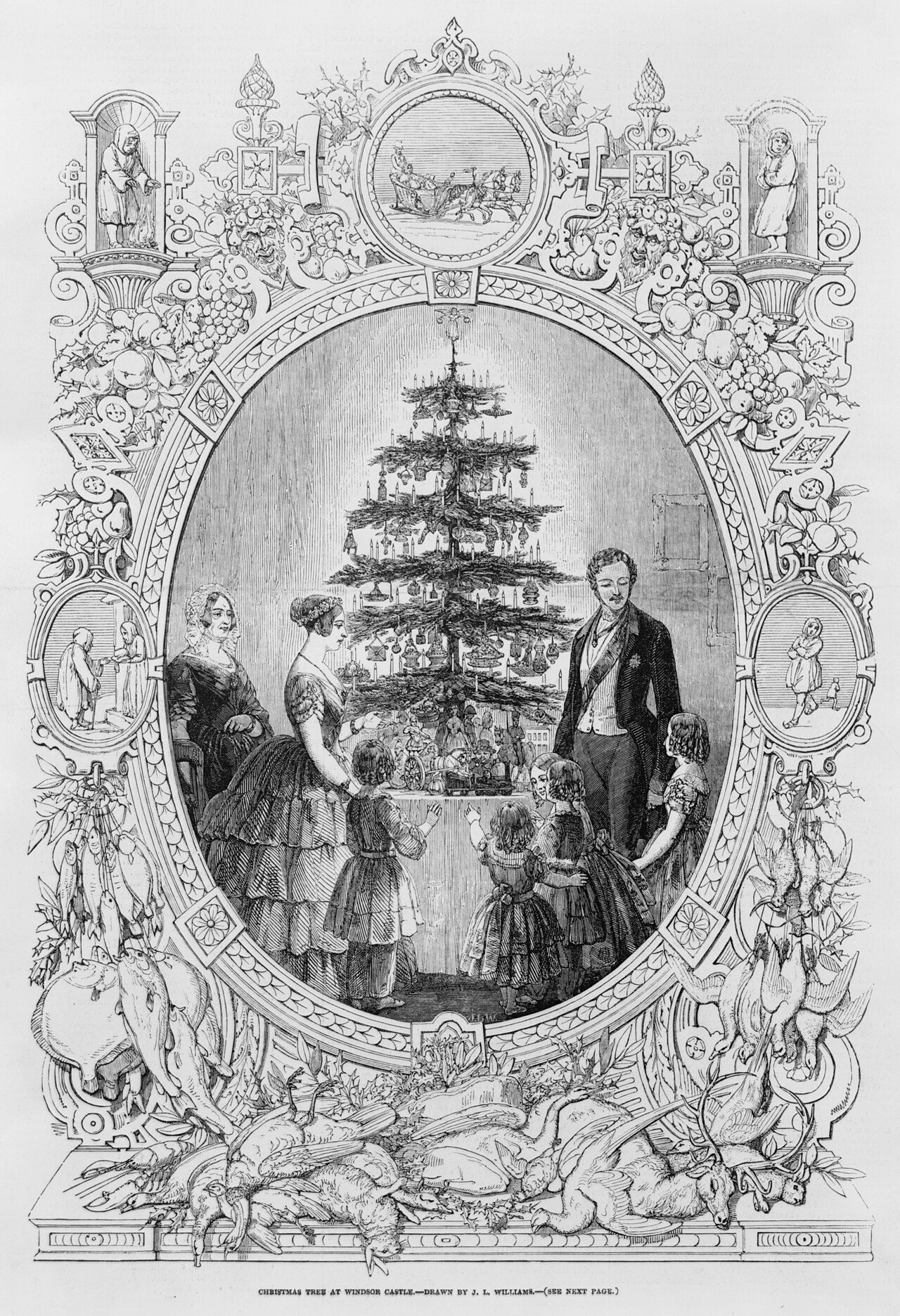
The Christmas tree began in Germany: a fir hung with apples for medieval plays about Adam and Eve became, by 1605, a household tree hung with roses and sweets, and an 1848 engraving of Victoria and Albert's tree made it the centre of Christmas worldwide.
At a Glance
- Origin
- Western Germany: the medieval Paradise Tree of the Adam and Eve plays, merged with the Christmas pyramid by the 16th century
- Earliest claims
- Tallinn 1441 and Riga 1510, both for guild trees of the Brotherhood of the Blackheads - both disputed by historians
- First full description
- Strasbourg, 1605: firs in rooms hung with paper roses, apples, wafers, gold foil and sweets
- First at English court
- Queen Charlotte's tree at Windsor, 1800
- The famous picture
- The Illustrated London News engraving of Victoria and Albert's tree, December 1848; reprinted in America by Godey's Lady's Book in 1850
- In America
- Brought by German settlers; first recorded displays in Pennsylvania German communities in the 1830s
- Rockefeller Center
- Workers' own 20-foot tree in 1931; first official lighting, of a 50-foot tree, in 1933
Introduction
The Christmas tree - an evergreen, usually a fir, spruce or pine, brought indoors, hung with lights and ornaments, and piled around with presents - feels like the oldest part of Christmas. It is not. The tree as we know it is a German invention of the sixteenth century, assembled from a medieval stage prop, spread by guilds and Lutherans, carried into English drawing rooms by two German-born royals, and turned into a global industry by magazine pictures and American cities.
Its history also contains a genuine argument. Two Baltic capitals, Riga and Tallinn, each claim the first Christmas tree, long before the German evidence begins, and historians have been unable to award the prize.
Evergreens and the Paradise Tree
Greenery in midwinter is far older than Christmas. Britannica notes that the use of evergreen trees, wreaths and garlands to symbolise eternal life was a custom of the ancient Egyptians, Chinese and Hebrews, and that tree worship survived among pagan Europeans into Christian times in Scandinavian customs of decorating house and barn with evergreens at the New Year. An evergreen, alive and green in the dead of winter, was an obvious emblem of life persisting through darkness; the Christmas tree inherited that symbolism ready-made.
The direct ancestor, though, was theatrical. The main prop of a popular medieval play about Adam and Eve, performed for the feast of Adam and Eve on 24 December, was a "paradise tree" - a fir hung with apples, representing the Garden of Eden and its forbidden fruit. German families set up paradise trees in their homes on 24 December and hung wafers on them, symbolising the eucharistic host; later the wafers were replaced by cookies of various shapes, and candles - Christ as the light of the world - were often added. In the same room stood the Christmas pyramid, a wooden construction holding figurines, candles and a star. By the sixteenth century, Britannica concludes, pyramid and paradise tree had merged, becoming the Christmas tree.
Guild Trees, Strasbourg and the German Custom
Before the tree was domestic it was civic. The Brotherhood of the Blackheads, a guild of unmarried merchants in the Baltic ports, set up trees at their midwinter festivities: Tallinn claims one in 1441 and Riga one in 1510, each decorated, danced around and finally burned. A guild in Freiburg put up a tree hung with apples, wafers, tinsel and gingerbread in 1419. These were public, festive trees, not family ones - but they show decorated evergreens at Christmas a century before the household custom is firmly documented.
The household record begins in Alsace. A tree was raised in Strasbourg Cathedral in 1539, and a Strasbourg description of 1605 gives the first full picture of the domestic custom: firs set up in people's rooms and hung with paper roses, apples, wafers, gold foil and sweets. The custom spread among German Lutherans through the seventeenth and eighteenth centuries, and by the nineteenth century the tree was a deep-rooted German tradition, exported wherever Germans emigrated.
Timeline
- Ancient world
Egyptians, Chinese and Hebrews use evergreens to symbolise eternal life; Europeans keep evergreen customs through the conversion to Christianity.
- Middle Ages
Medieval plays about Adam and Eve use a fir hung with apples - the Paradise Tree - for the 24 December feast; German homes adopt it.
- 1419
A bakers' guild at Freiburg erects a tree decorated with apples, wafers, tinsel and gingerbread - among the earliest recorded Christmas trees.
- 1441 (claimed)
Tallinn claims the Brotherhood of the Blackheads set up a decorated tree in its town square - a claim historians treat as unproven.
- 1510 (claimed)
Riga claims its Blackheads' tree of 1510 as the first; a plaque in Town Hall Square marks the spot.
- 1539
A Christmas tree is recorded in Strasbourg Cathedral, in the German-speaking Alsace.
- 1605
A Strasbourg account describes firs in rooms hung with paper roses, apples, wafers, gold foil and sweets - the first full description of the household tree.
- 1800
Queen Charlotte, wife of George III, sets up a decorated tree at Windsor - the first recorded at the English court.
- 1848
The Illustrated London News prints Victoria, Albert and their children around their tree at Windsor; the image makes the custom fashionable across Britain.
- 1850
Philadelphia's Godey's Lady's Book republishes the royal picture, reworked to look American, and the fashion crosses the Atlantic in print.
- 1931
Construction workers at Rockefeller Center, New York, pool their money for a 20-foot balsam fir and decorate it on the building site.
- 1933
Rockefeller Center holds its first official tree-lighting, with a 50-foot tree - the start of the annual tradition.
Significance
The tree's conquest of Britain is a case study in the power of one picture. Queen Charlotte had put up a tree at Windsor in 1800 and the custom stayed a German royal eccentricity for half a century. What changed everything was print: in December 1848 the Illustrated London News published an engraving of Queen Victoria, Prince Albert - who had grown up with the custom in Germany - and their children around a candlelit tree at Windsor. Victoria was the era's supreme trendsetter, and within a few years the tree was standard in respectable British homes. When Godey's Lady's Book reprinted the image in Philadelphia in 1850, with the royal details softened away so the family looked like prosperous Americans, it did the same work in the United States.
In America the tree also arrived from below. German settlers had brought it with them - the first recorded displays were in German communities in Pennsylvania in the 1830s - and other Americans, after initial suspicion of a foreign, supposedly pagan novelty, adopted it as the centre of the new domestic Christmas. The twentieth century crowned it with a civic version: the tree Rockefeller Center's workers raised in 1931, in the depth of the Depression, became from 1933 an official annual lighting, and the giant public tree is now as much a part of the festival as the small one in the living room.
Myths and disputes
Who had the first Christmas tree, Riga or Tallinn? Honestly presented, the dispute is unresolved. Tallinn's claim rests on a Blackheads' tree in 1441; Riga's on one in 1510, commemorated by a plaque in its Town Hall Square. But historians doubt both: the guild festivities may not have been Christmas celebrations at all, and Riga's "tree" may have been a wooden structure shaped like one. The documented line to the modern custom runs through Germany and Alsace, whatever the Baltic guilds were doing - which is why this page records both claims as claims.
Did Martin Luther invent the candle-lit tree? The beloved story says Luther, walking home through the woods on a winter night, was so struck by stars shining through the firs that he brought a tree indoors and lit it with candles for his children. It is a legend: no contemporary evidence supports it, and the first versions appear in the nineteenth century, three hundred years after his death. Britannica reports it only as something Luther "reportedly" did. The candles need no inventor - they were part of the paradise tree's symbolism, Christ the light of the world, before Luther was born. The older tale of St. Boniface felling Thor's oak in the eighth century and pointing to a fir belongs to the same category: a fine sermon story, not a document.
Legacy
The Christmas tree is now the festival's universal logo, recognised in countries with few Christians and adapted everywhere. Its decorations tell its history in miniature: apples for the Paradise Tree, wafers turned into biscuits and then baubles, candles turned into electric lights (strings of them were on sale in America by 1890), and a star or angel on top for the Nativity. Artificial trees, begun as German goose-feather imitations in the 1880s, now outsell real ones in the United States.
Yet the tree has kept the meaning it started with. A living green thing, brought into the house at the darkest point of the year and covered with lights and food, is the Paradise Tree still: Eden's tree, hung with apples, standing in a family's room on 24 December - exactly where German households put it five hundred years ago.
Sources
- Encyclopaedia Britannica - Christmas tree
- Encyclopaedia Britannica - History of Christmas Trees: How Did the Tradition Start?
- HISTORY - History of Christmas Trees
- National Geographic - Why do we have Christmas trees?
The facts on this page were checked against these sources on 19 November 2026. The History Trail's permanent pages are researched and written for this site; the live profiles elsewhere on The History Trail are assembled automatically from Wikipedia and Wikidata.
About the Author
Researched and written by the The History Trail Editorial Team — the accountable editorial function behind this site's permanent story pages. The team works from the published sources cited on each page; it does not invent historians, reviewers or credentials, and it corrects errors openly.
Fact Check
Every load-bearing fact on this page traces to one of the sources listed above, and significant claims link to their source in the text. Our checking method is described on the methodology page; errors can be reported via the corrections page.
Sources & Citations
Cite this page as: The History Trail Editorial Team, The History Trail — this article's title, publication and update dates are shown beneath its headline. The full source list appears under Sources above; the site's source standards are on the sources page.