
Things
World War I
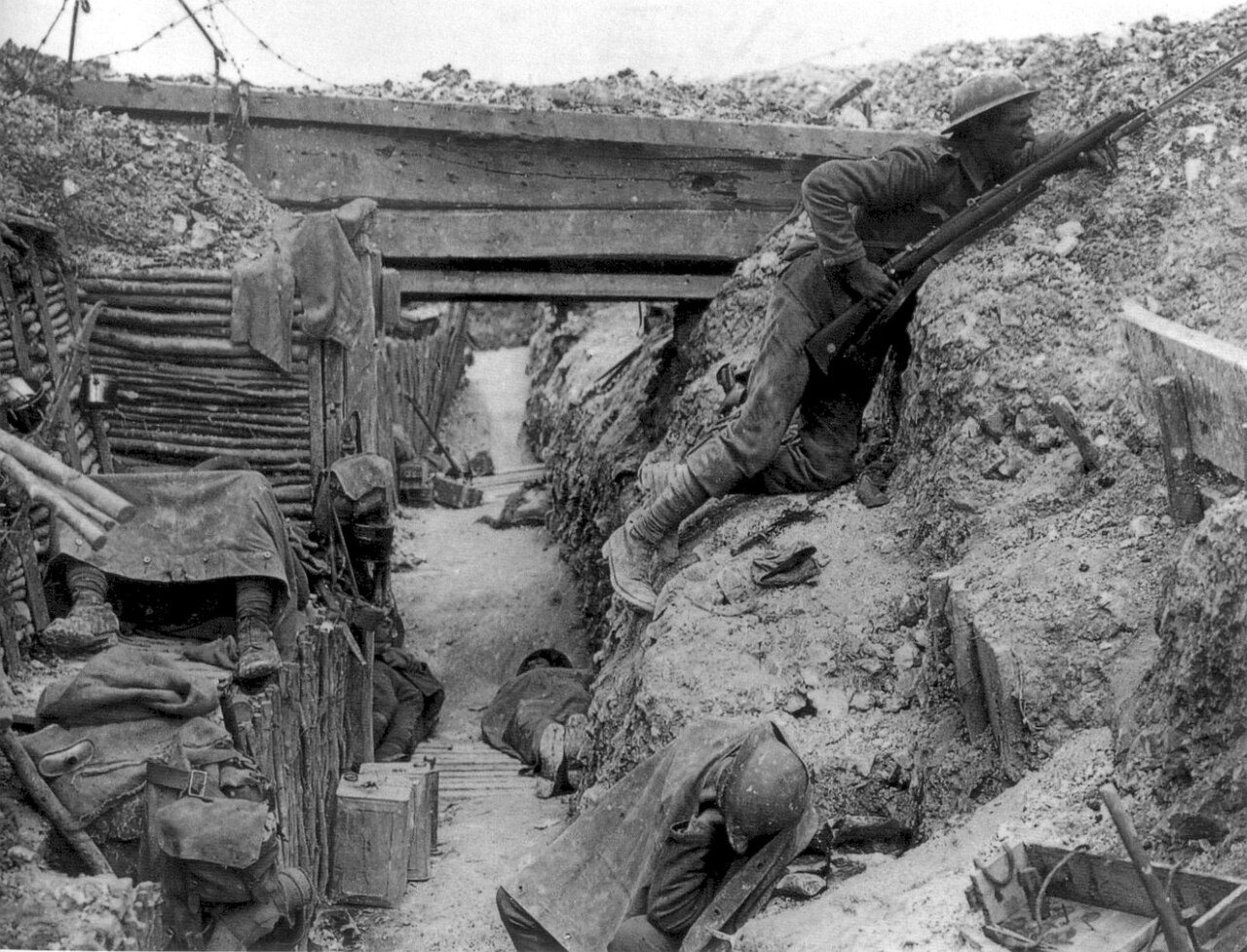
World War I (1914-1918) began with an assassination in Sarajevo on 28 June 1914 and, within six weeks, drew Europe's great powers into a general war. Fought largely from trenches on the Western Front, it killed millions, toppled empires and ended with the Armistice of 11 November 1918 - but the peace that followed left disputes unsettled.
At a Glance
- Dates
- 28 July 1914, when Austria-Hungary declared war on Serbia, to the Armistice of 11 November 1918
- The spark
- The assassination of Archduke Franz Ferdinand, heir to the Austro-Hungarian throne, at Sarajevo on 28 June 1914
- The sides
- The Allies - including France, Russia, the British Empire, Italy from 1915 and the United States from 1917 - against the Central Powers: Germany, Austria-Hungary, the Ottoman Empire and Bulgaria
- Deaths
- Britannica puts soldiers' deaths at some 8,500,000 and estimates civilian deaths at around 13,000,000; military deaths are commonly estimated in total at roughly 9-10 million, and no exact count exists
- The stalemate
- After the First Battle of the Marne in September 1914, the Western Front settled into trench lines that barely moved for three years
- The end
- The Armistice signed in the Forest of Compiegne took effect at 11 a.m. on 11 November 1918; the Treaty of Versailles followed on 28 June 1919
Introduction
The First World War was the first industrial war fought between global empires. Machine guns, heavy artillery, poison gas, tanks and aircraft were used on a scale no earlier conflict had seen, while the armies themselves numbered in the millions. Most of the fighting in the west took place along a line of trenches running from the North Sea to Switzerland; in the east, armies manoeuvred over vast distances, and the war also reached Africa, the Middle East, Asia and the world's oceans.
It began as a Balkan crisis and became a world war through decisions taken in five weeks in the summer of 1914: long-built tensions made a general war possible, and the choices of that July made it happen then.
Origins: Alliances and the July Crisis
By 1914 Europe's powers were grouped in two armed camps: the Triple Alliance of Germany, Austria-Hungary and Italy, and the Triple Entente of France, Russia and Britain. Imperial War Museums stresses that the alliances did not make war automatic: behind them lay growing nationalism, increased militarism, imperial rivalry and competition for power, and in the crisis of 1914 leaders chose war to defend or extend national interests.
On 28 June 1914 Archduke Franz Ferdinand and his wife were assassinated in Sarajevo by Gavrilo Princip, a young Bosnian Serb. Suspecting Serbian backing, Austria-Hungary, encouraged by Germany, sent Serbia an ultimatum hard to accept in full, and on 28 July 1914 declared war. Russia mobilised in Serbia's support; Germany declared war on Russia on 1 August and on France on 3 August; and the invasion of neutral Belgium, with British fears of German domination, brought Britain into the war on 4 August.
1914: The Schlieffen Plan, the Marne and the Trenches
Germany's only war plan was to defeat France quickly by sweeping through Belgium, then turn east against Russia before it could fully mobilise. The advance reached the River Marne, within reach of Paris, but in the First Battle of the Marne in September 1914 French and British forces counter-attacked and pushed the German armies back. Both sides then raced north to outflank each other, and by the end of 1914 two lines of trenches faced each other across a front that would barely move for three years.
The short-war expectation collapsed with it. Armies dug in because modern firepower favoured the defender: artillery and machine guns could break up attacks across open ground, while the attacker had no fast way to exploit a breakthrough. The result was stalemate in the west.
Attrition: Verdun, the Somme and Passchendaele
The war's middle years were a contest of endurance. At Verdun, from February to December 1916, Germany attacked the French fortress city in a battle of attrition that became a symbol of the war's cost; France held, at enormous loss on both sides. The British and French answered on the Somme from 1 July 1916. On its first day the British Army suffered 57,470 casualties, the heaviest loss of life for a single day of the war in Britannica's account, and the battle ground on until November.
In 1917 the pattern repeated at Passchendaele, the Third Battle of Ypres, fought through the autumn mud in Flanders. At sea, Britain blockaded Germany while German U-boats hunted merchant shipping; the one great fleet action, Jutland in 1916, left the blockade intact. New weapons - tanks, aircraft and poison gas - were introduced, but none yet broke the deadlock.
1917: America Enters, Russia Leaves
Two decisions transformed the war in 1917. Germany resumed unrestricted submarine warfare in February, gambling that Britain could be starved out before American power arrived; instead, the sinking of American ships and the exposure of German diplomacy helped bring the United States into the war, which Congress declared on 6 April 1917. American troops then reached France in growing numbers through 1918.
In Russia, the revolutions of 1917 destroyed the tsarist regime and brought the Bolsheviks to power; Russia left the war by the Treaty of Brest-Litovsk in March 1918. That freed German divisions for one last effort in the west - against a closing window, with American manpower arriving and its own people exhausted by blockade.
1918: The Spring Offensive, the Hundred Days and the Armistice
Germany's Spring Offensive, launched in March 1918, won more ground than any attack since 1914 but failed to break the Allies, and exhausted the attacking armies. From August 1918 the Allies counter-attacked in the Hundred Days, combining infantry, artillery, tanks and aircraft to push the German army steadily back. Germany's allies collapsed, revolution spread at home, and the Kaiser abdicated on 9 November.
The Armistice was signed in a railway carriage in the Forest of Compiegne in the early hours of 11 November 1918 and took effect at 11 a.m. that day - the eleventh hour of the eleventh day of the eleventh month, as the US National Archives records. The Treaty of Versailles, signed on 28 June 1919, exactly five years after Sarajevo, settled the war with Germany: it imposed reparations and territorial losses and created the League of Nations. Austria-Hungary and the Ottoman Empire had already broken apart, and the map was redrawn around new states.
Timeline
- 28 June 1914
Archduke Franz Ferdinand and his wife are assassinated at Sarajevo by Gavrilo Princip.
- 28 July 1914
Austria-Hungary declares war on Serbia, opening the July Crisis's chain of declarations and mobilisations.
- 4 August 1914
Germany invades Belgium; Britain declares war on Germany.
- September 1914
The First Battle of the Marne halts the German advance on Paris; trench lines form on the Western Front.
- February-December 1916
The Battle of Verdun: Germany's attrition offensive against France ends with the fortress held and huge losses on both sides.
- 1 July 1916
The Battle of the Somme begins; the British Army suffers 57,470 casualties on the first day.
- 6 April 1917
The United States declares war on Germany, following the resumption of unrestricted submarine warfare.
- July-November 1917
Passchendaele (Third Ypres): the British offensive in Flanders advances a few miles through mud at heavy cost.
- March 1918
Russia leaves the war at Brest-Litovsk; Germany launches its Spring Offensive in the west on 21 March.
- August-November 1918
The Hundred Days: Allied offensives roll the German army back toward its own frontier.
- 11 November 1918
The Armistice takes effect at 11 a.m.; fighting on the Western Front stops.
- 28 June 1919
The Treaty of Versailles is signed at the Paris Peace Conference.
Significance
The war destroyed four empires - German, Austro-Hungarian, Ottoman and Russian - and redrew the map from Poland to Palestine. It accelerated the rise of the United States and brought communist government to Russia. Its human cost is given only as estimates, because, as Britannica notes, revolutions in four warring countries in 1918 and the chaos of the fighting mean a completely accurate table of losses may never be compiled.
Myths and disputes
It is often said that everyone expected the war to be over by Christmas 1914. The phrase survives as a popular expectation of a short war, and captures something real about the mood of August 1914 - but it should be handled carefully: it is a summary applied afterwards as much as a documented universal belief, and some professional soldiers had warned a great-power war could be long. What is documented is that the short-war plans failed, and the trenches were the result.
The sharpest dispute is over generalship, summed up in the phrase lions led by donkeys: brave soldiers, in this view, were sent to their deaths by incompetent commanders. The phrase was popularised by Alan Clark's 1961 book The Donkeys, though the quotation he attributed to German generals has never been traced to its claimed source. Historians such as John Terraine and Gary Sheffield have argued the other side: that commanders faced an unprecedented tactical problem, that armies learned and adapted between 1916 and 1918, and that the force that won the Hundred Days was the product of that learning. The casualty figures are not in dispute; what they prove about the generals still is.
Legacy
Remembrance became the war's most durable institution: Armistice Day, and the war cemeteries and memorials that the Smithsonian among others documents, still structure how the war is recalled. Politically, the Versailles settlement's grievances, the League's weakness and the war's unpaid debts formed part of the road to the Second World War - which Britannica describes, in many respects, as a continuation of the disputes the First World War left unsettled.
Sources
- Imperial War Museums — Outbreak of the First World War
- Encyclopaedia Britannica — World War I: Killed, wounded, and missing
- Encyclopaedia Britannica — How many people died during World War I?
- The National Archives (UK) — Cabinet meeting minutes, 11 November 1918
- Library of Congress — Timeline: Echoes of the Great War, American Experiences of World War I
- US National Archives — Captured on Film: Armistice Day 1918
- Smithsonian Magazine — 35 Places to Commemorate the 100th Anniversary of the End of World War I
The facts on this page were checked against these sources on 19 November 2026. The History Trail's permanent pages are researched and written for this site; the live profiles elsewhere on The History Trail are assembled automatically from Wikipedia and Wikidata.
About the Author
Researched and written by the The History Trail Editorial Team — the accountable editorial function behind this site's permanent story pages. The team works from the published sources cited on each page; it does not invent historians, reviewers or credentials, and it corrects errors openly.
Fact Check
Every load-bearing fact on this page traces to one of the sources listed above, and significant claims link to their source in the text. Our checking method is described on the methodology page; errors can be reported via the corrections page.
Sources & Citations
Cite this page as: The History Trail Editorial Team, The History Trail — this article's title, publication and update dates are shown beneath its headline. The full source list appears under Sources above; the site's source standards are on the sources page.