
Things
Solar eclipse
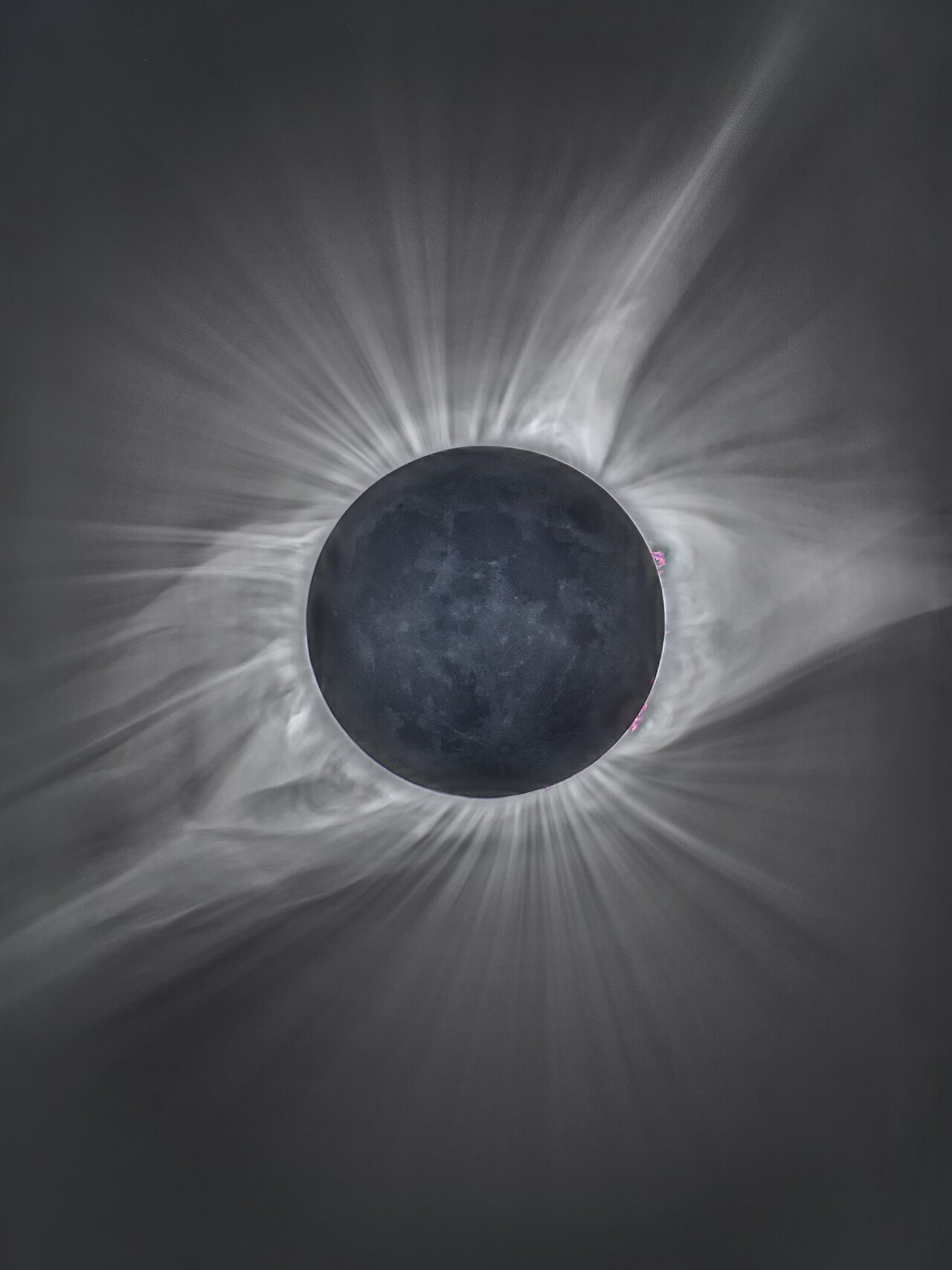
A solar eclipse happens when the Moon passes between the Sun and Earth and its shadow sweeps across the surface: total where the Moon covers the Sun completely, annular where a ring of light remains, partial elsewhere in the shadow. Humans have recorded eclipses for more than four thousand years - as omens, as calendar anchors, and finally as instruments of science, most famously on 29 May 1919, when eclipse expeditions measured starlight bending past the darkened Sun and confirmed Einstein's general relativity.
At a Glance
- What it is
- The Moon passing between Earth and the Sun, casting a shadow - umbra and penumbra - that sweeps across Earth's surface
- The types
- Total (Sun completely covered), annular (a ring of sunlight remains) and partial (Sun partly covered), depending on alignment and the Moon's distance
- Totality
- At most 7 minutes 30 seconds, visible only within the narrow strip crossed by the umbra; a total eclipse recurs at any one place only after centuries
- Earliest record
- A Chinese record in the Shujing, identified with 22 October 2137 BCE; the attached story of the astronomers Ho and Hi is probably apocryphal, as NASA cautions
- The chronology anchor
- The Assyrian eclipse of 15 June 763 BCE, recorded in the Assyrian chronicles, is a fixed point for dating the ancient Near East
- The Einstein test
- On 29 May 1919 expeditions to Principe and Sobral measured starlight bent by about Einstein's predicted 1.75 arcseconds; results announced 6 November 1919
- Safe viewing
- Never look at a partial eclipse without certified eclipse glasses or a filter meeting the ISO 12312-2 standard, Britannica advises; only totality itself is safe to view directly
Introduction
Britannica defines a solar eclipse as the Moon coming between Earth and the Sun so that the Moon's shadow sweeps over Earth's surface. The shadow has two parts: the umbra, into which no direct sunlight penetrates, where observers see the Sun completely covered - a total eclipse; and the penumbra, where the eclipse is partial. When the Moon is too far away to cover the Sun completely, a ring of sunlight remains and the eclipse is annular. Totality lasts at most seven and a half minutes and is visible only from a narrow strip of land or sea.
No other routine astronomical event has left such a long paper trail. Eclipses were recorded in China more than four thousand years ago, fixed the chronology of the ancient Near East, revealed the Sun's corona to nineteenth-century science, and in 1919 provided the first famous test of Einstein's general theory of relativity. The history of the solar eclipse is therefore two histories at once: of the phenomenon, and of what each age could learn from a few minutes of daytime darkness.
Ancient Records: China, Assyria and Babylon
Among the earliest written eclipse records is one preserved in the ancient Chinese text known as the Shujing: 'On the first day of the last month of autumn, the Sun and Moon did not meet harmoniously in Fang.' Using the reference to Fang, a section of the sky in Scorpius, and the reign in which the text places the event, scholars have identified it with an eclipse of 22 October 2137 BCE - though the famous story attached to it is probably legend, as the myths section notes. NASA's historical tables list the same date, while cautioning that inclusion does not itself validate ancient stories.
Other ancient records proved more solid. The Assyrian record of a total eclipse on 15 June 763 BCE became a fixed point from which the chronology of the ancient Near East can be anchored. The Babylonians went further: by tracking eclipses over centuries they recognised the repeating cycle now called the Saros, which made it possible to say when an eclipse was likely, if not exactly where it would be seen.
Eclipse Science: Halley, Photography and the Corona
In 1715 Edmund Halley turned prediction into public science, calculating the path of a total eclipse across England and publishing a map of where totality would fall. The nineteenth century then made eclipses into expeditions. NASA's tables mark 1851 as the year of the first eclipse expedition and 1860 as the year of the first wet-plate eclipse photograph; observers travelled the world to spend a few minutes inside the Moon's shadow with telescopes, spectroscopes and cameras.
What they were chasing was the corona, the Sun's outer atmosphere, overwhelmed by glare at ordinary times and revealed only when the Moon covers the disk. Eclipse observations established that the corona and prominences belong to the Sun, and eclipse spectroscopy opened a window on the Sun's composition no other method then allowed. The eclipse had become a laboratory nature switched on, briefly, a few times a year.
1919: The Eclipse That Tested Einstein
Einstein's general theory of relativity, published in 1915, predicted that the Sun's gravity would bend light from a background star passing close to it by 1.75 arcseconds at the Sun's limb - twice the Newtonian value. The only way to measure so small a shift was during a total eclipse, when stars near the Sun become visible. The eclipse of 29 May 1919 was exceptionally favourable: totality was long, and the Sun sat in front of the Hyades, a rich field of bright stars. Astronomer Royal Frank Dyson organised two British expeditions: Arthur Eddington and Edwin Cottingham to Principe, off West Africa, and Charles Davidson and Andrew Crommelin to Sobral, in Brazil.
Cloud spoiled most of the Principe plates and one Sobral instrument's images were distorted, but the surviving data favoured Einstein's value over the Newtonian one. On 6 November 1919 Dyson presented the results to a joint meeting of the Royal Society and the Royal Astronomical Society in London. Press coverage the next day made Einstein world-famous almost overnight, and the test established general relativity in the public mind - though, as the myths section shows, its data have been argued over ever since.
Timeline
- 22 October 2137 BCE
The eclipse recorded in the Chinese Shujing is identified with this date; the tale of the astronomers Ho and Hi is probably legend.
- 15 June 763 BCE
A total eclipse recorded in the Assyrian chronicles becomes a fixed point for dating the ancient Near East.
- 28 May 585 BCE
The eclipse Herodotus says Thales predicted falls during a battle between the Medes and the Lydians; tradition says the fighting stopped.
- 3 May 1715
Edmund Halley's eclipse: Halley publishes the path of totality across England in advance, a landmark in public prediction.
- 28 July 1851
The first eclipse expedition: observers organise travel purely to study totality; within a decade, the first wet-plate eclipse photograph follows in 1860.
- 29 May 1919
Eddington observes the eclipse from Principe and the Greenwich team from Sobral, Brazil, measuring the bending of starlight by the Sun.
- 6 November 1919
Dyson announces the results in London: the deflection matches Einstein's 1.75 arcseconds, and Einstein becomes world-famous.
- 30 June 1973
The supersonic Concorde airliner races the Moon's shadow across Africa, extending observations of totality far beyond the ground limit.
- 21 August 2017 and 8 April 2024
Total eclipses cross the United States from coast to coast and then from Mexico to Canada, watched by tens of millions.
Significance
The solar eclipse is the rare natural event that has served, in turn, as a calendar, a clock and a laboratory. Ancient records still do work today: the Assyrian eclipse of 763 BCE anchors Near Eastern chronology, and old eclipse timings are evidence for slow changes in Earth's rotation. Eclipse expeditions drove the development of astronomical photography and spectroscopy, and the corona they revealed is now central to understanding the solar wind - the same stream of particles that produces auroras. Above all, the eclipse is where a theory of the universe was first put to a public test: general relativity did not win acceptance from the 1919 data alone, but the eclipse gave it a dramatic, checkable prediction, tested on two continents and reported around the world.
Myths and disputes
The oldest eclipse story is also the least reliable. Tradition says the Chinese court astronomers Ho and Hi were executed for failing to predict the eclipse of 2137 BCE, having been too drunk to perform the rites. NASA itself flags the story as possibly apocryphal, and the neat rhymes that retell it are much later inventions. This page treats the eclipse record as genuine and the execution as legend. The same caution applies to Thales: Herodotus says he predicted the eclipse of 585 BCE, but Babylonian methods of the time could flag a likely eclipse season, not the exact day and place; whether Thales predicted anything remains disputed.
The 1919 results have their own dispute. In 1980 the philosophers John Earman and Clark Glymour argued that the expeditions' data selection was flawed - one Sobral data set, which gave a lower deflection, was discarded - and accused Eddington of bias. A detailed reanalysis in the Royal Society's Notes and Records in 2021 found the opposite: the discarded plates were set aside by Dyson's Greenwich team, not Eddington, because of documented instrument distortion, and the original analysis was methodologically sound. Later eclipses and modern techniques have confirmed the prediction independently, so the dispute now concerns the history of the measurement, not the physics.
Legacy
Yet the eclipse keeps its oldest function. It is still the only time the corona - source of the solar wind - can be studied from the ground in visible light, and scientists still mount expeditions into the shadow for measurements no spacecraft fully replaces. Four thousand years after a Chinese scribe wrote that the Sun and Moon did not meet harmoniously, the meeting is still teaching.
Sources
- NASA Goddard Space Flight Center - Solar Eclipses of Historical Interest
- Royal Society, Notes and Records - The 1919 eclipse results that verified general relativity and their later detractors
- Encyclopaedia Britannica - Solar eclipse
- Astronomy Magazine - Oct. 22, 2137 B.C.E.: An eclipse darkens skies over ancient China
The facts on this page were checked against these sources on 19 November 2026. The History Trail's permanent pages are researched and written for this site; the live profiles elsewhere on The History Trail are assembled automatically from Wikipedia and Wikidata.
About the Author
Researched and written by the The History Trail Editorial Team — the accountable editorial function behind this site's permanent story pages. The team works from the published sources cited on each page; it does not invent historians, reviewers or credentials, and it corrects errors openly.
Fact Check
Every load-bearing fact on this page traces to one of the sources listed above, and significant claims link to their source in the text. Our checking method is described on the methodology page; errors can be reported via the corrections page.
Sources & Citations
Cite this page as: The History Trail Editorial Team, The History Trail — this article's title, publication and update dates are shown beneath its headline. The full source list appears under Sources above; the site's source standards are on the sources page.