
Things
Electric Light
Electric light began in 1802 with Humphry Davy's brilliant but impractical arc lamp. It took until the late 1870s for Joseph Swan in England and Thomas Edison in America, working independently, to make incandescent lamps that lasted — and until Edison built a whole power system around his bulb for electric light to become something a city could buy.
At a Glance
- First demonstration
- Humphry Davy's electric arc lamp, 1802
- Practical incandescent lamps
- Joseph Swan (England) and Thomas Edison (USA), independently, late 1870s
- Edison's lamp patent
- US patent granted 27 January 1880, after a carbonised thread burned for more than 14 hours in October 1879
- First central power system
- Edison's Pearl Street station, New York, operative September 1882
- Patent rivals merged
- Edison and Swan combine their British interests as the Edison & Swan United Electric Light Company ('Ediswan'), 1883
- The currents settled
- AC defeats DC for distribution; Niagara Falls power lights Buffalo, 16 November 1896
- The modern successor
- The LED — first practical visible-spectrum device demonstrated by Nick Holonyak Jr. in 1962
Light Without a Flame
Electric light began in 1802, when the British chemist Humphry Davy produced a brilliant arc of light between carbon electrodes connected to a powerful battery — the first electric lamp. It was dazzling, short-lived and wholly impractical for a home, but it proved electricity could make light. For the next seventy years inventors chased two different lamps: the arc lamp, fierce enough for streets and factories, and the gentler incandescent lamp, in which a filament glows inside a glass bulb.
The incandescent race was won, in effect, twice. In England, Joseph Swan had been experimenting with carbonised paper filaments in evacuated bulbs since 1850, and by 1878, with better vacuum pumps, he had a workable lamp. In America, Thomas Edison at Menlo Park took up the problem in 1878 and in October 1879 produced a carbonised cotton thread that glowed for more than fourteen hours. The Science Museum's verdict is the fair one: the first practical incandescent lamps were invented independently in the late 1870s by Swan and Edison.
Filaments, Vacuums and a Patent War
Neither man worked in a vacuum of ideas — only in vacuum bulbs. James Bowman Lindsay had demonstrated a constant electric light in Dundee as early as 1835, Warren de la Rue had run current through a platinum coil in an evacuated tube in 1840, and Canadians Henry Woodward and Mathew Evans patented a carbon-rod lamp in 1874. What the early lamps lacked was a combination of a durable filament, a high vacuum and a supply of electricity strong and cheap enough to feed them. Swan's breakthroughs in vacuum technique and Edison's high-resistance filament, which made distribution economical, supplied the missing pieces.
Success brought lawyers. Swan patented his lamp in Britain in 1880 and began installing it in homes and landmarks; Edison's companies claimed infringement of Edison's patents, granted in the United States in January 1880. In Britain the fight ended not in a courtroom verdict but in a merger: in 1883 the rivals combined into the Edison & Swan United Electric Light Company, known everywhere by its brand name, Ediswan, which dominated the British market. Swan could claim priority of experiment; Edison's design, and above all his system, was what spread.
Timeline
- 1802
Humphry Davy demonstrates the first electric arc lamp in Britain, striking a brilliant arc between carbon electrodes.
- 1835
James Bowman Lindsay publicly demonstrates a constant incandescent electric light in Dundee, Scotland, then turns his attention to other inventions.
- 1874
Henry Woodward and Mathew Evans patent an incandescent lamp in Canada; unable to commercialise it, they later sell the rights to Edison.
- October 1879
Edison's laboratory at Menlo Park produces a carbonised thread filament that glows for more than fourteen hours; his US lamp patent follows, granted on 27 January 1880.
- 1881
Swan's lamps light London's Savoy Theatre — the first public building, and first theatre, lit entirely by electricity.
- September 1882
Edison's Pearl Street station in lower Manhattan begins operating, the first permanent commercial central power system, built to feed his lamps.
- 1883
Edison and Swan end their British patent war by merging into the Edison & Swan United Electric Light Company — Ediswan.
- 1893
At the Chicago World's Fair, George Westinghouse lights the exhibition with alternating current, underbidding General Electric's direct-current bid.
- 16 November 1896
Alternating current generated at Niagara Falls lights Buffalo, New York, demonstrating that AC can carry power over distance — the practical end of the war of the currents.
- 1930s
Fluorescent lamps, far more efficient than incandescent bulbs, reach the market and are showcased at the 1939 New York World's Fair.
- 1962
Nick Holonyak Jr. demonstrates the first practical visible-spectrum LED, producing red light — the ancestor of today's LED lamps.
The System Was the Invention
Edison understood that a lamp without electricity to feed it was a glass ornament. Modelling his system on gas lighting, he built the whole chain: generators, underground mains, switches, meters to bill customers, and the lamp itself, designed with a high-resistance filament so that many lamps could run economically on one circuit. His Pearl Street station, which he supervised personally and which became operative in September 1882, was the first permanent commercial central power system — electricity sold as a service. That, more than any single bulb, is why Edison's name attached itself to electric light.
The system's weakness was its direct current, which could not easily be changed to higher or lower voltages and so could travel only a short distance from the station. Alternating current, championed by Nikola Tesla and George Westinghouse, could be transformed up for long-distance transmission and down again for use. In the war of the currents Edison campaigned to discredit AC as dangerous, even publicly electrocuting animals with it; but Westinghouse lit the Chicago World's Fair in 1893, won the Niagara Falls contract the same year, and in 1896 Niagara's AC lit Buffalo. The grid the world still uses is AC — though, as the US Department of Energy notes, the computers, LEDs and solar panels at its edges all run on DC.
From Filament to Photon
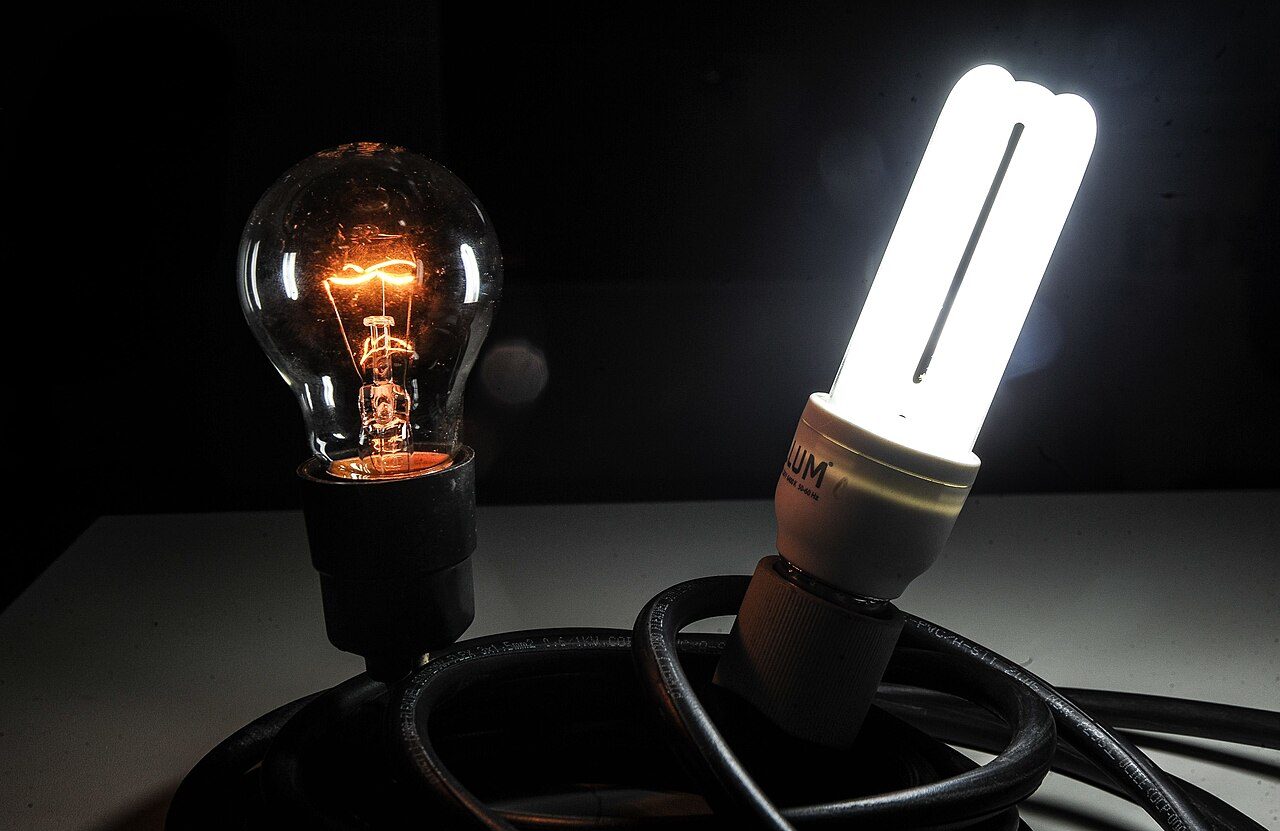
The twentieth century improved the lamp Edison and Swan left behind. Tungsten filaments replaced carbon, making incandescent bulbs brighter and longer-lived; fluorescent tubes, commercialised in the late 1930s, converted electricity to light several times more efficiently and took over offices, factories and schools. Each technology kept the same basic promise — light at the flick of a switch, with no flame, no matches and no smoke — while steadily cutting the energy each lumen cost.
The LED completed the pattern. Light-emitting diodes began as indicator lights after Holonyak's 1962 red device; the arrival of practical blue LEDs in the 1990s made white light possible, and LED lamps now outlast and out-perform both incandescent and fluorescent lighting. When Edison died in 1931, the electric and lighting industries he helped found were already worth five billion dollars a year in the United States alone. The night has never gone back to being dark by default.
Sources
- Science Museum Group Collection — Swan electric lamp, 1878–1879
- Science Museum Group Collection — Ediswan light bulb (Edison & Swan United Electric Light Co.)
- US Department of Energy — The War of the Currents: AC vs. DC Power
- Engineering and Technology History Wiki (IEEE) — Edison's Incandescent Lamp
- US Department of Energy — The History of the Light Bulb
The facts on this page were checked against these sources on 19 November 2026. The History Trail's permanent pages are researched and written for this site; the live profiles elsewhere on The History Trail are assembled automatically from Wikipedia and Wikidata.
About the Author
Researched and written by the The History Trail Editorial Team — the accountable editorial function behind this site's permanent story pages. The team works from the published sources cited on each page; it does not invent historians, reviewers or credentials, and it corrects errors openly.
Fact Check
Every load-bearing fact on this page traces to one of the sources listed above, and significant claims link to their source in the text. Our checking method is described on the methodology page; errors can be reported via the corrections page.
Sources & Citations
Cite this page as: The History Trail Editorial Team, The History Trail — this article's title, publication and update dates are shown beneath its headline. The full source list appears under Sources above; the site's source standards are on the sources page.