
People
Nikola Tesla
Tesla arrived in New York in 1884 with four cents, some poems and the design of a motor turning in his head. Within a decade his alternating-current system had beaten Edison's, lit a world's fair and harnessed Niagara Falls. The fame was real; the fortune never stayed.
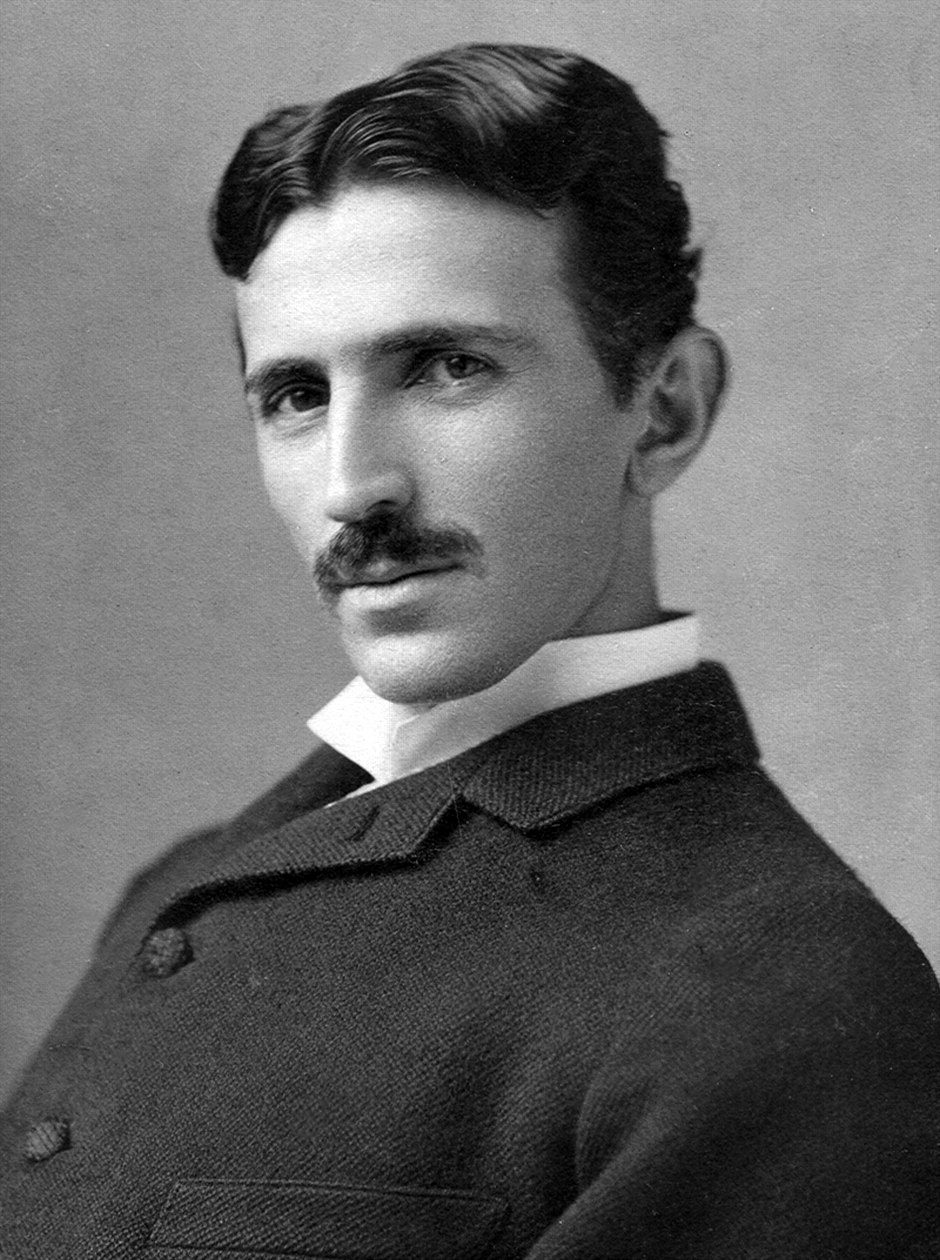
At a Glance
- Born
- 9/10 July 1856, Smiljan, Austrian Empire (now Croatia)
- Died
- 7 January 1943, New York City
- Core invention
- The rotating magnetic field — basis of most alternating-current machinery — and the three-phase power transmission system
- Key sale
- AC patent rights sold to George Westinghouse, May 1888
- Tesla coil
- Invented 1891; still widely used in radio and television technology
- Honours
- Edison Medal, 1917 — the American Institute of Electrical Engineers' highest honour
- Namesake
- Tesla Inc., founded 2003, named in his honour
Introduction
Nikola Tesla was born on the night of 9–10 July 1856 in Smiljan, in the Austrian Empire in what is now Croatia, into a family of Serbian origin. His father was an Orthodox priest; his mother, though unschooled, was highly intelligent. He trained for an engineering career at the Technical University at Graz, in Austria, and at the University of Prague. At Graz he first saw the Gramme dynamo, which worked as a generator and, reversed, as an electric motor — and conceived a way to use alternating current to advantage.
Later, in Budapest, Tesla visualised the principle of the rotating magnetic field and developed plans for an induction motor: the idea that would become his first step toward the successful use of alternating current, and the foundation of most AC machinery since. In 1882 he went to work in Paris for the Continental Edison Company, and on assignment to Strassburg in 1883 he built, after work hours, his first induction motor.
Background
Tesla first found work with Thomas Edison, but the two inventors were far apart in background and methods, and their separation was inevitable. In May 1888 George Westinghouse, head of the Westinghouse Electric Company in Pittsburgh, bought the patent rights to Tesla's polyphase system of alternating-current dynamos, transformers and motors. The transaction precipitated a titanic power struggle — the war of the currents — between Edison's direct-current systems and the Tesla-Westinghouse alternating-current approach, which eventually won out.
To allay public fears of alternating current, Tesla gave exhibitions in his laboratory in which he lit lamps by allowing electricity to flow through his own body, and he lectured at home and abroad. Westinghouse used Tesla's AC system to light the World's Columbian Exposition at Chicago in 1893, and the success helped win the contract to install the first power machinery at Niagara Falls, which bore Tesla's name and patent numbers. The project was carrying power to Buffalo by 1896.
Timeline
- 9/10 July 1856
Nikola Tesla is born in Smiljan, Austrian Empire, son of an Orthodox priest and a gifted, unschooled mother.
- 1882
Working in Budapest and then Paris for the Continental Edison Company, Tesla develops his plans for an induction motor using alternating current.
- 1883
On assignment in Strassburg, Tesla builds his first induction motor after work hours.
- 1884
Tesla arrives in New York with four cents, his poems and calculations for a flying machine; he works briefly for Edison.
- May 1888
George Westinghouse buys the patent rights to Tesla's polyphase AC system, setting up the war of the currents against Edison's DC.
- 1891
Tesla invents the Tesla coil and becomes a United States citizen.
- 1893
Westinghouse lights the World's Columbian Exposition in Chicago using Tesla's alternating-current system.
- 1896
Power machinery at Niagara Falls, bearing Tesla's name and patent numbers, carries electricity to Buffalo.
- 1898
Tesla demonstrates a teleautomatic boat guided by remote control before a crowd at Madison Square Garden.
- 1899–1900
At Colorado Springs Tesla pursues his work on terrestrial stationary waves and high-voltage experiments.
- 1900
Construction begins on Long Island of Tesla's wireless world broadcasting tower, backed by $150,000 from J. Pierpont Morgan; the project is later abandoned.
- 7 January 1943
Tesla dies in New York City; hundreds attend his funeral at the Cathedral of St. John the Divine.
Significance
Tesla changed the world, in Britannica's summary, by developing the alternating-current power system that provides electricity for homes and buildings — the rotating magnetic field, the induction motor and the three-phase system of transmission are the working core of the modern grid. He also pioneered radio communication and was granted more than a hundred United States patents. Every wall socket in the world is, in that sense, running on the side Tesla took in the war of the currents.
The Colorado Springs work showed the other Tesla. There, from May 1899 to early 1900, he made what he regarded as his most important discovery — terrestrial stationary waves, proving Earth could be used as a conductor and made to resonate at a certain electrical frequency. He was also, at one time, certain he had received signals from another planet there — a claim met with derision in scientific journals, and a fair sample of the prophecies that made editors unsure how seriously to take him.
Legacy
Tesla's later work shifted to turbines and other projects, but lack of funds left his ideas in notebooks that enthusiasts still examine for unexploited clues. In 1915 he was severely disappointed when a report that he and Edison would share the Nobel Prize proved erroneous; in 1917 he received the Edison Medal, the highest honour the American Institute of Electrical Engineers could bestow — an irony history enjoys. After his death his papers passed eventually to his nephew Sava Kosanovich and to the Nikola Tesla Museum in Belgrade.
The name completed its journey in 2003, when Martin Eberhard and Marc Tarpenning founded Tesla Inc., the electric-car, solar and battery manufacturer, in the inventor's honour; it became one of the most recognisable car brands in the world. The grid, the motor and the car all carry the same signature now.
Sources
- Encyclopaedia Britannica — Nikola Tesla
- Smithsonian Institution Archives — Kenneth M. Swezey Papers (Tesla collection, National Museum of American History)
- Encyclopaedia Britannica — Thomas Edison (the other side of the war of the currents)
The facts on this page were checked against these sources on 19 November 2026. The History Trail's permanent pages are researched and written for this site; the live profiles elsewhere on The History Trail are assembled automatically from Wikipedia and Wikidata.
About the Author
Researched and written by the The History Trail Editorial Team — the accountable editorial function behind this site's permanent story pages. The team works from the published sources cited on each page; it does not invent historians, reviewers or credentials, and it corrects errors openly.
Fact Check
Every load-bearing fact on this page traces to one of the sources listed above, and significant claims link to their source in the text. Our checking method is described on the methodology page; errors can be reported via the corrections page.
Sources & Citations
Cite this page as: The History Trail Editorial Team, The History Trail — this article's title, publication and update dates are shown beneath its headline. The full source list appears under Sources above; the site's source standards are on the sources page.