
People
Sidney Poitier
Sidney Poitier (1927-2022) was the Bahamian-American actor who broke Hollywood's colour barrier: the first Black winner of the Academy Award for Best Actor, for Lilies of the Field in 1964, and by 1967 the biggest box-office draw in America. He was born in Miami on 20 February 1927, two months premature, to tomato farmers from Cat Island in the Bahamas - and the centenary of that unlikely birth falls on 20 February 2027.
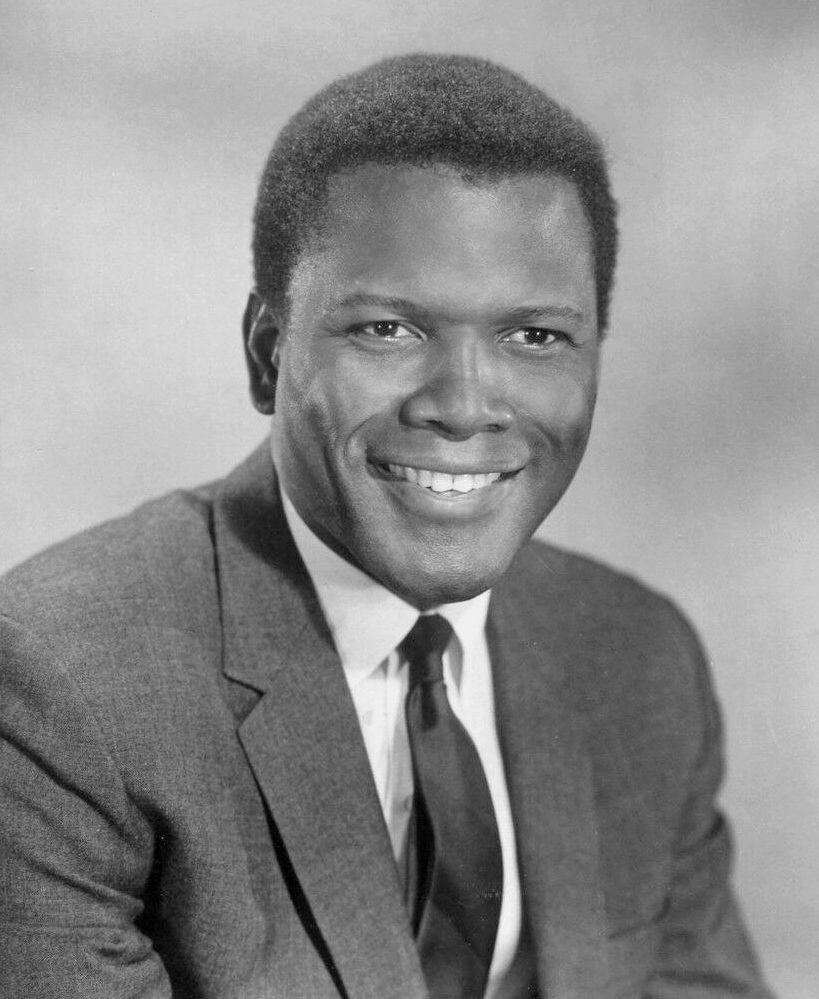
At a Glance
- Born
- 20 February 1927, Miami, Florida - two months premature, to Bahamian parents visiting from Cat Island; the centenary of his birth falls on 20 February 2027
- Raised
- On Cat Island and in Nassau, the Bahamas; returned to the United States as a teenager and trained at the American Negro Theatre
- Breakthrough
- No Way Out (1950), Blackboard Jungle (1955), and an Oscar nomination for The Defiant Ones (1958)
- The Oscar
- Best Actor for Lilies of the Field, awarded 13 April 1964 - the first Black winner of the award
- The peak
- Three hits in 1967 - To Sir, with Love; In the Heat of the Night; Guess Who's Coming to Dinner - made him America's top box-office draw
- Second career
- Director of Buck and the Preacher (1972) and Stir Crazy (1980); ambassador of the Bahamas to Japan, 1997-2007
- Died
- 6 January 2022, Los Angeles, aged 94; Presidential Medal of Freedom awarded in 2009
Introduction
Poitier's career was built on a refusal. From his first film onwards he turned down roles that traded in racial stereotypes, and instead played doctors, detectives, teachers and engineers - Black professionals, in an industry that had rarely allowed Black actors to be anything but servants or comic relief. Britannica's summary is blunt: he broke the colour barrier in the American motion-picture industry, becoming the first African American to win the Academy Award for Best Actor and the first Black movie star.
The scale of that achievement is easy to miss now. When Poitier won his Oscar in 1964, he remained the only Black man to hold it for thirty-eight years. When his three films of 1967 made him the top box-office draw in the United States, no Black actor had ever stood where he stood. He carried that position with a deliberate public dignity, marched in the civil rights movement, and then directed some of the most successful comedies of the 1970s and 1980s and served his other country, the Bahamas, as an ambassador.
Cat Island to New York
He was the youngest of seven children of Evelyn and Reginald James Poitier, tomato farmers who owned a farm on Cat Island in the Bahamas, then a British Crown colony. The family travelled to Miami to sell their produce, and it was on one such trip, on 20 February 1927, that Sidney was born - two months premature and not expected to survive. His parents stayed three months in Miami to nurse him before taking him home. The accident of that birthplace mattered for life: born on American soil, he was a United States citizen.
He lived on Cat Island until he was ten, when the family moved to Nassau; there he saw his first films. As a teenager he was sent back to Florida to live with a brother, encountered American segregation at first hand, and made his way to New York. During the Second World War he enlisted in the US Army and served briefly in a medical unit. After his discharge he applied to the American Negro Theatre - and was rejected, his Bahamian accent against him. He spent months listening to radio announcers and practising American speech, applied again, and was accepted. In 1946 he made his Broadway debut in Lysistrata.
The Breakthrough Years
His first credited film role set the pattern: in No Way Out (1950) he played Dr Luther Brooks, a Black doctor treating a bigoted white criminal. In Blackboard Jungle (1955) he was Gregory Miller, an alienated high-school student, in a film that announced youth rebellion. In The Defiant Ones (1958), chained to Tony Curtis as two escaped prisoners forced to cooperate or be caught, he became the first African American male performer nominated for the Academy Award for Best Actor. On Broadway in 1959 he created Walter Lee Younger in Lorraine Hansberry's A Raisin in the Sun, and played him again in the 1961 film.
The summit came with Lilies of the Field (1963), in which his Homer Smith, an ex-serviceman, helps East German nuns build a chapel in the Arizona desert. On 13 April 1964 he received the Academy Award for Best Actor - the first competitive Oscar ever won by an African American man, and only the second won by a Black performer in any category, a quarter-century after Hattie McDaniel's supporting-actress award. Then, in a single year, 1967, he starred in To Sir, with Love, as a teacher winning over a rough London classroom; in In the Heat of the Night, as Virgil Tibbs, the Philadelphia detective whose investigation shames a Mississippi town - the film won the Oscar for Best Picture; and in Guess Who's Coming to Dinner, as the fiance presented to his white fiancee's liberal parents, in Spencer Tracy's last film. Their combined success made Poitier the number one box-office draw of the year.
Timeline
- 20 February 1927
Born in Miami, Florida, two months premature, to Bahamian tomato farmers visiting from Cat Island; his US birth gives him American citizenship.
- 1943
Returns to the US as a teenager, reaches New York and enlists in the Army, serving in a medical unit.
- 1946
Accepted by the American Negro Theatre at his second attempt, after months spent shedding his Bahamian accent; Broadway debut in Lysistrata.
- 1950
First credited film role: Dr Luther Brooks in No Way Out - the template for his career of dignified professionals.
- 1958
The Defiant Ones earns him the first Academy Award nomination for Best Actor ever given to an African American male performer.
- 13 April 1964
Wins the Academy Award for Best Actor for Lilies of the Field - the first Black winner of the award.
- 1967
To Sir, with Love, In the Heat of the Night and Guess Who's Coming to Dinner all land in one year; Poitier is the top box-office draw in America.
- 1972
Directorial debut with the western Buck and the Preacher, co-starring Harry Belafonte.
- 1995
Receives the Kennedy Center Honor for lifetime contributions to American culture.
- 1997-2007
Serves as the Bahamas' ambassador to Japan, a citizen of both his countries representing one of them abroad.
- 12 August 2009
President Barack Obama awards him the Presidential Medal of Freedom, the highest civilian honour in the United States.
- 6 January 2022
Dies in Los Angeles, aged 94.
Significance
Poitier's significance is not only the list of firsts. It is the mechanism by which he achieved them: by insisting that a Black actor could carry a film as its unquestioned centre, in roles written as full human beings, he changed what studios believed audiences would accept. The Smithsonian's National Museum of African American History and Culture, marking his death, put it this way: he achieved a number of firsts - and made sure he was never the last, inspiring generations of Black actors and activists. He was active in the movement whose battles his films mirrored, attending the March on Washington in 1963 and travelling to Mississippi in 1964 in the days after the murders of three civil rights workers.
His second career extended the argument behind the camera. His directing debut, Buck and the Preacher (1972), was followed by the hit comedies Uptown Saturday Night (1974) and Let's Do It Again (1975), made with Bill Cosby and Harry Belafonte; and Stir Crazy (1980), directed without appearing in it, was for many years the highest-grossing film by a Black director. The man who had proved a Black actor could open a film had also proved a Black director could top the charts with one.
Questions readers ask
Was he really the first Black Oscar winner? Not quite - and the distinction matters to his story. Hattie McDaniel won Best Supporting Actress for Gone with the Wind in 1939, and James Baskett received an honorary Oscar in 1948. Poitier's was the first competitive Academy Award won by a Black man, and the first Best Actor award won by any Black performer; the Academy itself recognised the arc in 2002, presenting him with an Honorary Award - handed to him, fittingly, by Denzel Washington on the very night Washington became the second Black winner of Best Actor.
Was he born in 1924 or 1927? Some reference works long gave 1924, and the discrepancy followed him for decades. Britannica notes the disagreement and follows the majority of sources, including Poitier himself: 20 February 1927. The centenary of his birth is therefore marked on 20 February 2027.
Legacy
The honours accumulated in his last decades: an honorary knighthood in 1974, the Golden Globes' Cecil B. DeMille Award in 1982, the Kennedy Center Honor in 1995, the Honorary Academy Award in 2002, the BAFTA Fellowship in 2016, and the Presidential Medal of Freedom in 2009. He also wrote his life three times over - This Life (1980), The Measure of a Man (2000) and Life Beyond Measure (2008).
Poitier died on 6 January 2022, aged 94, having outlived the world that told a premature baby from a Cat Island farm that there was no place for him at the centre of a film. Every Black leading actor since has worked in the space he opened; his own measure of success, as the Smithsonian said, was that he made sure he was never the last.
Sources
- Encyclopaedia Britannica - Sidney Poitier
- Smithsonian National Museum of African American History and Culture - Statement on the Death of Acclaimed Hollywood Actor and Activist Sidney Poitier
- Turner Classic Movies - Sidney Poitier Profile
- Academy of Motion Picture Arts and Sciences - Academy Awards Acceptance Speech Database: Sidney Poitier, Honorary Award (74th Academy Awards)
- Playbill - Oscar Winner and Tony Nominee Sidney Poitier Dies at 94
The facts on this page were checked against these sources on 19 November 2026. The History Trail's permanent pages are researched and written for this site; the live profiles elsewhere on The History Trail are assembled automatically from Wikipedia and Wikidata.
About the Author
Researched and written by the The History Trail Editorial Team — the accountable editorial function behind this site's permanent story pages. The team works from the published sources cited on each page; it does not invent historians, reviewers or credentials, and it corrects errors openly.
Fact Check
Every load-bearing fact on this page traces to one of the sources listed above, and significant claims link to their source in the text. Our checking method is described on the methodology page; errors can be reported via the corrections page.
Sources & Citations
Cite this page as: The History Trail Editorial Team, The History Trail — this article's title, publication and update dates are shown beneath its headline. The full source list appears under Sources above; the site's source standards are on the sources page.