
People
Saint Valentine
Saint Valentine was one or more third-century Christian martyrs named Valentinus, executed at Rome under Claudius II in or about 269 and commemorated on 14 February. Almost nothing else about him is certain - the sources cannot even agree on how many men he was - and the romantic love attached to his day is a medieval invention, a thousand years younger than the martyr himself.
At a Glance
- Who he was
- One or more Christian martyrs named Valentinus, executed at Rome under Claudius II in or about 269 and buried on the Via Flaminia; the sources disagree on whether there were two men or one
- Feast day
- 14 February - traditionally established under Pope Gelasius I in 496, an attribution modern scholars treat with caution
- The record
- No contemporary account survives; the early martyrologies name a priest of Rome, a bishop of Terni and possibly a third Valentine martyred in Africa
- The romance
- A medieval addition, not a Roman one: Chaucer's Parlement of Foules (1382) is the first text to link the feast with lovers
- The legends
- Secret marriages defying Claudius II's supposed ban, and a farewell letter signed "from your Valentine" - both labelled legend, untraceable to the third century
- 1969
- Removed from the General Roman Calendar for lack of reliable history, but still recognised as a saint and listed in the Roman Martyrology
- Patron of
- Lovers, engaged couples and happy marriages - and, in the older lists, beekeepers and people with epilepsy
Introduction
In the third century, one or more Christian men named Valentinus were martyred at Rome and buried on the Via Flaminia, and their feast was kept on 14 February. Almost everything else - the secret weddings, the farewell letter signed "from your Valentine", the romance - was added later, some of it a thousand years later. Britannica describes Valentine as one or two legendary martyrs killed under the emperor Claudius II Gothicus about 270; the Catholic Encyclopedia counts three Valentines attached to the date.
A martyr (or martyrs) of the persecution years; a feast in the calendar of saints; a medieval poem that wed the date to the mating of birds; and a modern festival of cards and flowers that took the saint's name and left the saint behind. Valentine is the patron of the world's most romantic day, and he may be the saint about whom the least is reliably known.
One Name, Several Martyrs
The Catholic Encyclopedia finds three Valentines under 14 February: a priest at Rome, a bishop of Interamna - modern Terni, north of Rome - both said to have suffered in the later third century and been buried on the Flaminian Way, and a third who suffered in Africa with companions, of whom nothing further is known. Accounts of the first two survive, but the Encyclopedia is candid that they are late and of no historical value. Modern scholars have often suggested the simplest solution: priest and bishop are one man whose story was told in two places - the suspicion the Bollandist scholars, who spent centuries auditing the saints' lives, reached themselves.
What the tradition consistently reports is this: a clergyman named Valentinus ministered to persecuted Christians under Claudius II, was arrested, refused to renounce his faith, and was beaten with clubs and beheaded outside the Flaminian Gate, on 14 February in or about 269. His body was buried on the Via Flaminia. The earliest list of Roman martyrs, the Chronography of 354, does not name him; he appears in the Martyrologium Hieronymianum, compiled in the following centuries. That is the whole early record - a name, a road, a date.
The Legends: Weddings and a Letter
Legend filled the silence generously. In the best-known story, Claudius II had forbidden marriage for young men, believing single men fought better; Valentine defied the ban and married Christian couples in secret. In another, imprisoned and awaiting death, he healed the blind daughter of his jailer - Asterius, in some tellings, converted by the miracle - and on the eve of his execution sent her a farewell note signed "from your Valentine": the supposed origin of every Valentine card since.
None of it can be traced to the third century. The marriage ban itself is doubted by historians - no Roman source records such a decree by Claudius II - and the letter, the blind girl and the secret weddings all surface in medieval and later retellings. They are labelled legend here because that is what the sources call them: the stories tell us what later ages wanted from Valentine, not what the third century did to him.
Timeline
- c. 269
A Valentinus - priest of Rome, bishop of Terni, or one man in two traditions - is martyred under Claudius II and buried on the Via Flaminia.
- 496 (traditional date)
The feast is traditionally said to have been established under Pope Gelasius I - an attribution modern scholars treat with caution.
- 8th century
The Gelasian Sacramentary records the feast of St Valentine on 14 February, established by now in the Western Church.
- c. 1260
Jacobus de Voragine's Golden Legend retells Valentine's martyrdom for all Europe, spreading the cult.
- 1382
Geoffrey Chaucer's Parlement of Foules links St Valentine's Day to birds choosing their mates - the first recorded association of the feast with romantic love.
- 1415
Charles, Duke of Orleans, imprisoned in the Tower of London after Agincourt, writes his wife a love poem calling her his sweet Valentine - the oldest surviving valentine.
- 1477
Margery Brews addresses her future husband John Paston as her "right well-beloved Valentine" - among the earliest valentines in English.
- 18th century
Antiquarians Alban Butler and Francis Douce propose that the day was created to supplant the Roman festival of Lupercalia - a theory still debated.
- 1969
The Catholic Church removes St Valentine's feast from the General Roman Calendar, because so little is reliably known of him; he remains a recognised saint, listed in the Roman Martyrology for 14 February.
Significance
Valentine's significance is almost the opposite of other saints'. Nicholas of Myra left a cult that built customs; Valentine left a date that built a festival. Because the record was nearly empty, the date could be filled with whatever an age needed: martyrdom in the early Church, courtly love in Chaucer's age, verses in the fifteenth century, printed cards in the industrial one.
Smithsonian Magazine's historian Lisa Bitel states the scholarly position plainly: St Valentine was no lover or patron of love, and the day began as a liturgical feast marking a beheading. The saint did not create Valentine's Day as we know it; Valentine's Day created the saint as we imagine him.
Myths and disputes
Did the feast replace Lupercalia? The Roman festival, held in mid-February and suppressed at the end of the fifth century, sits temptingly close to 14 February, and the claim that Gelasius placed Valentine's feast to Christianise it is centuries old. But no ancient source says so, and modern scholars largely reject the direct link: Gelasius condemned Lupercalia, yet there is no evidence he instituted Valentine's feast as its replacement - and the widely repeated claim that he established the feast in 496 rests on a document, the so-called Gelasian Decree, that does not mention Valentine at all. The honest verdict is debate, not descent: two observances shared a season, and nothing proves one was built on the other.
Was Chaucer really first? The Parlement of Foules (1382) is the earliest surviving text that ties the date to lovers, and Chaucer's circle developed the idea together. But the scholar Henry Ansgar Kelly argued that Chaucer may have meant a different St Valentine, a bishop of Genoa whose feast fell on 3 May, when birds pairing makes seasonal sense, as mid-February does not.
And why did Rome drop his feast in 1969? Not because the Church decided he never existed, but because that year's calendar reform removed saints whose lives could not be verified to a modern standard. Valentine remains in the Roman Martyrology, and Terni, which claims him as its bishop, keeps his feast still. Removal from a calendar is an editor's decision, not a verdict of non-existence.
Legacy
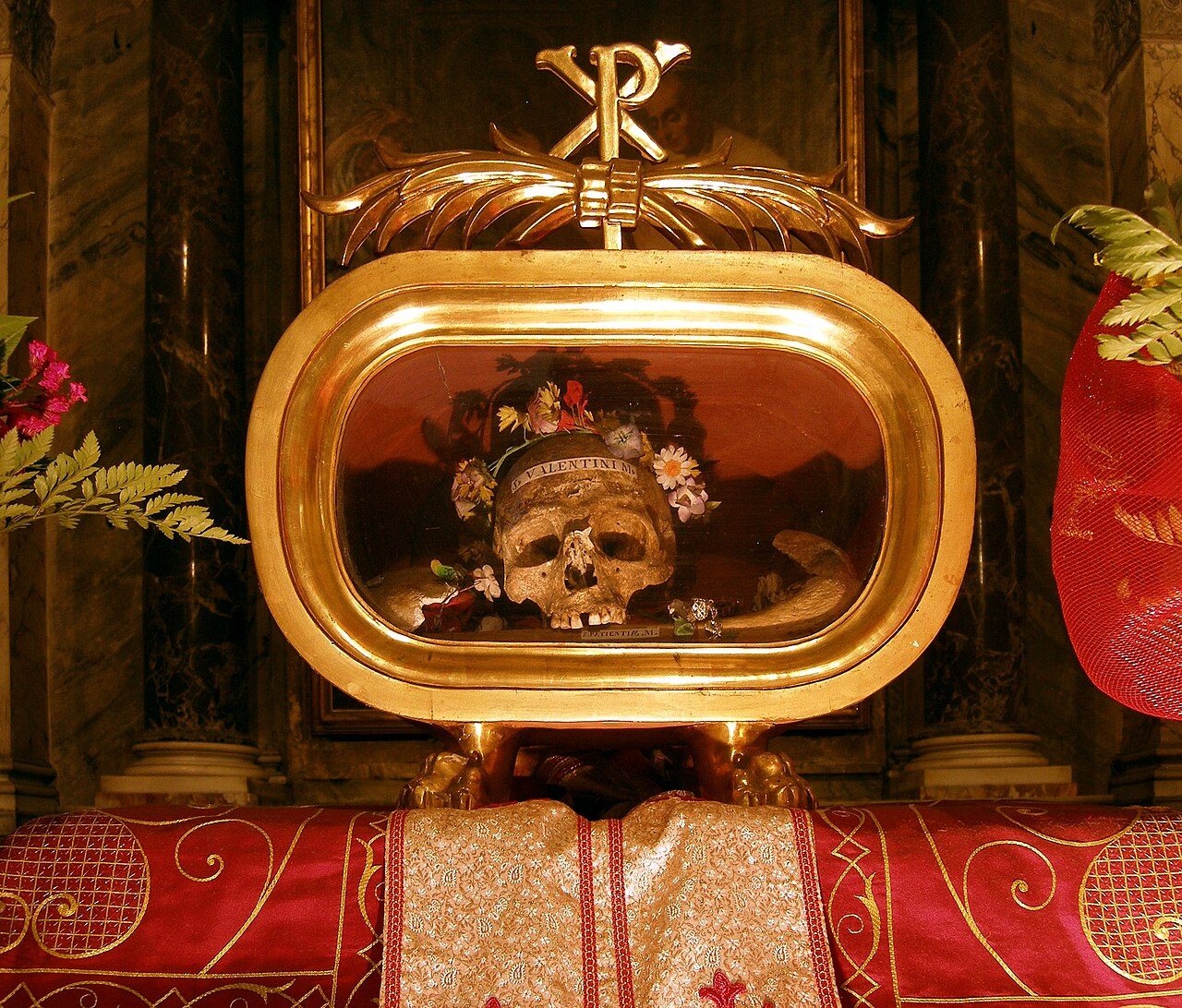
The relics tell the same story: churches across Europe claim fragments of Valentine - a skull crowned with flowers at Santa Maria in Cosmedin in Rome, relics at Whitefriar Street in Dublin, where those seeking love still visit on 14 February. Whether any of them belonged to a third-century martyr cannot be shown; that people have treasured them for centuries can.
His true legacy is the date itself. Every 14 February, hundreds of millions of people exchange tokens of love in the name of a man whose one certain bequest was his name and the day of his death. Few saints have been so thoroughly reinvented. The tradition was never really about the martyr: it was about the date he left behind, waiting in mid-February for poets to give it something to mean.
Sources
- Encyclopaedia Britannica - Valentine's Day
- Catholic Encyclopedia - St. Valentine
- Smithsonian Magazine - The Gory Origins of Valentine's Day
- HISTORY - History of Valentine's Day
The facts on this page were checked against these sources on 19 November 2026. The History Trail's permanent pages are researched and written for this site; the live profiles elsewhere on The History Trail are assembled automatically from Wikipedia and Wikidata.
About the Author
Researched and written by the The History Trail Editorial Team — the accountable editorial function behind this site's permanent story pages. The team works from the published sources cited on each page; it does not invent historians, reviewers or credentials, and it corrects errors openly.
Fact Check
Every load-bearing fact on this page traces to one of the sources listed above, and significant claims link to their source in the text. Our checking method is described on the methodology page; errors can be reported via the corrections page.
Sources & Citations
Cite this page as: The History Trail Editorial Team, The History Trail — this article's title, publication and update dates are shown beneath its headline. The full source list appears under Sources above; the site's source standards are on the sources page.