
People
Saint Nicholas
Saint Nicholas was a fourth-century bishop of Myra whose secret gift of gold dowries to three poor girls made him the patron of children and sailors, the owner of pawnbrokers' three gold balls, and - by way of Dutch Sinterklaas - the ancestor of Santa Claus.
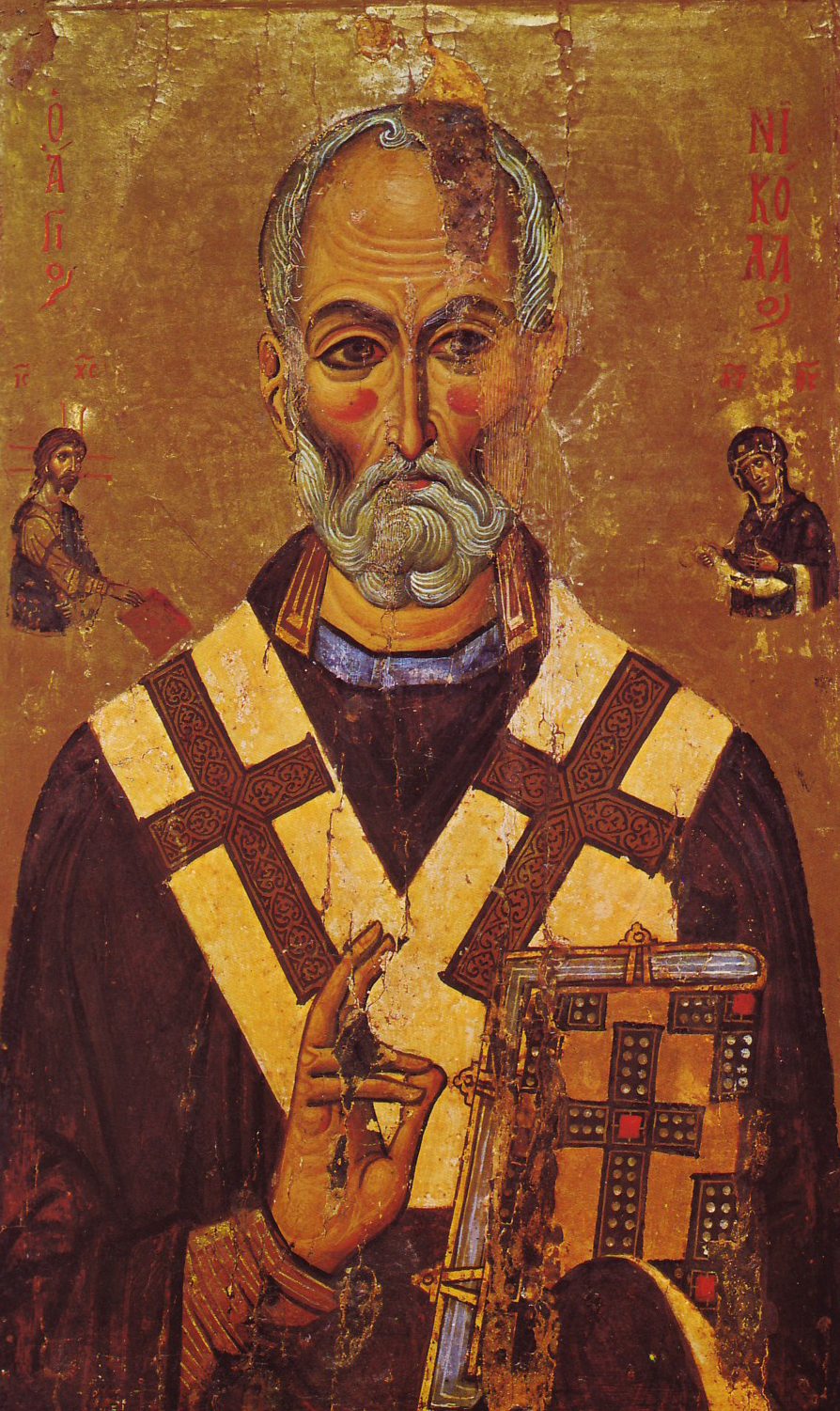
At a Glance
- Who he was
- Bishop of Myra in Lycia (near modern Demre, Turkey), probably in the 4th century; no contemporary document attests his life
- Feast day
- 6 December in Western churches; 19 December in Eastern churches keeping the older calendar
- Famous legend
- He secretly gave bags of gold as dowries for three poor girls - the root of stockings, gift-giving and Santa Claus
- Patron saint of
- Children and sailors above all; also merchants, pawnbrokers, unmarried girls, the falsely accused, Russia and Greece
- His symbol
- Three gold balls - the dowry bags in stylised form, adopted as the pawnbrokers' shop sign
- Relics
- Taken from Myra to Bari, Italy, in 1087; enshrined in the basilica of San Nicola, where they remain
- Survival
- Suppressed across Protestant Europe after the Reformation, he survived in Holland as Sinterklaas - and crossed to America
Introduction
Saint Nicholas is the real man - or as much of a real man as the fourth century allows us to recover - behind Santa Claus. He was, in all probability, bishop of Myra, a port city in Lycia in Asia Minor, near modern Demre in Turkey, sometime in the 300s. Beyond that single fact, almost everything is tradition: Britannica states plainly that his existence is not attested by any historical document, so nothing certain is known of his life except that he was probably bishop of Myra in the fourth century.
And yet this obscure bishop became one of the most popular saints in both the Eastern and Western churches, the patron of children, sailors, merchants and pawnbrokers, the dedicatee of thousands of churches, and the giver whose feast day, 6 December, filled children's shoes and stockings with gifts for a thousand years before Christmas Day took over the job. What the world remembers is not anything Nicholas wrote or ruled, but one act of secret generosity, retold until it founded a custom.
The Bishop of Myra
Tradition fills in the outline: Nicholas was born at Patara, a Lycian seaport, and travelled while young to Palestine and Egypt. He became bishop of Myra soon after returning to Lycia. He was imprisoned, and likely tortured, during the persecution of Christians under the emperor Diocletian, and released under Constantine the Great. He may have attended the first Council of Nicaea in 325, where he allegedly struck the heretic Arius in the face - a story Britannica reports only as allegation, and which belongs to legend.
He was buried in his church at Myra, and by the sixth century his shrine there had become well known; the emperor Justinian I built a church to him at Constantinople as early as that century. In the Middle Ages, devotion to Nicholas extended to all parts of Europe. He became patron saint of Russia and Greece, of charitable fraternities and guilds, of children, sailors, unmarried girls, merchants and pawnbrokers, and of cities from Fribourg to Moscow. His miracles were a favourite subject for medieval artists and plays.
The Dowry Legend
The legend that made him immortal is the dowry story. A poor man had three daughters and no money for their marriage dowries; without dowries they could not marry, and poverty threatened them with lives of prostitution, in Britannica's blunt summary. Nicholas, hearing of their plight and unwilling to give openly, came by night and gave gold in secret - in the fullest tellings, a bag of gold for each daughter on three successive nights, thrown through a window or dropped down the chimney, the last time into a stocking or shoe left by the fire to dry. The father, watching on the third night, caught and thanked his benefactor, who asked only that the gift stay secret.
Every element of later Christmas giving is already inside that tale: the night visit, the chimney, the stocking hung to dry, the gift that must not be thanked. The three bags were drawn by artists as three purses, three coins or three golden balls - and pawnbrokers and bankers, who took Nicholas as their patron, adopted the three gold balls as their shop sign, where they hung over pawnshops for centuries - his gold had redeemed three lives, as a pawnbroker redeems what is pledged.
Timeline
- c. 270 (traditional)
Nicholas is born at Patara in Lycia, according to tradition, not documents.
- 4th century
Nicholas serves as bishop of Myra, near modern Demre, Turkey - the one fact historians treat as probable.
- Early 4th century (tradition)
Tradition holds that Nicholas was imprisoned during Diocletian's persecution of Christians and released under Constantine.
- 325 (tradition)
Nicholas is said to have attended the Council of Nicaea and struck the heretic Arius - reported as allegation, not record.
- 6 December
Nicholas's feast day, traditionally the date of his death (often given as 343); children receive gifts on it across Europe.
- 6th century
His shrine at Myra is famous; Justinian I builds him a church at Constantinople.
- 1087
Italian sailors or merchants take his alleged remains from Myra to Bari; Bari becomes a great pilgrimage centre.
- Middle Ages
Nicholas becomes patron of children, sailors, merchants, pawnbrokers, Russia and Greece; thousands of churches bear his name.
- 16th century
After the Reformation, devotion to Nicholas disappears in Protestant Europe - except in Holland, where he survives as Sinterklaas.
- 17th century
Dutch colonists carry Sinterklaas to New Amsterdam (now New York City); the name becomes Santa Claus in English-speaking America.
- 2017
Researchers date a relic fragment of bone held in the United States and confirm it is from the 4th century, consistent with Nicholas's era.
Significance
Nicholas's significance is out of all proportion to his documentation, and that is itself the point. Medieval Europe did not need a biography; it needed a patron for everyone the world left unprotected - children, sailors in storms, girls without dowries, the falsely accused, merchants far from home. Nicholas, remembered as the bishop who gave in secret and defended the weak, accumulated those patronages one guild and one port at a time, until he was, as Britannica puts it, one of the most popular minor saints in both halves of Christendom.
His relics extended his reach. When sailors or merchants from Bari took his remains from Myra in 1087, the removal greatly increased his popularity in Europe and made Bari one of the most crowded pilgrimage centres of the age; the relics remain in the eleventh-century basilica of San Nicola there, and the sweet-smelling liquid reported from the tomb, the "manna of St. Nicholas," has been distributed to pilgrims ever since.
Myths and disputes
Was there really a Nicholas? Probably - but the honest answer begins with how thin the record is. No document from his lifetime names him; the earliest accounts were written centuries after his death. The traditional dates - born about 270, died 6 December 343 - are exactly that: traditional. The imprisonment under Diocletian, the journey to Egypt and Palestine, and the slap at Nicaea all come from those later lives, and a responsible account labels them as tradition, as this page does.
The dowry story is legend too, however old and beloved. It is told with bags, balls, bars or coins of gold, through a window or down a chimney, and no version can be traced to Nicholas's own century. What can be traced is its effect: it is the documented origin of secret gift-giving on his feast, of the three gold balls of the pawnbrokers, of stockings and shoes left out at night, and ultimately of Santa Claus himself. The legend is not evidence about the bishop; it is evidence about what generations of ordinary people valued - generosity that refuses an audience.
Even his relics carry a question mark that the sources keep visible: Britannica calls the remains taken to Bari in 1087 his "alleged" remains. The 2017 dating of a hip-bone fragment to the fourth century shows that at least one venerated fragment is the right age; it cannot show whose bone it was.
Legacy
Nicholas's legacy runs on two tracks. On 6 December - 19 December in Eastern churches that keep the older calendar - St. Nicholas Day is still kept across the Netherlands, Belgium, Germany and much of Europe: Sinterklaas arrives, children leave out shoes, and the bishop, not his American descendant, does the giving. The Dutch survival is remarkable because the Reformation abolished his cult almost everywhere else in Protestant Europe; Holland alone kept him, and Holland exported him.
The second track is the transformation. Carried to New Amsterdam in the seventeenth century and adopted by the English-speaking majority, Sinterklaas became Santa Claus, and the feast-day bishop of 6 December became the Christmas Eve gift-bringer of 25 December. The mitre became a fur cap, the crozier vanished, but the essentials of the dowry legend - the secret night visit, the gift for children, the giver who must not be seen - survived the crossing intact. Every Santa Claus is, at one remove, a fourth-century bishop of Myra still giving his gold away in the dark.
Sources
- Encyclopaedia Britannica - St. Nicholas
- St. Nicholas Center - Patron Saint of Pawnbrokers and Others
- Encyclopaedia Britannica - Santa Claus
- Smithsonian Magazine - The Legend of the Christmas Stocking
The facts on this page were checked against these sources on 19 November 2026. The History Trail's permanent pages are researched and written for this site; the live profiles elsewhere on The History Trail are assembled automatically from Wikipedia and Wikidata.
About the Author
Researched and written by the The History Trail Editorial Team — the accountable editorial function behind this site's permanent story pages. The team works from the published sources cited on each page; it does not invent historians, reviewers or credentials, and it corrects errors openly.
Fact Check
Every load-bearing fact on this page traces to one of the sources listed above, and significant claims link to their source in the text. Our checking method is described on the methodology page; errors can be reported via the corrections page.
Sources & Citations
Cite this page as: The History Trail Editorial Team, The History Trail — this article's title, publication and update dates are shown beneath its headline. The full source list appears under Sources above; the site's source standards are on the sources page.