
People
Muhammad Ali
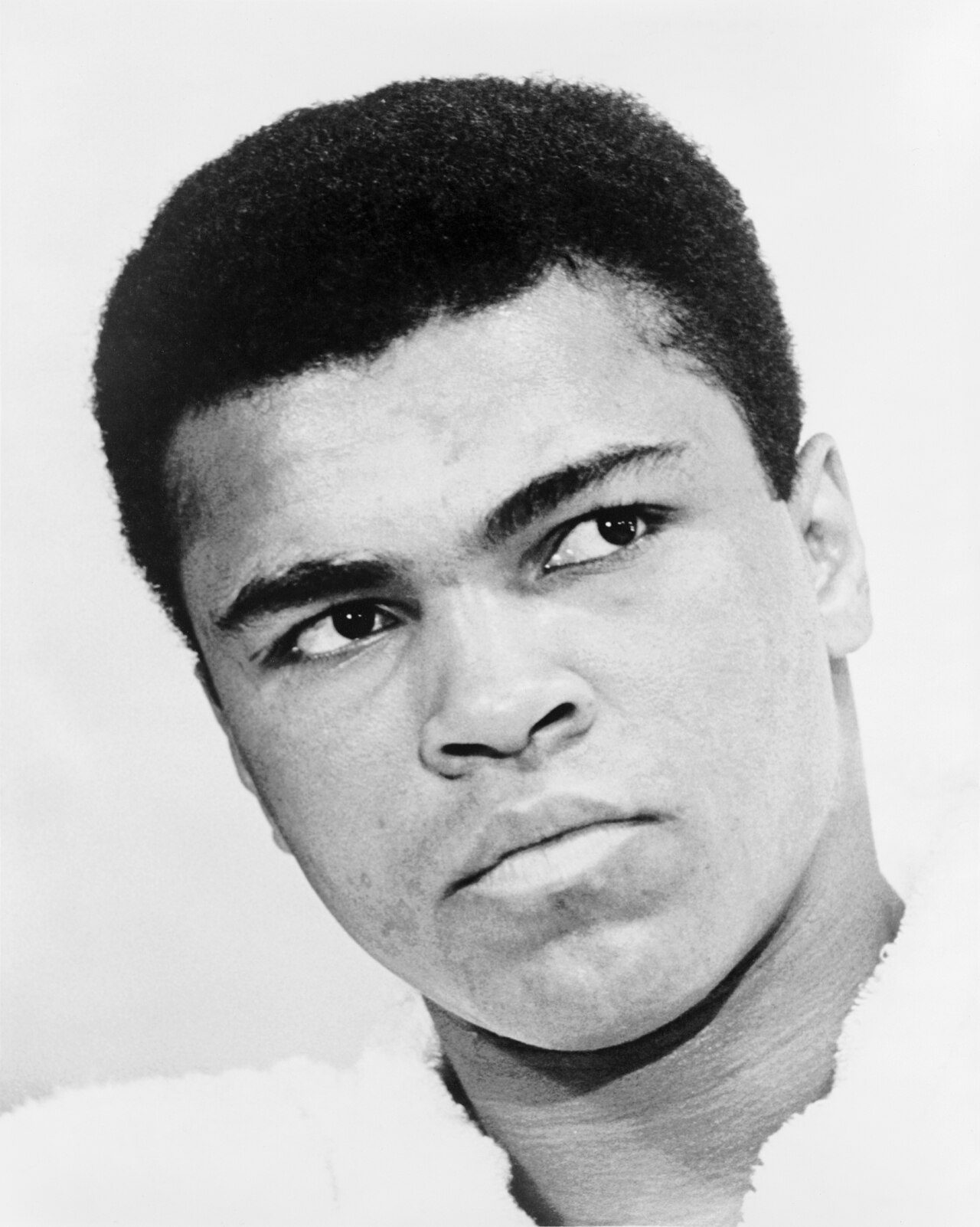
Muhammad Ali, born Cassius Clay in Louisville on 17 January 1942, was the first boxer to win the world heavyweight championship three times. He lost his title and licence in 1967 for refusing induction into the Vietnam War, was vindicated by the Supreme Court in 1971, and lit the Olympic flame at Atlanta in 1996. He died on 3 June 2016.
At a Glance
- Born
- Cassius Marcellus Clay Jr., 17 January 1942, Louisville, Kentucky
- Olympic gold
- Light-heavyweight, Rome 1960, aged 18
- First world title
- Beat Sonny Liston, 25 February 1964; took the name Muhammad Ali on 6 March 1964
- The exile
- Refused Vietnam induction 28 April 1967; stripped of title and licence for three and a half years; conviction overturned unanimously by the Supreme Court in 1971
- Signature wins
- Rumble in the Jungle v. Foreman, Kinshasa, 30 October 1974; Thrilla in Manila v. Frazier, 1 October 1975
- Record
- 56 wins, 5 losses, 37 knockouts; first man to win the heavyweight title three times; final fight December 1981
- Died
- 3 June 2016, Scottsdale, Arizona, aged 74
Introduction
Muhammad Ali was born Cassius Marcellus Clay Jr. on 17 January 1942 in Louisville, Kentucky, and died on 3 June 2016 in Scottsdale, Arizona. Between those dates he became the most famous athlete on earth: Olympic champion at 18, world heavyweight champion at 22, exiled from boxing for refusing to fight in Vietnam, then champion twice more - the first man to win the heavyweight crown three times. On 17 January 2027 the world marks 85 years since his birth.
Ali's fame was never only about boxing. He changed his name as an act of faith and defiance, talked in rhyme, predicted his knockout rounds, and told a segregated America he was the greatest at exactly the moment it least wanted to hear it. The price he paid for his principles is a large part of why the fame lasted.
Louisville, a stolen bicycle and Rome 1960
Clay grew up in the segregated South; his father painted billboards and signs, his mother worked as a household domestic. He took up boxing at 12 after his bicycle was stolen - a Louisville policeman, Joe Martin, suggested he learn to fight first - and rose fast with an unorthodox style: hands low, leaning back from punches, dancing on his toes. At the 1960 Olympic Games in Rome, aged 18, he won the light-heavyweight gold medal, beating Poland's Zbigniew Pietrzykowski in the final, and turned professional that autumn.
As a professional he was at first rated more for his mouth than his hands: he composed poems about his opponents, called the round in which they would fall, and announced that he floated like a butterfly and stung like a bee. The sceptics stopped laughing on 25 February 1964, when the 22-year-old Clay, a heavy underdog, made the fearsome champion Sonny Liston quit on his stool after six rounds and took the world heavyweight title. Two days later he announced his conversion to Islam, and on 6 March 1964 Elijah Muhammad, leader of the Nation of Islam, gave him the name Muhammad Ali.
Exile: the stand that cost him his prime
Ali dominated the division for three years, defending the title nine times. Then, on 28 April 1967, at the height of the Vietnam War, he reported for induction into the U.S. Army in Houston - and refused to step forward, citing his religious beliefs: he had, as he put it a year earlier, no quarrel with the Viet Cong. He was stripped of his championship and banned by every state athletic commission; on 20 June 1967 he was convicted of draft evasion and sentenced to five years in prison. He stayed free on bail while he appealed, but for three and a half years, from 25 to nearly 29 - a boxer's peak - he could not legally fight.
The vindication came in stages. In October 1970 Georgia, which had no state boxing commission, let him return, and he stopped Jerry Quarry in Atlanta. In March 1971 he lost his first fight, the Fight of the Century against Joe Frazier. Then, on 28 June 1971, the U.S. Supreme Court unanimously overturned his conviction in Clay v. United States, ruling that his conscientious-objector claim had been wrongly denied a proper hearing. Ali never went to prison, and the stand that had made him a pariah increasingly made him a hero as the war fell out of favour.
Rumble, Thrilla and the third crown
The second Ali was slower of foot but craftier. After beating Frazier in a 1974 rematch, he went to Kinshasa, Zaire, on 30 October 1974 to challenge the undefeated champion George Foreman - the Rumble in the Jungle. Ali spent long stretches leaning on the ropes, absorbing the champion's heaviest punches - the rope-a-dope - and when Foreman was spent, knocked him out in the eighth round to regain the title at 32. A year later, on 1 October 1975, came the Thrilla in Manila, the third Frazier fight: fourteen brutal rounds that ended when Frazier's corner stopped it, a fight many still call the greatest heavyweight bout ever fought.
In February 1978 Ali lost the title to Leon Spinks, a novice with seven professional fights, and seven months later beat Spinks in the rematch to become champion for the third time - a first in heavyweight history. He retired in 1979, returned unwisely, and was beaten by Larry Holmes in 1980 and by Trevor Berbick in December 1981, his final fight. His record stood at 56 wins, 5 losses, 37 knockouts.
Timeline
- 17 January 1942
Cassius Marcellus Clay Jr. is born in Louisville, Kentucky.
- September 1960
Aged 18, Clay wins light-heavyweight gold at the Rome Olympics.
- 25 February 1964
Clay stuns champion Sonny Liston in Miami Beach to win the world heavyweight title.
- 6 March 1964
Having embraced the Nation of Islam, he takes the name Muhammad Ali.
- 28 April 1967
Ali refuses induction into the U.S. Army in Houston, citing his religious beliefs; he is stripped of his title and licence.
- 20 June 1967
He is convicted of draft evasion and sentenced to five years, remaining free on bail while appealing.
- 28 June 1971
The U.S. Supreme Court unanimously overturns his conviction in Clay v. United States.
- 30 October 1974
The Rumble in the Jungle: Ali knocks out George Foreman in the eighth round in Kinshasa, Zaire, regaining the title.
- 1 October 1975
The Thrilla in Manila: Ali beats Joe Frazier when Frazier's corner stops the fight after 14 rounds.
- September 1978
Ali beats Leon Spinks in their rematch to win the title for a record third time; his final fight follows in December 1981.
- 19 July 1996
Ali, trembling with Parkinson's, lights the Olympic flame at the Atlanta Games, 36 years after his Rome gold.
- 3 June 2016
Ali dies in Scottsdale, Arizona, aged 74; his funeral in Louisville draws mourners worldwide.
Significance
Inside the ring, Ali rewrote what a heavyweight could be: a tall man who danced for fifteen rounds, jabbed moving backwards, and won with speed, reflexes and an extraordinary ability to absorb punishment. His three fights with Frazier and the Foreman fight in Zaire remain the standard for boxing spectacles, and his three separate reigns place him among the greatest fighters who ever lived.
Outside it, he was bigger still. Ali fused sport with Black pride, religious identity and anti-war dissent at a moment when athletes were expected to be grateful and silent, and he accepted the destruction of his career rather than recant. As public opinion turned against the Vietnam War, the pariah became a prophet. His example - that an athlete could speak, refuse, and be vindicated - reshaped every generation of sports stars after him.
Myths and disputes
The most retold Ali story is also the least certain. In his 1975 autobiography Ali said that after Rome he threw his Olympic gold medal into the Ohio River, disgusted at being refused service in a segregated Louisville restaurant. Later accounts suggest the medal was simply lost, and Ali gave shifting versions. The honest summary is that the medal disappeared, the river story may be embroidered, and the IOC presented him with a replacement during the 1996 Atlanta Games.
His Parkinson's diagnosis (1984) is often flatly attributed to boxing. Britannica notes that the doctors who treated him stated his symptoms were those of Parkinson disease and differed from the injury-induced intellectual deficits of chronic traumatic encephalopathy. The tremor advanced for three decades; at Atlanta in 1996 he steadied a shaking hand to light the flame, knowing exactly what the world would see.
Legacy
Retirement turned Ali into a travelling statesman: he delivered food and medicine abroad, was named a United Nations Messenger of Peace in 1998, and in November 2005 received the Presidential Medal of Freedom and saw the Muhammad Ali Center open in Louisville. When he died on 3 June 2016, his Louisville funeral - planned by Ali himself as an open, interfaith service - was a global event.
He had called himself the Greatest as a boast; the obituaries agreed as a judgement. The 85th anniversary of his birth, on 17 January 2027, finds his reputation still growing: the champion who lost everything for a belief and won it all back is now the reference point whenever sport and conscience collide.
Sources
- Encyclopaedia Britannica - Muhammad Ali
- Muhammad Ali Center - Muhammad Ali: An Olympic Life
- U.S. Olympic & Paralympic Museum - Muhammad Ali
- Muhammad Ali Center - Biography
- National Museum of African American History and Culture, Smithsonian Institution - Ali vs. Terrell, The Astrodome, Houston, 1967
- BlackPast - Muhammad Ali (1942-2016)
The facts on this page were checked against these sources on 19 November 2026. The History Trail's permanent pages are researched and written for this site; the live profiles elsewhere on The History Trail are assembled automatically from Wikipedia and Wikidata.
About the Author
Researched and written by the The History Trail Editorial Team — the accountable editorial function behind this site's permanent story pages. The team works from the published sources cited on each page; it does not invent historians, reviewers or credentials, and it corrects errors openly.
Fact Check
Every load-bearing fact on this page traces to one of the sources listed above, and significant claims link to their source in the text. Our checking method is described on the methodology page; errors can be reported via the corrections page.
Sources & Citations
Cite this page as: The History Trail Editorial Team, The History Trail — this article's title, publication and update dates are shown beneath its headline. The full source list appears under Sources above; the site's source standards are on the sources page.