
People
Abraham Lincoln
Abraham Lincoln (1809-1865), the sixteenth president of the United States, was shot by John Wilkes Booth at Ford's Theatre in Washington on the evening of Good Friday, 14 April 1865, and died the next morning, 15 April. The self-educated frontier lawyer who had led the Union through the Civil War and issued the Emancipation Proclamation was killed five days after the Confederate surrender at Appomattox.
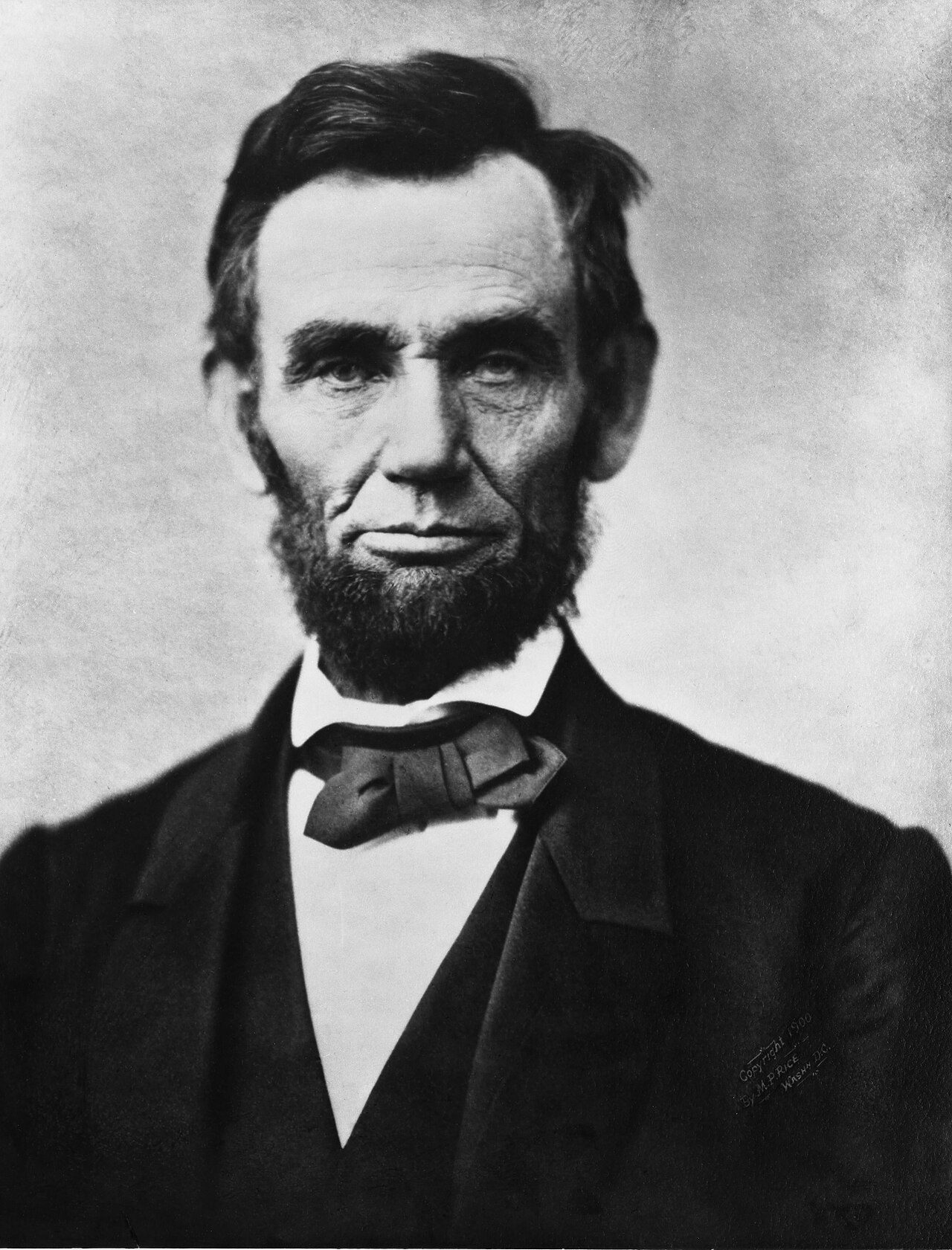
At a Glance
- Born
- 12 February 1809, near Hodgenville, Kentucky, United States
- Died
- 15 April 1865, Washington, D.C., aged 56 - shot the previous evening at Ford's Theatre
- Office
- 16th president of the United States, 4 March 1861 to 15 April 1865
- Before the presidency
- Self-educated Springfield lawyer; four terms in the Illinois legislature; United States representative, 1847-1849
- Emancipation
- Emancipation Proclamation issued 1 January 1863; championed the Thirteenth Amendment, passed by Congress in January 1865
- The speeches
- Gettysburg Address, 19 November 1863; Second Inaugural Address, 4 March 1865
- Assassination
- Shot by the actor John Wilkes Booth, a Confederate sympathiser, during Our American Cousin at Ford's Theatre on Good Friday, 14 April 1865
Introduction
Lincoln was born on 12 February 1809 in a one-room log cabin near Hodgenville, Kentucky, the son of Thomas and Nancy Hanks Lincoln. The family moved to Indiana in 1816 and to Illinois in 1830, and his formal schooling, by his own later account, amounted to less than a year in total. He educated himself: borrowed books, and, decisively, law books read while he worked as a store clerk, postmaster and surveyor in the village of New Salem.
From that self-education came a Springfield law practice, four terms in the Illinois legislature, a single term in Congress, and a national reputation won in defeat. The presidency consumed him: four years of civil war, the transformation of that war into a war against slavery, and two of the greatest speeches in the language. He was killed five days after Lee's surrender at Appomattox, and the mourning that followed made him the central martyr of American public life.
Frontier, Law and the Illinois Legislature
Lincoln's mother died in 1818, when he was nine; his father remarried, and Lincoln credited his stepmother, Sarah Bush Lincoln, with encouraging his reading. In New Salem from 1831 he tried storekeeping, served as a militia captain in the Black Hawk War, and lost his first election in 1832. He won in 1834 and served four terms in the Illinois legislature, helping to move the state capital to Springfield.
In Springfield from 1837 he built the career that made everything else possible. Licensed in 1836, he rode the Eighth Judicial Circuit for months each year, and the National Park Service's Lincoln Home history calls him one of the most successful and sought-after attorneys in the state. He married Mary Todd in 1842 and in 1844 bought the Springfield house - the only home he ever owned - now the Lincoln Home National Historic Site. Elected to Congress in 1846, he served one term, 1847 to 1849, opposing the Mexican-American War, and then returned to the law.
The Debates, the Election and the War
The Kansas-Nebraska Act of 1854, which reopened the territories to slavery, returned Lincoln to politics. In 1858 he ran for the Senate against Stephen A. Douglas, and their seven debates across Illinois made him a national figure even though Douglas kept the seat. In 1860 the Republicans nominated Lincoln for president; he won that November with a minority of the popular vote but a clear electoral majority, and Southern states began seceding before he took office on 4 March 1861.
The Civil War began at Fort Sumter in April 1861. Lincoln's war leadership was managerial as much as military: he held together a cabinet of rivals, sustained Northern opinion through years of casualties, and cycled through generals until, in March 1864, he gave Ulysses S. Grant command of all the Union armies. His stated first object was the preservation of the Union; emancipation entered as a war measure and became, in his hands, the war's meaning. He issued a preliminary Emancipation Proclamation on 22 September 1862, after Antietam, and the final Proclamation on 1 January 1863, and he pressed Congress to pass the Thirteenth Amendment abolishing slavery, which it did in January 1865.
Timeline
- 12 February 1809
Abraham Lincoln is born near Hodgenville, Kentucky, in a one-room log cabin.
- 1830
The Lincoln family settles in Illinois; Abraham strikes out on his own the following year at New Salem.
- 1834
Elected to the Illinois legislature, the first of four terms; he begins studying law.
- 1836-1837
Licensed as a lawyer and moves to Springfield, which he helped make the state capital.
- 1847-1849
Serves a single term in the United States House of Representatives.
- 1858
The seven Lincoln-Douglas debates make him nationally known, though Douglas keeps the Senate seat.
- 6 November 1860
Elected sixteenth president of the United States.
- 1 January 1863
The Emancipation Proclamation takes effect, declaring enslaved people in the rebellious states free and opening Union service to Black men.
- 19 November 1863
Delivers the Gettysburg Address at the dedication of the soldiers' cemetery at Gettysburg.
- 8 November 1864
Re-elected president, defeating George B. McClellan.
- 4 March 1865
Delivers his Second Inaugural Address, calling for reconciliation as the war nears its end.
- 9 April 1865
Lee surrenders at Appomattox; the Civil War is effectively over.
- 14-15 April 1865
Shot by John Wilkes Booth at Ford's Theatre on Good Friday evening; dies at the Petersen House at 7:22 the next morning, aged 56.
Gettysburg and the Second Inaugural
On 19 November 1863 Lincoln dedicated the cemetery at Gettysburg, where the war's bloodiest battle had been fought that July. Edward Everett, the day's principal orator, spoke for two hours; Lincoln spoke for about two minutes. The Address he delivered - some 272 words in its best-known version - recast the war as a test of whether a nation dedicated to the proposition that all men are created equal could endure, and it closed with the resolve, in the words the National Archives preserves, 'that government of the people, by the people, for the people, shall not perish from the earth'. Five manuscript copies in Lincoln's hand survive, two of them held by the Library of Congress.
His Second Inaugural, delivered on 4 March 1865 with victory in sight, refused triumphalism: it treated slavery as an offence for which the war might be a shared national judgement, and looked toward binding up the nation's wounds. Inscribed on the Lincoln Memorial, it is often read as his political testament.
Significance
Lincoln preserved the Union through its bloodiest war and, in doing so, changed what the Union was. The Emancipation Proclamation did not by itself end slavery - it applied to the rebellious states, exempted the loyal border states, and rested on his war powers - but, as the National Archives puts it, it placed abolition squarely at the top of the wartime agenda, opened the Union Army and Navy to Black enlistment, and made every Union advance an advance of freedom. The Thirteenth Amendment, which Lincoln championed and which was ratified after his death in December 1865, completed in constitutional law what the Proclamation had begun as a war measure. Britannica's verdict, that he preserved the Union and brought about the emancipation of enslaved people in the United States, is the standard summary because the record supports it.
Myths and disputes
'Honest Abe' is a nickname with a real career behind it - Lincoln's reputation for square dealing as a store clerk and lawyer was remarked on by contemporaries - but the famous anecdotes attached to it, of the young clerk walking miles to return a few cents of overchange or to deliver forgotten tea, come from later reminiscence and biography rather than contemporary documents. They are best read as evidence of the reputation, not as transcripts of events. The same caution applies to the log-cabin imagery of the 1860 campaign, true in outline and polished in presentation.
The envelope story, by contrast, can be positively disproved. Lincoln did not dash off the Gettysburg Address on the back of an envelope on the train to Gettysburg, a tale popularised by Mary Raymond Shipman Andrews's 1906 story The Perfect Tribute. The surviving drafts tell the real story: the earliest copies, the Nicolay and Hay manuscripts now at the Library of Congress, show a text begun in Washington on executive stationery and revised at Gettysburg, and Lincoln wrote out three further copies afterwards. The Address was not improvised; it was drafted, revised and re-copied - which is precisely why its wording can be studied at all. Even so, scholars note that the five copies differ in small details, and that the phrase 'under God', absent from the two earliest drafts, appears in the later ones and in newspaper reports of the speech as delivered.
Legacy
Lincoln's funeral train carried his body from Washington to Springfield through a country in public mourning, and his tomb and the Lincoln Memorial remain places of pilgrimage. His legacy is textual as much as political: the Gettysburg Address and the Second Inaugural are memorised, carved in stone and quoted wherever democratic government is defended, and his papers, at the Library of Congress, are among the most studied of any president's. The manner of his death, at the moment of victory, fixed him in national memory.
Sources
- National Archives - The People's Vote: 100 Documents That Shaped America (Gettysburg Address and Emancipation Proclamation)
- National Park Service, Ford's Theatre National Historic Site - FAQ: The Assassination
- National Park Service, Lincoln Home National Historic Site - Life of Lincoln
- Smithsonian National Portrait Gallery - Abraham Lincoln (1809-1865)
- Encyclopaedia Britannica - Abraham Lincoln
- American Battlefield Trust - Versions of the Gettysburg Address
- National Archives, Clinton White House - Abraham Lincoln, Sixteenth President 1861-1865
The facts on this page were checked against these sources on 19 November 2026. The History Trail's permanent pages are researched and written for this site; the live profiles elsewhere on The History Trail are assembled automatically from Wikipedia and Wikidata.
About the Author
Researched and written by the The History Trail Editorial Team — the accountable editorial function behind this site's permanent story pages. The team works from the published sources cited on each page; it does not invent historians, reviewers or credentials, and it corrects errors openly.
Fact Check
Every load-bearing fact on this page traces to one of the sources listed above, and significant claims link to their source in the text. Our checking method is described on the methodology page; errors can be reported via the corrections page.
Sources & Citations
Cite this page as: The History Trail Editorial Team, The History Trail — this article's title, publication and update dates are shown beneath its headline. The full source list appears under Sources above; the site's source standards are on the sources page.