
On This Day
May 23 in History
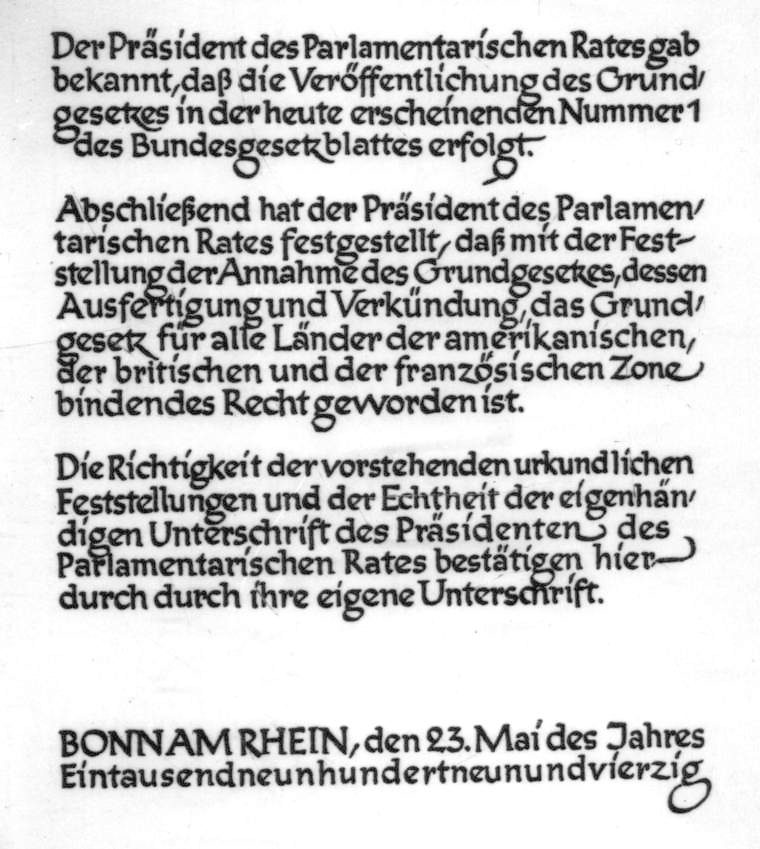
May 23 is the birthday of modern Germany. On this day in 1949 the Basic Law was signed and proclaimed in Bonn, bringing the Federal Republic of Germany, known as West Germany, into existence four years after the Second World War. The document was meant to be temporary, a placeholder until Germany could be reunited; instead it became one of the most durable and admired constitutions in the world. The date also saw the Defenestration of Prague in 1618, the hanging of Captain Kidd in 1701 and the deaths of Bonnie and Clyde in 1934.
Choose another date: open the On This Day calendar to browse events, births and deaths for any day of the year.
At a Glance
- Date
- 23 May 1949
- Place
- Bonn
- Document
- The Basic Law (Grundgesetz)
- Drafted by
- The Parliamentary Council, 65 members
- Proclaimed by
- Konrad Adenauer, president of the Parliamentary Council
- First Chancellor
- Konrad Adenauer, from September 1949
Events on this day
- 1430Joan of Arc is captured by Burgundian forces at Compiegne and later handed over to the English.
- 1618Protestant nobles throw two imperial officials from a window of Prague Castle in the Defenestration of Prague, igniting the Thirty Years' War.
- 1701Captain William Kidd is hanged at Execution Dock in London after being convicted of piracy and murder.
- 1785Benjamin Franklin describes his invention of bifocal glasses in a letter, the earliest clear evidence of the design.
- 1900Sergeant William Harvey Carney receives the Medal of Honor for protecting the US flag at Fort Wagner, the first Black American to earn it.
- 1903Horatio Nelson Jackson and Sewall Crocker set out from San Francisco on the first transcontinental automobile trip, reaching New York in just over 63 days.
- 1911The New York Public Library is dedicated in a ceremony presided over by President William Howard Taft.
- 1915Italy declares war on Austria-Hungary and enters the First World War on the Allied side.
- 1934Outlaws Bonnie Parker and Clyde Barrow are shot dead by police near Gibsland, Louisiana, ending a 21-month crime spree.
- 1949The Federal Republic of Germany is formally established as the Basic Law is proclaimed in Bonn — the featured story above.
- 1980Stanley Kubrick's horror film The Shining opens in cinemas.
- 2015Ireland votes to legalise same-sex marriage, becoming the first country to do so by popular referendum.
Born on this day
- 1650John Churchill, 1st Duke of Marlborough — English general who won the great victories of the War of the Spanish Succession
- 1707Carolus Linnaeus — Swedish botanist who created the modern system of naming living organisms
- 1883Douglas Fairbanks — American silent-film star famous for his swashbuckling adventure roles
- 1933Joan Collins — English actress best known for playing Alexis Carrington in the television series Dynasty
- 1958Drew Carey — American comedian and host of The Price Is Right and Whose Line Is It Anyway?
- 1974Jewel — American singer-songwriter whose debut album Pieces of You became a folk-pop landmark
Died on this day
- 1701William Kidd — Scottish privateer turned pirate, hanged at Execution Dock in London
- 1934Bonnie Parker — American outlaw killed alongside Clyde Barrow in a police ambush in Louisiana
- 1934Clyde Barrow — American outlaw whose crime spree with Bonnie Parker captivated Depression-era America
- 1945Heinrich Himmler — head of the Nazi SS, who killed himself with a cyanide capsule a day after being captured by British troops
- 2015John Nash — American mathematician and Nobel laureate whose life inspired the film A Beautiful Mind; killed in a car crash
The featured story: A new German state is born, 23 May 1949
When the Second World War ended in 1945, Germany was divided into four occupation zones administered by the United States, Britain, France and the Soviet Union. As relations between East and West collapsed, the three western zones were drawn together, and in September 1948 a Parliamentary Council of 65 members, delegates chosen by the German state parliaments, convened in Bonn to write a constitution for a new western German state. Because the country was divided, they deliberately called their text not a constitution but a Basic Law, a provisional framework meant to last only until reunification.
The Council adopted the Basic Law on 8 May 1949. The Allied military governors gave their approval, and between 16 and 22 May the state parliaments voted to ratify it. Every Land approved except Bavaria, whose parliament voted against the text, while accepting that it would still take effect if two-thirds of the other states agreed, as they had. The stage was set for the formal act of foundation.
On 23 May 1949, in a ceremony in Bonn accompanied by music from Handel and broadcast by radio, the Parliamentary Council established that the Basic Law had been duly ratified, and its president, Konrad Adenauer, signed and proclaimed it. The first edition of the Federal Law Gazette, carrying the text, was dated the same day. At the end of 23 May the Basic Law came into force, and the Federal Republic of Germany had entered history, as Adenauer put it that day. Elections followed in August, and in September Adenauer became the republic's first Chancellor. In October the Soviet zone responded by founding the German Democratic Republic in the east.
The provisional document outlasted every expectation. The Basic Law anchored West Germany's transformation into a stable, prosperous democracy, and when Germany reunified in 1990 the eastern states simply joined the Federal Republic under its terms. The temporary constitution of 1949, drafted in a borrowed academy building in Bonn, remains the constitution of Germany today.
Why this date matters
May 23 is a date of foundings and flashpoints. A constitution proclaimed in Bonn in 1949 gave Germany its modern shape, while three centuries earlier officials thrown from a Prague window in 1618 lit the fuse of the Thirty Years' War. It is also a day of endings delivered by rope and bullet: Captain Kidd hanged in London, Bonnie and Clyde ambushed in Louisiana, Himmler dead by his own hand in British custody. In between come quieter milestones of the modern world, a public library dedicated in New York, a first drive across America, and Ireland's marriage referendum, the first of its kind anywhere.
Sources
- Encyclopaedia Britannica — On This Day: May 23
- HISTORY — This Day in History: May 23
- US Department of State, Office of the Historian — Foreign Relations of the United States, 1949, Vol. III
- City of Bonn — 75 Years of the Basic Law: Historical Introduction
The facts on this page were checked against these sources on 19 November 2026. The History Trail's permanent pages are researched and written for this site; the live profiles elsewhere on The History Trail are assembled automatically from Wikipedia and Wikidata.
About the Author
Researched and written by the The History Trail Editorial Team — the accountable editorial function behind this site's permanent story pages. The team works from the published sources cited on each page; it does not invent historians, reviewers or credentials, and it corrects errors openly.
Fact Check
Every load-bearing fact on this page traces to one of the sources listed above, and significant claims link to their source in the text. Our checking method is described on the methodology page; errors can be reported via the corrections page.
Sources & Citations
Cite this page as: The History Trail Editorial Team, The History Trail — this article's title, publication and update dates are shown beneath its headline. The full source list appears under Sources above; the site's source standards are on the sources page.