
On This Day
May 24 in History
May 24 is the day New York walked across the East River. On this day in 1883 the Brooklyn Bridge opened after 14 years of construction that cost 27 lives, including its designer's. The world's first steel-wire suspension bridge, with the longest span on Earth, it joined New York and Brooklyn into the path of a single great city. The date also brought Samuel Morse's telegraph demonstration in 1844, the birth of Queen Victoria in 1819 and the Judgment of Paris wine tasting that humbled French wine in 1976.
Choose another date: open the On This Day calendar to browse events, births and deaths for any day of the year.
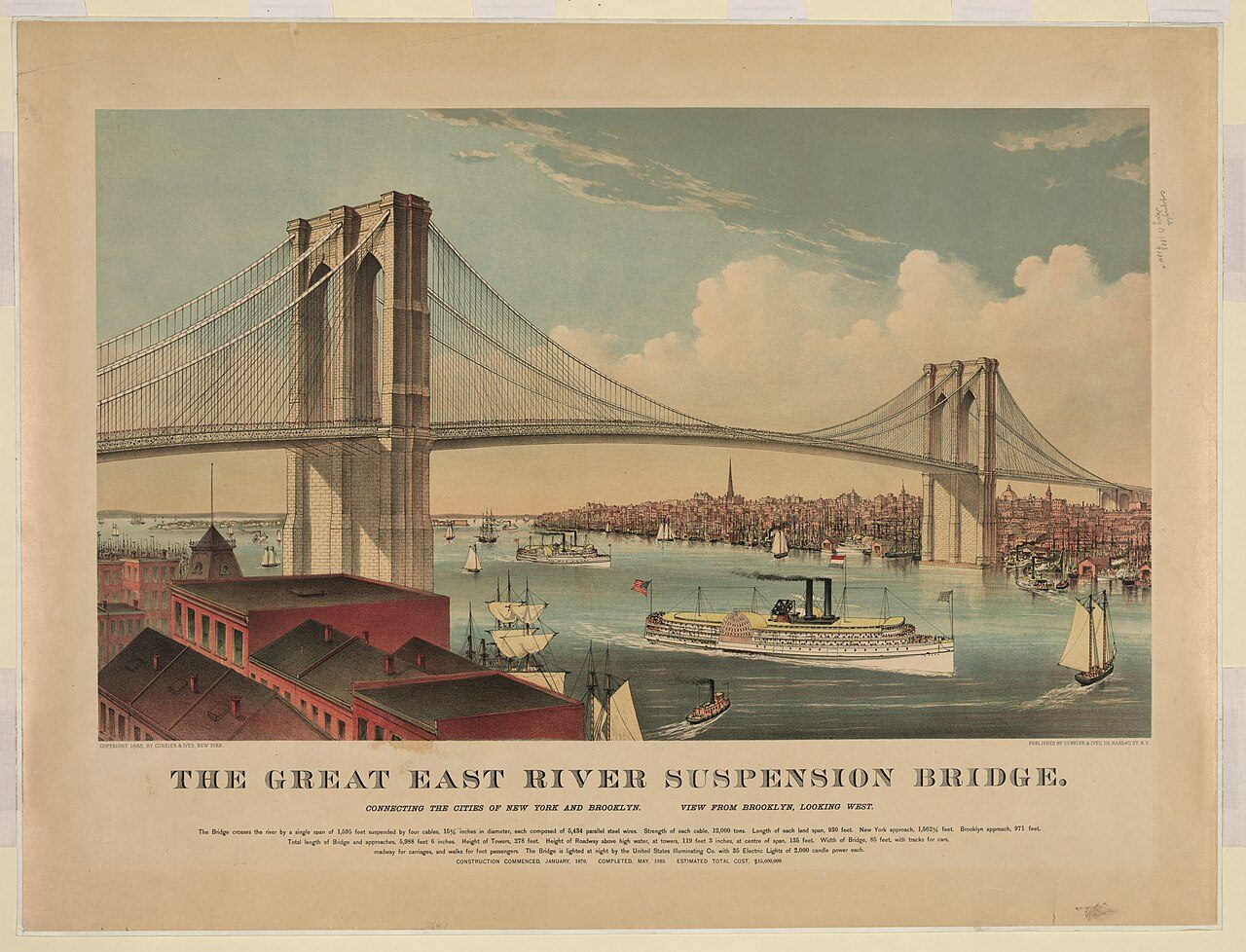
At a Glance
- Date opened
- 24 May 1883
- Designer
- John A. Roebling
- Chief engineer at completion
- Washington Roebling
- Main span
- 1,595 feet
- Construction
- 14 years; 27 workers and its designer died
- First-day crowds
- An estimated 250,000 people crossed within 24 hours
Events on this day
- 1689England's Toleration Act grants freedom of worship to Protestant dissenters, though not to Catholics.
- 1775John Hancock is elected president of the Second Continental Congress in Philadelphia.
- 1830The Baltimore and Ohio Railroad opens the first regular railroad passenger service in the United States.
- 1844Samuel Morse demonstrates his telegraph, sending the message 'What hath God wrought?' from Washington to Baltimore.
- 1883The Brooklyn Bridge opens between New York and Brooklyn after 14 years of construction — the featured story above.
- 1917Britain introduces the convoy system to protect merchant shipping from German submarines.
- 1935Major League Baseball's first night game is played at Crosley Field, where the Cincinnati Reds beat the Philadelphia Phillies 2-1.
- 1941The German battleship Bismarck sinks the British battlecruiser HMS Hood in the Denmark Strait, with the loss of more than 1,400 lives.
- 1964A riot at a football match in Lima, Peru, kills more than 300 spectators and injures another 500.
- 1976At the Judgment of Paris, a blind tasting in which nine French judges rank California wines above famous French vintages in both red and white categories.
Born on this day
- 1686Gabriel Fahrenheit — Polish-Dutch physicist who invented the mercury thermometer and the temperature scale named after him
- 1819Queen Victoria — British monarch whose 63-year reign gave its name to an era of industrial and imperial expansion
- 1940Joseph Brodsky — Russian-American poet who won the Nobel Prize in Literature in 1987
- 1941Bob Dylan — American singer-songwriter whose work reshaped popular music and won the Nobel Prize in Literature
Died on this day
- 1543Nicolaus Copernicus — Polish astronomer whose heliocentric model placed the Sun, not the Earth, at the centre of the solar system
- 1959John Foster Dulles — US secretary of state and a chief architect of American Cold War policy
- 1974Duke Ellington — American jazz composer and bandleader, among the most influential figures in American music
- 2023Tina Turner — American-born singer whose powerful voice and stage presence made her a global rock icon
The featured story: New York walks to Brooklyn, 24 May 1883
In the 1860s New York and Brooklyn were separate cities divided by the East River, crossed only by ferries that ice and fog could halt. The engineer John A. Roebling proposed to span the river with a suspension bridge of steel wire, longer than any bridge yet built. Construction began in 1869, and almost at once the bridge claimed its designer: Roebling's foot was crushed by a docking boat as he surveyed the site, and he died of tetanus three weeks later, the first of the 27 people who would die building the bridge.
His son Washington Roebling took over as chief engineer, but the work destroyed his health too. Descending into the pressurised caissons sunk into the riverbed, he was crippled by caisson disease in 1872 and left bedridden. From a room in Brooklyn Heights he watched the work through a telescope while his wife, Emily Roebling, became his eyes, voice and deputy on the site, mastering the engineering herself and relaying his instructions to the foremen for more than a decade.
On 24 May 1883 the bridge opened in a ceremony presided over by President Chester A. Arthur and New York governor Grover Cleveland. Emily Roebling was given the first ride across the completed bridge, carrying a rooster as a symbol of victory. With a main span of 1,595 feet, the Brooklyn Bridge was the world's first steel-wire suspension bridge and the largest suspension bridge yet built. An estimated 250,000 people walked across within the first 24 hours, paying a cent each to use the elevated promenade. For Brooklyn, then a great city in its own right, the bridge ended a dependence on ferries that fog could stop and winter ice could suspend for days at a time, stranding commuters on the wrong side of the river from their work.
The triumph was shadowed within the week: on 30 May a rumour that the bridge was collapsing triggered a stampede on the crowded walkway that killed 12 people. But the bridge endured and transformed its cities, binding Brooklyn ever more tightly to New York until the two merged into Greater New York in 1898. The Brooklyn Bridge remains one of the most recognisable structures in the United States.
Why this date matters
May 24 is a date about connection. Its centrepiece joined two cities with wire and stone, but the same day also carried Morse's telegraph wire humming between Washington and Baltimore, the first American passenger railroad, and a blind tasting in Paris that connected California's vineyards to the top rank of world wine. It is bookended by the heavens and the Earth: Copernicus, who rearranged the universe, died on this date in 1543, and Queen Victoria, whose name came to define an age of steam and empire, was born on it in 1819. Again and again, May 24 shrinks a distance that had seemed fixed. Its births and deaths sketch the same arc from cosmos to city: Copernicus reordering the heavens, Victoria presiding over the steam age, and two American musicians, Ellington and Dylan, born and lost on a date that keeps redrawing the map of what connects to what.
Sources
- Encyclopaedia Britannica — On This Day: May 24
- HISTORY — This Day in History: May 24
- HISTORY — Brooklyn Bridge Opens
- Wikimedia Commons — Currier and Ives Brooklyn Bridge file page

The facts on this page were checked against these sources on 19 November 2026. The History Trail's permanent pages are researched and written for this site; the live profiles elsewhere on The History Trail are assembled automatically from Wikipedia and Wikidata.
About the Author
Researched and written by the The History Trail Editorial Team — the accountable editorial function behind this site's permanent story pages. The team works from the published sources cited on each page; it does not invent historians, reviewers or credentials, and it corrects errors openly.
Fact Check
Every load-bearing fact on this page traces to one of the sources listed above, and significant claims link to their source in the text. Our checking method is described on the methodology page; errors can be reported via the corrections page.
Sources & Citations
Cite this page as: The History Trail Editorial Team, The History Trail — this article's title, publication and update dates are shown beneath its headline. The full source list appears under Sources above; the site's source standards are on the sources page.