
On This Day
May 22 in History
May 22 is dominated by the most powerful earthquake ever measured. On this day in 1960 a magnitude 9.5 earthquake ruptured the coast of southern Chile near Valdivia, flattening cities, triggering landslides and launching a tsunami that killed people as far away as Hawaii, Japan and the Philippines. No earthquake recorded by instruments has ever matched it. The date also carries the opening battle of the Wars of the Roses in 1455, Aaron Burr's treason trial in 1807 and the unification of Yemen in 1990.
Choose another date: open the On This Day calendar to browse events, births and deaths for any day of the year.
At a Glance
- Date
- 22 May 1960
- Magnitude
- 9.5, the largest ever recorded
- Epicentre region
- Near Valdivia, southern Chile
- Fault rupture
- About 1,000 km of the Chilean coast
- Death toll
- Estimates range from about 490 to 5,700
- Tsunami
- Crossed the Pacific to Hawaii, Japan and the Philippines
Events on this day
- 1455The First Battle of St Albans opens the Wars of the Roses; the Duke of Somerset is killed and King Henry VI is captured.
- 1783A London court hears the Zong case, an insurance dispute over at least 130 captive Africans thrown overboard from a slave ship.
- 1807Former vice president Aaron Burr goes on trial for treason in Richmond, accused of plotting to seize Spanish territory; he is later acquitted.
- 1856Congressman Preston Brooks beats Senator Charles Sumner with a cane on the floor of the US Senate over an antislavery speech.
- 1939Germany and Italy sign the Pact of Steel, formally allying the two Axis powers.
- 1942Mexico declares war on Germany, Italy and Japan, entering the Second World War on the Allied side.
- 1960An earthquake of magnitude 9.5, the largest ever recorded, devastates Valdivia and southern Chile — the featured story above.
- 1972President Richard Nixon arrives in Moscow, becoming the first US president to visit the Soviet capital.
- 1990North Yemen and South Yemen unite to form the Republic of Yemen.
- 2011A catastrophic tornado strikes Joplin, Missouri, killing some 160 people in one of the deadliest tornadoes in US history.
- 2017A suicide bomber kills 22 people leaving an Ariana Grande concert at the Manchester Arena in England.
Born on this day
- 1813Richard Wagner — German composer whose operas, including the Ring cycle, transformed Western music
- 1844Mary Cassatt — American impressionist painter celebrated for her intimate scenes of women and children
- 1859Arthur Conan Doyle — Scottish writer who created Sherlock Holmes, the prototype of the modern detective hero
- 1907Laurence Olivier — English actor and director regarded as one of the greatest stage performers of the 20th century
Died on this day
- 337Constantine I — Roman emperor who legalised Christianity in the empire and founded Constantinople
- 1802Martha Washington — first First Lady of the United States, who died at Mount Vernon aged 70
- 1885Victor Hugo — French author of Les Miserables and The Hunchback of Notre-Dame, who died in Paris aged 83
The featured story: The great Chilean earthquake, 22 May 1960
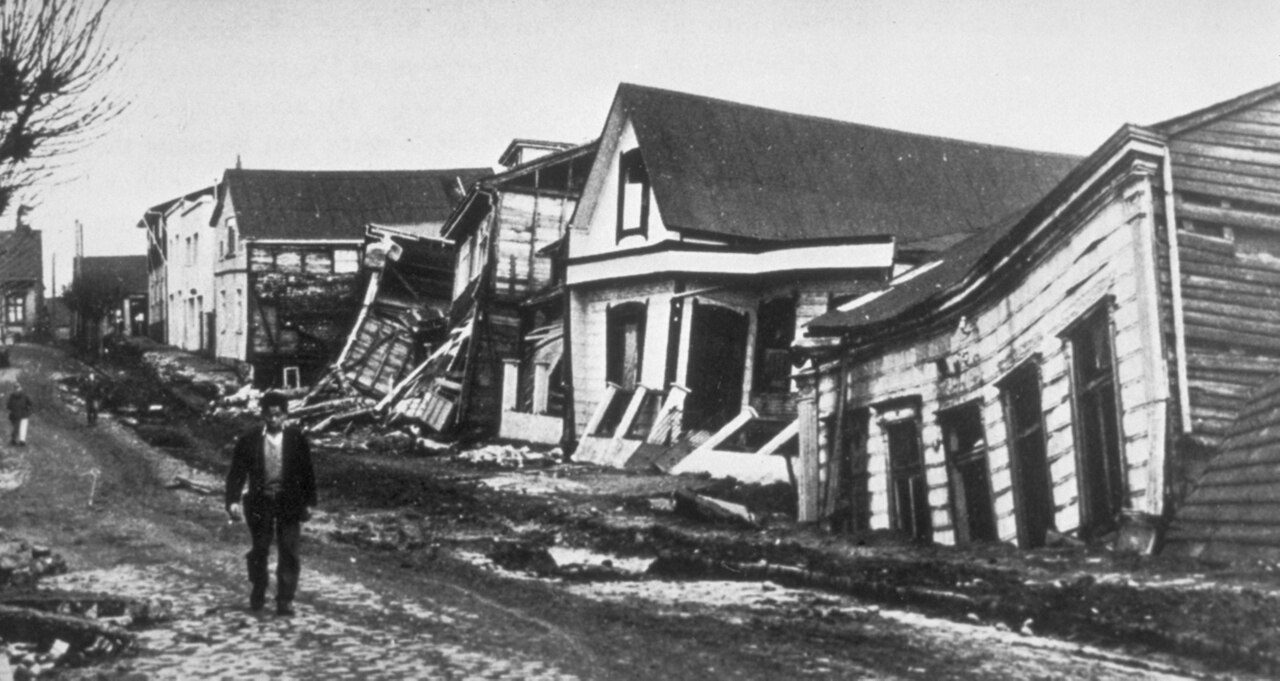
Southern Chile lies above one of the most dangerous boundaries on Earth, where the Nazca Plate grinds beneath the South American continent. The strain announced itself on 21 May 1960 with a strong foreshock near Concepcion. At mid-afternoon on 22 May the fault let go completely. Centred off the coast near Valdivia, the earthquake reached magnitude 9.5, the largest ever measured by instruments, as roughly 1,000 kilometres of the fault ruptured over the following days in a sequence of colossal shocks. The warning had come the day before: a first great tremor, measured at about magnitude 7.6, had already damaged Concepcion and the surrounding region on 21 May, cracking buildings and sending frightened residents into the streets, so that when the far larger shock came, many in the south already understood what was happening.
Valdivia, Puerto Montt and dozens of smaller towns were shattered. Landslides tore down hillsides, and debris blocked the outflow of Lake Rinihue, threatening a second, delayed flood that engineers raced to prevent. Far worse was to come from the sea. The quake heaved the ocean floor and sent a tsunami racing across the entire Pacific. In Hilo, Hawaii, the waves killed 61 people; in Japan they killed 138, and in the Philippines 32, according to figures compiled by the US Geological Survey.
Counting the Chilean dead proved impossible to fix precisely. Official and scientific estimates of the total death toll range from about 490 to as many as 5,700, with one widely used USGS accounting putting the Chilean toll at about 1,655 killed, 3,000 injured and some two million people left homeless, with damage in southern Chile of about $550 million. Two days after the main shock, the Puyehue volcano erupted, an explosion widely linked to the earthquake's disturbance of the crust.
The Valdivia earthquake changed science as well as Chile. Its enormous rupture, measured across a continent's edge, gave geophysicists decisive evidence for how subduction zones work, feeding the emerging theory of plate tectonics. It also spurred improvements in tsunami warning across the Pacific. More than six decades later, magnitude 9.5 remains the benchmark: the largest earthquake human beings have ever recorded. No later earthquake has matched it: the great Sumatra shock of 2004 and the Tohoku earthquake that struck Japan in 2011, each devastating in its own right, both measured well below the Valdivia earthquake's magnitude 9.5, which remains the ceiling of the instrumental record.
Why this date matters
May 22 is a date when the ground itself, literal and political, gives way. It opens with a battle that starts a civil war in England and a courtroom argument over the human cargo of a slave ship; it carries a senator beaten senseless in the US Senate and two dictatorships bound together by a pact of steel. Above all it holds the Valdivia earthquake, the planet's largest recorded release of energy, whose waves were still killing people on the far side of the Pacific a day later. Even its quieter entries, a unification in Yemen and a summit in Moscow, are moments when old arrangements shifted.
Sources
- Encyclopaedia Britannica — On This Day: May 22
- HISTORY — This Day in History: May 22
- Wikimedia Commons — Valdivia after earthquake, 1960 file page
- Wikipedia — May 22

The facts on this page were checked against these sources on 19 November 2026. The History Trail's permanent pages are researched and written for this site; the live profiles elsewhere on The History Trail are assembled automatically from Wikipedia and Wikidata.
About the Author
Researched and written by the The History Trail Editorial Team — the accountable editorial function behind this site's permanent story pages. The team works from the published sources cited on each page; it does not invent historians, reviewers or credentials, and it corrects errors openly.
Fact Check
Every load-bearing fact on this page traces to one of the sources listed above, and significant claims link to their source in the text. Our checking method is described on the methodology page; errors can be reported via the corrections page.
Sources & Citations
Cite this page as: The History Trail Editorial Team, The History Trail — this article's title, publication and update dates are shown beneath its headline. The full source list appears under Sources above; the site's source standards are on the sources page.