
On This Day
January 12 in History
On 12 January 2010 a magnitude 7.0 earthquake struck Haiti just before 5 p.m. local time, its epicentre only about 25 kilometres from the capital, Port-au-Prince. The Haitian government officially put the death toll at more than 300,000, making it one of the deadliest natural disasters ever recorded. January 12 is also the day Motown's forerunner was founded, the New York Jets won Super Bowl III and a blizzard killed 235 people in the American Midwest.
Choose another date: open the On This Day calendar to browse events, births and deaths for any day of the year.
At a Glance
- When
- 12 January 2010, at 4:53 p.m. local time
- Magnitude
- Mw 7.0, at a shallow depth of about 13 kilometres
- Epicentre
- About 25 kilometres west-southwest of Port-au-Prince, on the Enriquillo fault system
- Death toll
- Officially put by the Haitian government at 316,000; other estimates range from about 100,000 to 160,000
- People exposed
- An estimated three million people experienced severe shaking
- Symbol of the disaster
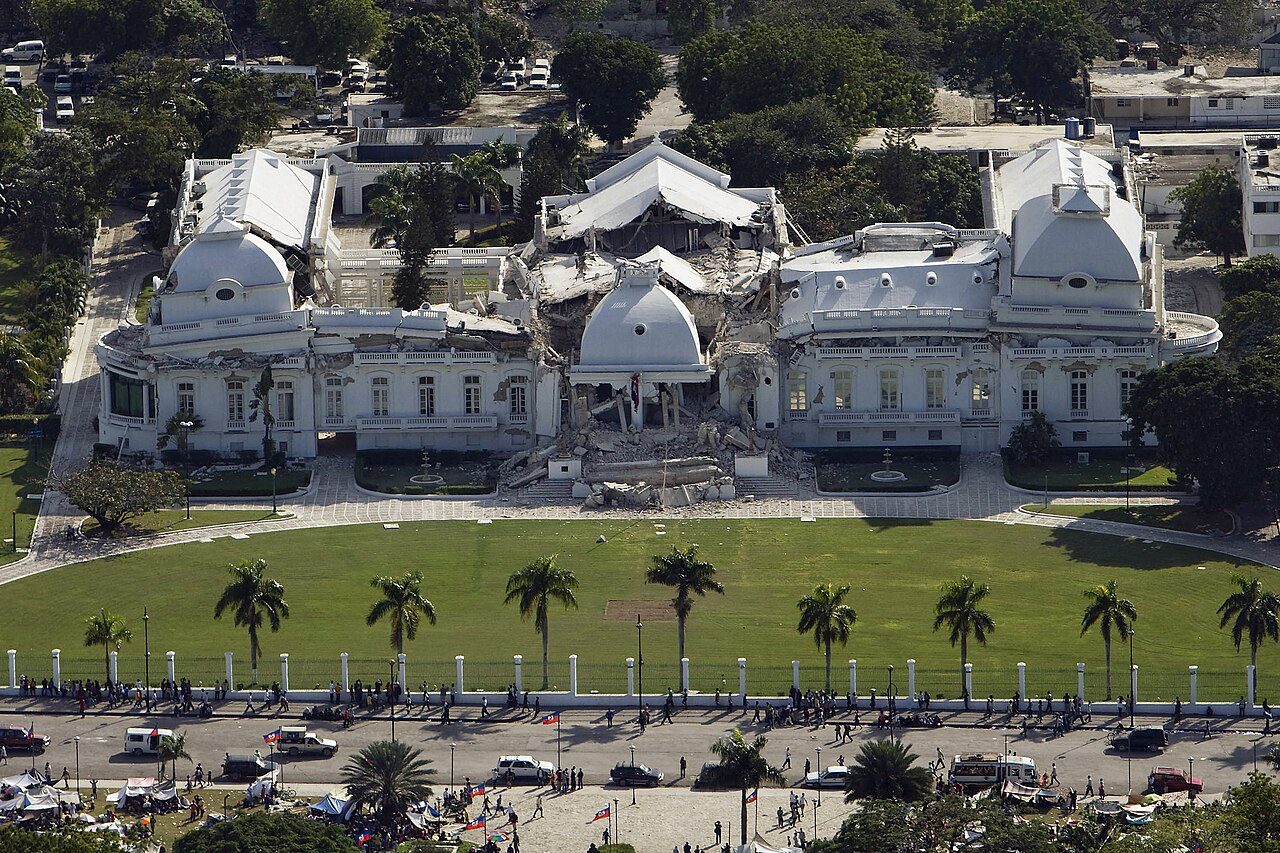
- The National Palace in Port-au-Prince, whose central dome and pavilion collapsed
Events on this day
- 1773The Charleston Museum is founded in South Carolina — the oldest public museum in the United States.
- 1838Mormon leader Joseph Smith flees Ohio for Missouri after the failure of a church-backed bank brings threats and charges against him.
- 1879The Anglo-Zulu War begins in southern Africa, as British forces invade the Zulu kingdom of King Cetshwayo.
- 1888The Schoolchildren's Blizzard sweeps the American Great Plains, killing 235 people, many of them children caught on their way home from school.
- 1919The 'Big Four' — Wilson, Clemenceau, Lloyd George and Orlando — meet in Paris to shape the peace after the First World War.
- 1932Hattie Caraway of Arkansas becomes the first woman elected to the United States Senate, winning the seat she had first filled by appointment.
- 1943Soviet forces breach the German siege of Leningrad, opening a narrow land corridor into the starving city.
- 1959Berry Gordy founds Tamla Records in Detroit — the company that grows into Motown, the defining sound of 1960s soul.
- 1969The New York Jets stun the Baltimore Colts 16–7 in Super Bowl III, the young AFL's first championship win over the NFL.
- 1971All in the Family debuts on American television, bringing the arguments of a divided country into the sitcom living room.
- 1986Franklin Chang-Díaz flies aboard the shuttle Columbia, becoming the first Hispanic American in space.
- 2005NASA launches Deep Impact, a spacecraft sent to fire a projectile into a comet and study what flies out.
- 2010A magnitude 7.0 earthquake devastates Haiti, killing more than 300,000 people by the official count — the featured story above.
Born on this day
- 1580Jan Baptista van Helmont — Flemish chemist and physician who coined the word 'gas' for the vapours he studied.
- 1628Charles Perrault — French writer whose Tales of Mother Goose gave Cinderella and Sleeping Beauty their classic forms.
- 1737John Hancock — American merchant and statesman, first signer of the Declaration of Independence, famous for his bold signature.
- 1876Jack London — American novelist of The Call of the Wild and White Fang, chronicler of the Klondike gold rush.
- 1926Morton Feldman — American composer of vast, quiet, slowly unfolding works that redefined musical time.
- 1949Haruki Murakami — Japanese novelist of Norwegian Wood and The Wind-Up Bird Chronicle, read worldwide.
- 1952Walter Mosley — American crime novelist, creator of the detective Easy Rawlins.
Died on this day
- 1519Maximilian I — Holy Roman Emperor whose marriage diplomacy made the Habsburgs a European superpower.
- 1777Hugh Mercer — Scottish-born American brigadier general, mortally wounded at the Battle of Princeton in the Revolutionary War.
- 1976Agatha Christie — English writer, creator of Hercule Poirot and Miss Marple, the best-selling novelist of all time, dead at 85.
The featured story: the Haiti earthquake, 12 January 2010
At 4:53 in the afternoon of 12 January 2010, the ground beneath western Haiti moved. A magnitude 7.0 earthquake, centred roughly 25 kilometres west-southwest of Port-au-Prince at a depth of only about 13 kilometres, struck along the Enriquillo fault system. Because the quake was shallow and close to a densely built capital, the shaking was catastrophic: the U.S. Geological Survey estimated that some three million people were exposed to severe or violent shaking. Within seconds, much of Port-au-Prince — its cathedral, its hospitals, its schools, its ministries and its National Palace — lay in ruins.
The human cost defies easy counting, and the figures still differ. The Haitian government officially put the death toll at 316,000, a figure Britannica's day page repeats as the country's official count; other studies have estimated between roughly 100,000 and 160,000 deaths. What is not disputed is the scale: hundreds of thousands injured, more than a million people left homeless, and a capital city whose basic institutions — government, police, the United Nations mission, whose headquarters collapsed killing its leadership — were themselves among the victims. Port-au-Prince's building stock, much of it concrete construction never designed for earthquakes, failed almost everywhere at once.
The response became one of the largest international relief efforts ever mounted. Search-and-rescue teams, field hospitals, warships and aid flights converged on a country whose single airport and damaged port could barely receive them. In the years that followed, reconstruction was slowed by a cholera epidemic that began later in 2010, by political instability and by the sheer depth of the damage; the ruined National Palace, its tilted white dome the emblem of the disaster, was not demolished until 2012, and the cathedral remained a ruin far longer.
The earthquake also changed how the world thought about seismic risk in the Caribbean. Haiti sits on the boundary between the Caribbean and North American plates, and geologists had warned that the Enriquillo fault was locked and accumulating strain — a warning that arrived too late for a city built as if the ground would never move. January 12 is now Haiti's day of remembrance, marked each year at the hour the earth shook.
Why this date matters
January 12 keeps returning to the theme of fragile ground — literal and otherwise. A blizzard buried the Plains in 1888, the siege of Leningrad cracked in 1943, and in 2010 the earth itself gave way under Haiti's capital. Yet the same date also carries beginnings built to last: a museum in 1773, a record label in a Detroit house in 1959, a television family in 1971. It is a day that shows how quickly the structures people trust can fall, and how stubbornly new ones are raised in their place.
Sources
- Encyclopaedia Britannica — On This Day: January 12
- HISTORY — What Happened on January 12
- U.S. Geological Survey — The Mw 7.0 Haiti Earthquake of January 12, 2010 (Open-File Report 2010-1048)
- U.S. Geological Survey — Magnitude 7.0 Earthquake Strikes Haiti
The facts on this page were checked against these sources on 19 November 2026. The History Trail's permanent pages are researched and written for this site; the live profiles elsewhere on The History Trail are assembled automatically from Wikipedia and Wikidata.
About the Author
Researched and written by the The History Trail Editorial Team — the accountable editorial function behind this site's permanent story pages. The team works from the published sources cited on each page; it does not invent historians, reviewers or credentials, and it corrects errors openly.
Fact Check
Every load-bearing fact on this page traces to one of the sources listed above, and significant claims link to their source in the text. Our checking method is described on the methodology page; errors can be reported via the corrections page.
Sources & Citations
Cite this page as: The History Trail Editorial Team, The History Trail — this article's title, publication and update dates are shown beneath its headline. The full source list appears under Sources above; the site's source standards are on the sources page.