
On This Day
February 27 in History
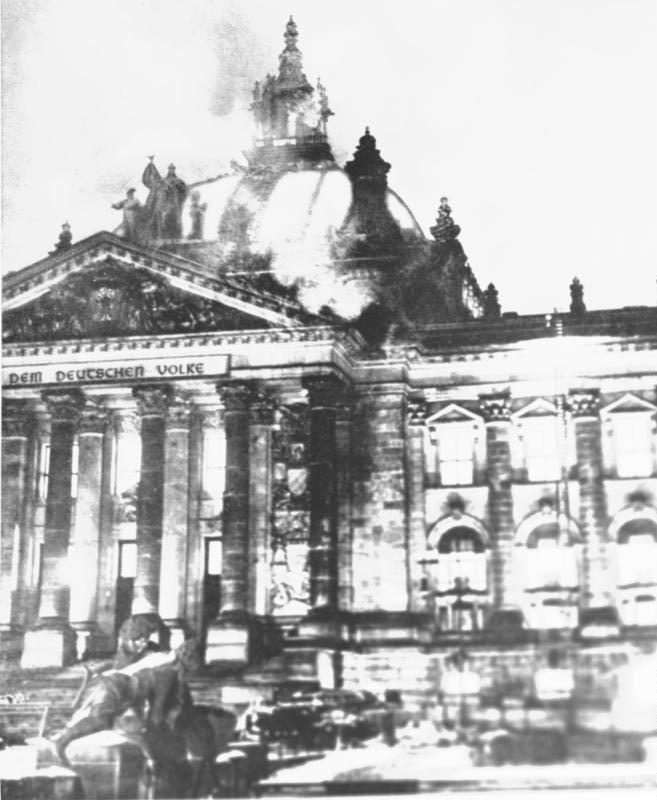
On the night of 27 February 1933 the Reichstag building in Berlin burned, and within twenty-four hours Adolf Hitler's government had used the fire to suspend the civil liberties of the German republic — the decisive step from chancellorship to dictatorship. February 27 is also the day Mathew Brady photographed Lincoln, the Supreme Court confirmed women's voting rights, and Walter Cronkite broke with the Vietnam War.
Choose another date: open the On This Day calendar to browse events, births and deaths for any day of the year.
At a Glance
- The fire
- Night of 27 February 1933 — the debating chamber of the Reichstag in Berlin was gutted and its dome destroyed
- The accused
- Marinus van der Lubbe, a young Dutch former communist, was arrested inside the building and confessed; he was executed in January 1934
- The decree
- On 28 February the Reichstag Fire Decree suspended freedom of speech, press, assembly and privacy of correspondence
- The election
- On 5 March 1933, campaigning under the decree, the Nazis won 43.9 percent of the vote and 288 seats
- The debate
- The Nazis blamed a communist plot; many opponents blamed the Nazis; the general consensus of historians is that van der Lubbe acted alone
- The building
- Parliament never returned to the Reichstag under Nazi rule, meeting instead in the Kroll Opera House
Events on this day
- 1827New Orleans celebrates Mardi Gras for the first time, beginning the carnival tradition that defines the city.
- 1844The Dominican Republic declares its independence from Haiti, founding the modern Dominican state.
- 1860Photographer Mathew Brady takes Abraham Lincoln's portrait in New York on the day of his Cooper Union address, producing the image that introduces the candidate to America.
- 1922In Leser v. Garnett, the U.S. Supreme Court upholds the Nineteenth Amendment, confirming women's constitutional right to vote.
- 1933Fire guts the Reichstag building in Berlin, and the Nazi government uses it as the pretext to suspend civil liberties — the featured story above.
- 1942British physicist James Stanley Hey discovers that the sun emits radio waves, opening the field of solar radio astronomy.
- 1942USS Langley, the U.S. Navy's first aircraft carrier, is sunk by Japanese aircraft south of Java while ferrying fighter planes.
- 1951The Twenty-second Amendment to the U.S. Constitution is ratified, limiting presidents to two terms in office.
- 1968CBS anchorman Walter Cronkite, the most trusted voice in American broadcasting, tells viewers that the Vietnam War can end only in a negotiated stalemate.
- 1973Members of the American Indian Movement occupy the hamlet of Wounded Knee, South Dakota, beginning a seventy-one-day standoff with federal authorities.
Born on this day
- c. 280Constantine the Great — Roman emperor who embraced Christianity and founded Constantinople; he is thought to have been born on this day in about 280.
- 1807Henry Wadsworth Longfellow — American poet, the most popular of his century, author of The Song of Hiawatha and Paul Revere's Ride.
- 1897Marian Anderson — American contralto whose 1939 concert at the Lincoln Memorial became a landmark of the civil rights era.
- 1902John Steinbeck — American novelist of The Grapes of Wrath and Of Mice and Men, winner of the Nobel Prize in Literature.
- 1930Joanne Woodward — American actress, Oscar winner for The Three Faces of Eve and one half of Hollywood's most durable marriage, to Paul Newman.
- 1932Elizabeth Taylor — English-American actress, a child star who became one of the defining screen figures of the twentieth century.
Died on this day
- 1936Ivan Pavlov — Russian physiologist whose experiments with dogs founded the study of classical conditioning; he died in Leningrad at 86.
- 2008William F. Buckley Jr. — American conservative writer and broadcaster, founder of National Review.
- 2015Leonard Nimoy — American actor beloved worldwide as Mr. Spock in Star Trek, dead at 83.
The featured story: the Reichstag fire, 27 February 1933
Adolf Hitler had been chancellor of Germany for less than a month when, on the night of 27 February 1933, fire broke out in the Reichstag building in Berlin, home of the German parliament. The blaze began sometime after nine in the evening and spread with astonishing speed through the debating chamber, whose wooden panelling and furnishings fed the flames; by the time firefighters brought it under control, the chamber was gutted and the building's great glass dome had shattered in the heat. Inside the burning building police found a young Dutchman, Marinus van der Lubbe — a former communist with a history of protest and attempted arson — half-undressed and carrying firelighters. He was arrested on the spot and confessed to setting the fire, saying he had acted alone, as a protest against the new regime. Elections were due on 5 March, less than a week away, and the Nazi leadership arrived at the scene within the hour.
Whether van der Lubbe acted alone has been argued ever since. The Nazis declared instantly, and without waiting for evidence, that the fire was the signal for a communist uprising — the opening move of a revolution that had to be crushed by any means necessary. Many of their opponents believed, then and later, that the Nazis had set the fire themselves as a pretext. The general consensus of historians today, as the German Historical Institute summarises it, is that van der Lubbe did indeed set the fire alone; what is beyond dispute is how completely the regime exploited it. That same night, thousands of communists and other opponents were arrested across Germany. The fire's political use was immediate, systematic and devastating.
The next morning, 28 February, President Hindenburg signed the Decree for the Protection of People and State — remembered as the Reichstag Fire Decree. Drafted overnight, it suspended, in a single page, the core civil liberties of the Weimar constitution: freedom of speech, freedom of the press, freedom of assembly and association, and the privacy of letters and telephone calls. It allowed the central government to override the states and to detain people without charge or trial. On that legal foundation the dictatorship was built: opposition newspapers were shut, meetings banned, and the Communist Party effectively outlawed in the middle of an election campaign. Even so, in the elections of 5 March the Nazis won 43.9 percent of the vote and 288 seats — a plurality, not a majority — but with their opponents arrested, exiled or intimidated, and with nationalist allies, they had enough. Within weeks the Enabling Act gave Hitler's government the power to legislate without parliament at all.
Van der Lubbe was tried at Leipzig in the autumn, convicted of high treason and arson, and executed in January 1934; his co-defendants, senior communists including the Bulgarian Georgi Dimitrov, were acquitted for want of evidence, to the regime's embarrassment. The burned Reichstag was never restored under Nazi rule — parliament met instead in the Kroll Opera House — and the ruin stood through the Second World War as a symbol of the republic that had died in its ashes. The deeper truth of 27 February is that the fire itself decided nothing: a single disturbed young man with firelighters could burn a building, but it took a government ready with a decree the next morning to burn a constitution. The decree was never repealed during the twelve years of the Third Reich.
Why this date matters
February 27 is a day about voices and who gets to use them. In 1860 a photograph and a speech in New York introduced Abraham Lincoln to a nation; in 1922 the Supreme Court confirmed that American women's votes could not be argued away; in 1968 Walter Cronkite used his voice to tell a president, in effect, that a war was lost. Against those stand the date's darkest entry: in 1933 a fire in Berlin became the excuse to silence every opposing voice in Germany at once, by decree, in a single day. The date holds both lessons at once — how speech builds republics, and how quickly, given a pretext and a ready pen, it can be switched off.
Sources
- Encyclopaedia Britannica — On This Day: February 27
- HISTORY — This Day in History: February 27
- Encyclopaedia Britannica — Reichstag fire
- Keekli — This Day in History: February 27 (Britannica list)
The facts on this page were checked against these sources on 19 November 2026. The History Trail's permanent pages are researched and written for this site; the live profiles elsewhere on The History Trail are assembled automatically from Wikipedia and Wikidata.
About the Author
Researched and written by the The History Trail Editorial Team — the accountable editorial function behind this site's permanent story pages. The team works from the published sources cited on each page; it does not invent historians, reviewers or credentials, and it corrects errors openly.
Fact Check
Every load-bearing fact on this page traces to one of the sources listed above, and significant claims link to their source in the text. Our checking method is described on the methodology page; errors can be reported via the corrections page.
Sources & Citations
Cite this page as: The History Trail Editorial Team, The History Trail — this article's title, publication and update dates are shown beneath its headline. The full source list appears under Sources above; the site's source standards are on the sources page.