
On This Day
February 26 in History
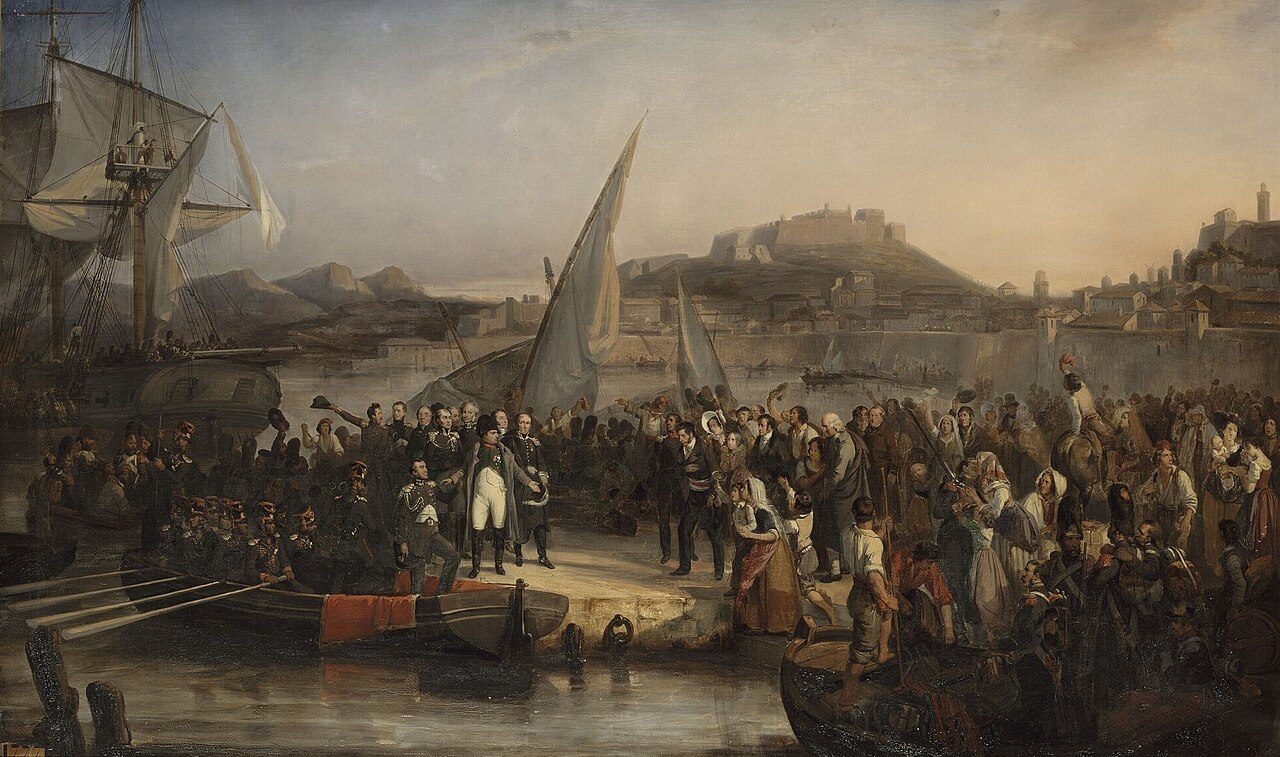
On 26 February 1815 Napoleon Bonaparte slipped away from his island exile on Elba with about a thousand men, landed in France, and within three weeks had retaken Paris without fighting a battle — beginning the Hundred Days that ended at Waterloo. February 26 is also the day Grand Canyon and Grand Teton became national parks, and the day a bomb exploded beneath the World Trade Center in 1993.
Choose another date: open the On This Day calendar to browse events, births and deaths for any day of the year.
At a Glance
- The exile
- Napoleon had ruled Elba as a sovereign principality since May 1814, after his first abdication
- The escape
- 26 February 1815 — he sailed from Portoferraio aboard the brig Inconstant while the guard ships were away
- The force
- About one thousand men: his guard, Polish lancers and volunteers, in a handful of small vessels
- The landing
- Golfe-Juan, on the French Riviera, on 1 March 1815
- The march
- Troops sent to arrest him joined him instead; he entered Paris on 20 March without fighting a battle
- The end
- The Hundred Days closed with defeat at Waterloo on 18 June 1815 and exile to Saint Helena
Events on this day
- 1815Napoleon Bonaparte escapes from exile on the island of Elba, beginning the Hundred Days — the featured story above.
- 1885The Berlin Conference concludes, as the European powers agree the rules by which they will carve up colonial claims in Africa.
- 1914The ocean liner Britannic, sister ship of the Titanic, is launched at Belfast; she will be sunk by a mine in the First World War.
- 1919Grand Canyon National Park is established in Arizona, protecting one of the world's great natural wonders.
- 1929Grand Teton National Park is established in Wyoming, preserving the Teton Range and the valley of Jackson Hole.
- 1935Adolf Hitler authorises the open creation of the Luftwaffe, Germany's air force, in defiance of the Treaty of Versailles, with Hermann Göring in command.
- 1970National Public Radio is founded in the United States, beginning as a network of educational radio stations.
- 1974Nike receives the patent for its waffle-sole running shoe, the design that helps launch the modern trainers industry.
- 1993A truck bomb explodes beneath the World Trade Center in New York, killing six people and injuring more than a thousand.
- 2012Trayvon Martin, an unarmed seventeen-year-old, is shot dead by a neighbourhood watch volunteer in Sanford, Florida, a killing that ignites a national argument about race and self-defence law.
Born on this day
- 1802Victor Hugo — French novelist and poet, author of Les Misérables and The Hunchback of Notre-Dame.
- 1829Levi Strauss — Bavarian-born American merchant who built a clothing empire on denim work trousers.
- 1846William F. Cody — American scout and showman, famous across two continents as Buffalo Bill.
- 1852John Harvey Kellogg — American physician and health reformer whose name survives on the breakfast cereal company he founded with his brother.
- 1928Fats Domino — American pianist and singer, a founding figure of rock and roll with Blueberry Hill and Ain't That a Shame.
- 1932Johnny Cash — American singer-songwriter, the Man in Black, whose songs crossed country, rock and gospel.
Died on this day
- 1813Robert R. Livingston — American statesman who, as minister to France, negotiated the Louisiana Purchase.
- 1977Bukka White — Mississippi Delta blues guitarist and singer, recorded again to acclaim in the 1960s blues revival.
- 1994Bill Hicks — American stand-up comedian whose dark, philosophical routines won him a devoted following after his death at 32.
The featured story: Napoleon escapes from Elba, 26 February 1815
In the spring of 1814, after two decades in which he had dominated Europe, Napoleon Bonaparte was forced to abdicate and was exiled to Elba, a small island in the Mediterranean between Italy and his native Corsica. The settlement was oddly generous: he was allowed to keep the title of emperor, to rule the island as his own tiny sovereign state, and to maintain a guard of several hundred men. Napoleon threw himself into governing Elba — building roads, reforming its administration, reorganising its iron mines — but he was also listening. Reports from France told of the restored Bourbon king Louis XVIII's growing unpopularity, and of his own veterans' discontent; reports from the Congress of Vienna, where the victorious powers were redrawing Europe's map, suggested the allies were falling out among themselves and even discussing moving him somewhere far more remote. After less than ten months on the island, Napoleon decided to gamble everything on a return.
On 26 February 1815, while the British and French guard ships assigned to watch him were absent, Napoleon slipped out of Portoferraio aboard the brig Inconstant, accompanied by a handful of small transports and about a thousand men — his guard, some Polish lancers and Corsican volunteers. The little fleet evaded the patrols and, on 1 March, landed at Golfe-Juan on the French Riviera, between Cannes and Antibes. Napoleon had returned to France with a force smaller than a single regiment of his old armies, against a kingdom with every reason and every means to destroy him. His proclamation to the French promised that the eagle would fly from steeple to steeple until it reached the towers of Notre Dame. What he could not know was whether anyone would rally to it — or whether the first troops he met would simply arrest or shoot him.
The answer came within days, and it became the stuff of legend. Royal troops sent south to intercept him instead went over to him, most famously the regiment that confronted him near Grenoble, whose men — ordered to fire on their old emperor — instead broke ranks to embrace him, in the encounter that produced the story of Napoleon baring his chest and daring them to shoot. Town after town opened its gates; Marshal Ney, who had promised the king he would bring Napoleon back in an iron cage, defected to him with his army instead. On 20 March 1815 Napoleon entered Paris, from which Louis XVIII had fled the night before, and was carried into the Tuileries on the shoulders of the crowd. He had reconquered France without, in the whole march, fighting a battle.
The restoration lasted one hundred days. Napoleon rebuilt an army and a government, but the allies at Vienna, on hearing of his escape, declared him an outlaw and united against him, and on 18 June 1815 his new army was destroyed at Waterloo by British and Prussian forces. This time there was no generous island near home: Napoleon was shipped to Saint Helena, a speck of British territory in the South Atlantic, where he died in 1821. Yet the escape from Elba remains the most audacious comeback in modern history — an exiled emperor with a thousand men retaking one of Europe's great powers in three weeks, on nothing but nerve and the memory of glory.
Why this date matters
February 26 is a day of foundations and defiance. It founds things that last: two of America's most loved national parks, in 1919 and 1929, a public radio network in 1970, a shoe that remade sport in 1974. And it defies things that were meant to last: the Berlin Conference of 1885 tried to settle Africa's future among Europeans and failed within a generation; Hitler in 1935 openly tore up the Versailles limits on German air power. Towering over all of it is the date's central act of defiance — a deposed emperor on a small island deciding that exile was a suggestion, and sailing home to prove it.
Sources
- Encyclopaedia Britannica — On This Day: February 26
- HISTORY — This Day in History: February 26
- Kennedy Center — On This Day in the Arts: February 26
- Wikipedia — Napoleon's Departure from Elba
The facts on this page were checked against these sources on 19 November 2026. The History Trail's permanent pages are researched and written for this site; the live profiles elsewhere on The History Trail are assembled automatically from Wikipedia and Wikidata.
About the Author
Researched and written by the The History Trail Editorial Team — the accountable editorial function behind this site's permanent story pages. The team works from the published sources cited on each page; it does not invent historians, reviewers or credentials, and it corrects errors openly.
Fact Check
Every load-bearing fact on this page traces to one of the sources listed above, and significant claims link to their source in the text. Our checking method is described on the methodology page; errors can be reported via the corrections page.
Sources & Citations
Cite this page as: The History Trail Editorial Team, The History Trail — this article's title, publication and update dates are shown beneath its headline. The full source list appears under Sources above; the site's source standards are on the sources page.