
On This Day
February 25 in History
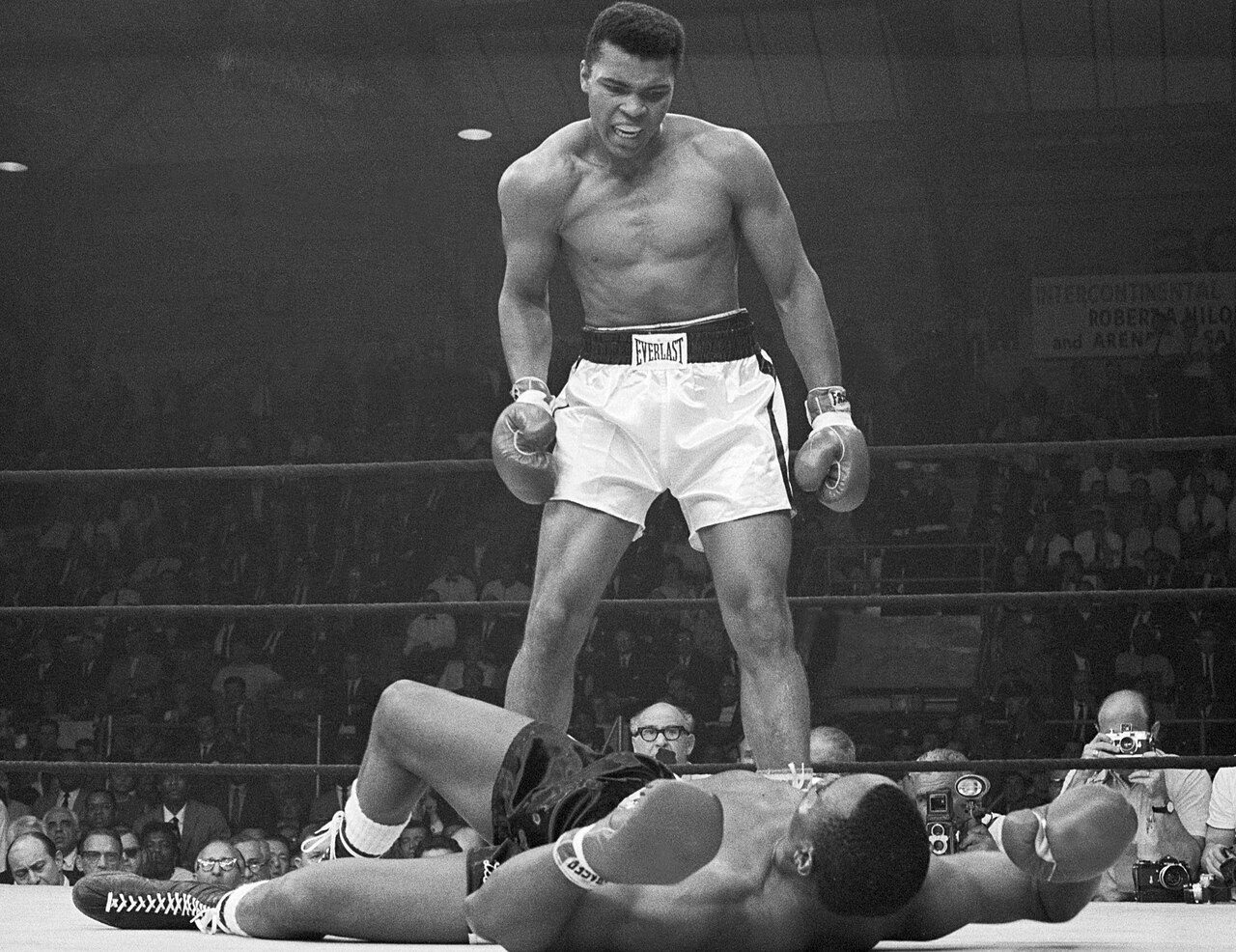
On 25 February 1964, in Miami Beach, the 22-year-old Cassius Clay — the future Muhammad Ali — stopped the fearsome Sonny Liston to become heavyweight champion of the world, in one of the greatest upsets in sporting history. February 25 is also the day Hiram Revels became the first African American in Congress, Khrushchev denounced Stalin in secret, and Ferdinand Marcos fled the Philippines.
Choose another date: open the On This Day calendar to browse events, births and deaths for any day of the year.
At a Glance
- The fight
- World heavyweight title, Convention Hall, Miami Beach, 25 February 1964
- The champion
- Sonny Liston, who had twice destroyed Floyd Patterson in one round, was an 8-to-1 favourite
- The challenger
- Cassius Clay, aged 22, undefeated but dismissed by many writers as a loudmouth
- The ending
- Liston, cut and battered in the sixth round, failed to answer the bell for the seventh and conceded the title
- The name
- Clay confirmed his conversion to Islam after the fight and soon took the name Muhammad Ali
- The rematch
- May 1965, Lewiston, Maine — Ali won in just over two minutes with the famous 'phantom punch'
Events on this day
- 1570Pope Pius V excommunicates Queen Elizabeth I of England, releasing her Catholic subjects from obedience to her.
- 1779George Rogers Clark forces the surrender of Fort Sackville at Vincennes, winning the Illinois country for the American cause in the Revolutionary War.
- 1862Congress passes the Legal Tender Act, authorising the issue of paper money — the greenbacks — to finance the Union war effort.
- 1870Hiram Rhodes Revels of Mississippi is sworn in as the first African American member of the United States Congress, taking his seat in the Senate.
- 1913The Sixteenth Amendment takes legal effect, giving the U.S. federal government the power to levy an income tax.
- 1940The first National Hockey League game is televised in the United States, as the New York Rangers beat the Montreal Canadiens 6–2.
- 1956Nikita Khrushchev delivers his secret speech denouncing Stalin to the closing session of the Twentieth Congress of the Soviet Communist Party.
- 1964Cassius Clay, the future Muhammad Ali, stops Sonny Liston to win the world heavyweight title — the featured story above.
- 1986Ferdinand Marcos flees the Philippines after the People Power uprising, and Corazon Aquino becomes president.
- 1990Violeta Chamorro defeats President Daniel Ortega in Nicaragua's election, ending a decade of Sandinista rule.
Born on this day
- 1841Pierre-Auguste Renoir — French painter, a founder of Impressionism, devoted to light, colour and the pleasures of ordinary life.
- 1842Karl May — German novelist whose adventure stories of the American West were read by generations of Europeans.
- 1866Benedetto Croce — Italian philosopher, historian and critic, the dominant Italian intellectual of his generation.
- 1873Enrico Caruso — Italian tenor whose voice made him the first great star of the gramophone age.
- 1917Anthony Burgess — English novelist, author of A Clockwork Orange.
- 1943George Harrison — English musician, lead guitarist of the Beatles and composer of Here Comes the Sun.
Died on this day
- 1983Tennessee Williams — American playwright of A Streetcar Named Desire and The Glass Menagerie, found dead in a New York hotel at 71.
- 2001Don Bradman — Australian cricketer whose Test batting average of 99.94 remains the most famous statistic in sport, dead at 92.
- 2020Hosni Mubarak — president of Egypt for thirty years until his overthrow in the Arab Spring of 2011, dead at 91.
The featured story: Cassius Clay defeats Sonny Liston, 25 February 1964
On paper, it was a mismatch. Sonny Liston, the heavyweight champion of the world, was the most feared fighter of his generation: a brooding ex-convict with enormous hands who had won the title by demolishing Floyd Patterson in a single round, then done exactly the same thing to him again in the rematch. The challenger at the Convention Hall in Miami Beach on 25 February 1964 was a 22-year-old from Louisville, Cassius Clay — brilliant, fast and undefeated, but famous above all for his mouth. Clay had spent the build-up taunting the champion in rhyme, predicting the round of his victory and heckling Liston at every opportunity, and at the weigh-in his antics were so wild that officials fined him and some observers wondered whether he was genuinely unhinged. The bookmakers were unmoved: Liston was an 8-to-1 favourite, and many sportswriters expected the fight to last only a few rounds.
The fight itself inverted every expectation. Clay's speed kept him out of range of Liston's crushing jab through the early rounds, and in the third he cut the champion around the eye — the first time Liston had been visibly hurt in years. There was a crisis for the challenger in the fifth, when something — later blamed on medication used on Liston's shoulder, getting into Clay's eyes — left him half-blinded, and he survived the round largely on instinct and movement. By the sixth his sight had cleared, and he battered the champion around the ring with combinations. When the bell sounded for the seventh round, Liston stayed on his stool. He had conceded: the most intimidating champion in memory had quit between rounds, saying afterwards that a shoulder injury had forced him to stop, and Cassius Clay was heavyweight champion of the world.
The shock was total, and Clay knew exactly what it meant. 'I shook up the world,' he shouted at ringside, and for once the boast was simply accurate. In the days after the fight he confirmed his conversion to Islam; within a short time he had taken the name Muhammad Ali, under which he would become the most famous athlete on Earth. The rematch, in May 1965 in Lewiston, Maine, ended even more strangely, with Liston knocked down in the first round by a punch so quick that many in the crowd never saw it — the so-called phantom punch — and Ali standing over him in the photograph that became the era's defining sporting image. That second fight was over in just over two minutes.
The Miami fight endures because it was a hinge between two ages of sport. Behind Liston stood the old heavyweight order — mob shadows, sullen champions, fights as grim business. Ahead of Clay lay the modern era he largely invented: the athlete as celebrity, poet, provocateur and political figure, who would lose his title for refusing the draft, regain it twice, and carry boxing around the world. All of it begins with a 22-year-old underdog making the scariest man in sport sit down and stay sat.
Why this date matters
February 25 has a talent for turning points disguised as paperwork. An excommunication in 1570, a paper-money act in 1862, an income-tax amendment in 1913, a secret speech in 1956 that began the unravelling of Stalin's myth — again and again the date's events work by changing the rules rather than by winning the battle. Its loudest moment breaks the pattern: in 1964 the loudest young man in sport backed up the loudest prediction in sport, in public, against the most frightening opponent available. The date also bookends empires of a kind — Marcos falling in Manila in 1986, Chamorro's voters ending a revolution in 1990 — but its centre is a boxing ring in Miami Beach, and a champion who could not be talked out of his stool.
Sources
- Encyclopaedia Britannica — On This Day: February 25
- HISTORY — This Day in History: February 25
- The Writer's Almanac — February 25, 2016
- Wisden Cricketers' Almanack — Don Bradman Obituary
The facts on this page were checked against these sources on 19 November 2026. The History Trail's permanent pages are researched and written for this site; the live profiles elsewhere on The History Trail are assembled automatically from Wikipedia and Wikidata.
About the Author
Researched and written by the The History Trail Editorial Team — the accountable editorial function behind this site's permanent story pages. The team works from the published sources cited on each page; it does not invent historians, reviewers or credentials, and it corrects errors openly.
Fact Check
Every load-bearing fact on this page traces to one of the sources listed above, and significant claims link to their source in the text. Our checking method is described on the methodology page; errors can be reported via the corrections page.
Sources & Citations
Cite this page as: The History Trail Editorial Team, The History Trail — this article's title, publication and update dates are shown beneath its headline. The full source list appears under Sources above; the site's source standards are on the sources page.