
On This Day
December 3 in History
On the night of 3 December 1926 the crime writer Agatha Christie drove away from her Berkshire home and disappeared, beginning an eleven-day mystery that none of her own detectives could have scripted better.
Choose another date: open the On This Day calendar to browse events, births and deaths for any day of the year.
At a Glance
- Vanished
- Night of 3 December 1926, from Styles, her home at Sunningdale, Berkshire
- Car found
- Her Morris Cowley, abandoned at Newlands Corner, Surrey, with a fur coat and her driving licence inside
- Found
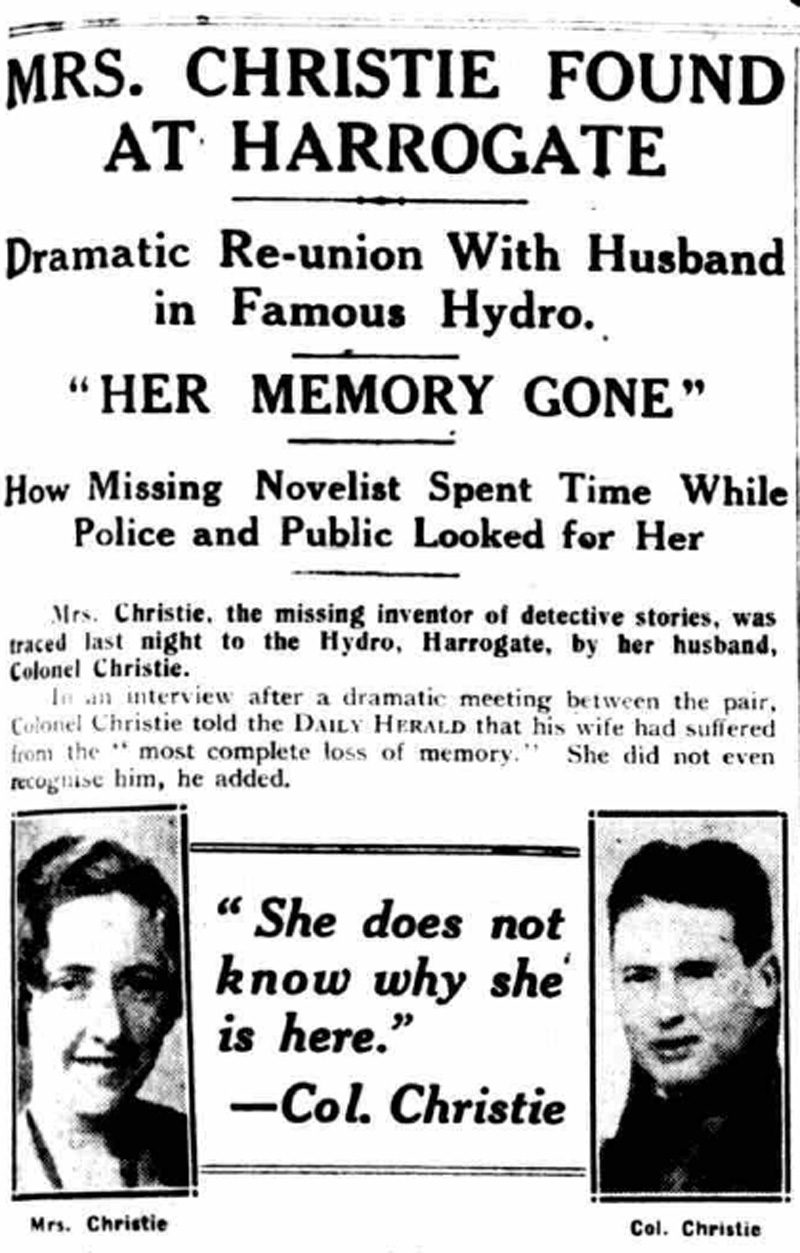
- 14 December 1926, at the Swan Hydropathic Hotel in Harrogate, Yorkshire
- Name she used
- Mrs Teresa Neele, saying she had come from Cape Town, South Africa
- Book of the year
- The Murder of Roger Ackroyd, published in 1926, had just made her famous
Events on this day
- 1818Illinois is admitted to the Union as the 21st state of the United States.
- 1847Frederick Douglass, who had escaped slavery, publishes The North Star, his antislavery newspaper.
- 1854Gold miners and government forces clash at the Eureka Stockade in Victoria, Australia, the climax of long grievances on the goldfields.
- 1912Bulgaria, Serbia, Greece and Montenegro sign an armistice with Turkey, ending the fighting of the First Balkan War.
- 1947Tennessee Williams's A Streetcar Named Desire premieres on Broadway, with Marlon Brando as Stanley Kowalski.
- 1967Christiaan Barnard performs the first human heart transplant at Groote Schuur Hospital, Cape Town; Louis Washkansky receives the heart of Denise Darvall.
- 1979Eleven people are killed in a crowd surge outside a concert by The Who in Cincinnati, Ohio.
- 1984A gas leak at a Union Carbide pesticide plant in Bhopal, India, kills thousands; Britannica puts the eventual death toll at 15,000 to 20,000, with some half a million survivors left with chronic ailments.
- 1989Meeting off Malta, US President George Bush and Soviet leader Mikhail Gorbachev issue statements suggesting the Cold War is coming to an end.
- 1992Engineer Neil Papworth sends the first text message, typing 'Merry Christmas' on a computer and sending it over the Vodafone network to a colleague's phone.
Born on this day
- 1755Gilbert Stuart — American portraitist, renowned for his portrait of George Washington.
- 1857Joseph Conrad — Polish-born English novelist of Heart of Darkness and Lord Jim.
- 1895Anna Freud — Austrian-British psychoanalyst, a founder of child psychoanalysis.
- 1911Nino Rota — Italian composer of concert works and celebrated film scores.
- 1924John Backus — American mathematician and computer scientist.
- 1930Jean-Luc Godard — French director whose Breathless pioneered the French New Wave.
- 1948Ozzy Osbourne — English singer, lead vocalist of the heavy metal band Black Sabbath.
- 1960Julianne Moore — Academy Award-winning American actress.
Died on this day
- 1552Francis Xavier — Spanish Jesuit, the leading Roman Catholic missionary of his age, dead of fever off the coast of China.
- 1894Robert Louis Stevenson — Scottish author of Treasure Island, dead in Samoa at 44.
- 1910Mary Baker Eddy — American religious leader, founder of Christian Science and of the Christian Science Monitor.
- 1919Pierre-Auguste Renoir — French painter, a founder of the Impressionist style.
- 1979Dhyan Chand — Indian field hockey legend of the pre-war Olympic game.
- 2000Gwendolyn Brooks — Pulitzer Prize-winning American poet of everyday Black life in Chicago.
The featured story: the night Agatha Christie vanished
In 1926 Agatha Christie was thirty-six, suddenly famous and privately in pieces. The Murder of Roger Ackroyd, published that spring, had made her the most talked-about crime writer in Britain, but her mother had died earlier in the year, and her husband Archie had told her he was in love with another woman, Nancy Neele, and wanted a divorce. On Friday 3 December the couple quarrelled, and Archie left their house, Styles, in Sunningdale, Berkshire, to spend the weekend away. Late that evening, at about a quarter to ten, Christie drove out into the dark — and vanished.
Her car was found the next morning at Newlands Corner, near Guildford, run into the bushes above a chalk quarry as if it had left the road out of control. Inside were a fur coat, a dressing case and her driving licence. Surrey police searched the Downs, dragged ponds and followed up reported sightings across the country, while the newspapers turned the hunt into a national sensation and a reward was offered. The surviving police file, kept by The National Archives, shows a quieter reality: the deputy chief constable later wrote to the Home Office that a good deal of the press coverage was without foundation, and that the whole search had cost his force about twenty-five pounds.
Eleven days after she disappeared, on 14 December, Christie was recognised at the Swan Hydropathic Hotel in Harrogate, a spa town some two hundred miles north. She had been staying there quietly under the name Mrs Teresa Neele — Neele being the surname of her husband's lover — and had told the hotel she came from Cape Town. Archie travelled up and identified her that evening, telling reporters that she had suffered a complete loss of memory and did not seem to know who she was. Doctors who examined her spoke of memory loss, and she could give no account of the missing days. Christie rarely spoke of the episode in public afterwards, and writers have argued ever since over what really happened in those eleven days: breakdown, amnesia, or a story she chose never to explain.
Why this date matters
December 3 keeps staging the same drama at different scales: something familiar breaks, and something new begins. A novelist walks out of her own life for eleven days and returns to become the best-selling fiction writer of all time. A Cape Town surgeon gives a dying grocer another woman's heart and opens the age of transplantation. A pesticide plant leaks in the night at Bhopal and becomes the worst industrial disaster in history. And an engineer testing a phone network types two words, 'Merry Christmas', and quietly starts the age of the text message.
Sources
- Encyclopaedia Britannica — On This Day: December 3
- HISTORY — What Happened on December 3
- The National Archives — Police report on the disappearance of Agatha Christie
- 1911 Encyclopaedia Britannica — Stevenson, Robert Louis Balfour (Wikisource)
The facts on this page were checked against these sources on 18 November 2026. The History Trail's permanent pages are researched and written for this site; the live profiles elsewhere on The History Trail are assembled automatically from Wikipedia and Wikidata.
About the Author
Researched and written by the The History Trail Editorial Team — the accountable editorial function behind this site's permanent story pages. The team works from the published sources cited on each page; it does not invent historians, reviewers or credentials, and it corrects errors openly.
Fact Check
Every load-bearing fact on this page traces to one of the sources listed above, and significant claims link to their source in the text. Our checking method is described on the methodology page; errors can be reported via the corrections page.
Sources & Citations
Cite this page as: The History Trail Editorial Team, The History Trail — this article's title, publication and update dates are shown beneath its headline. The full source list appears under Sources above; the site's source standards are on the sources page.