
On This Day
December 17 in History
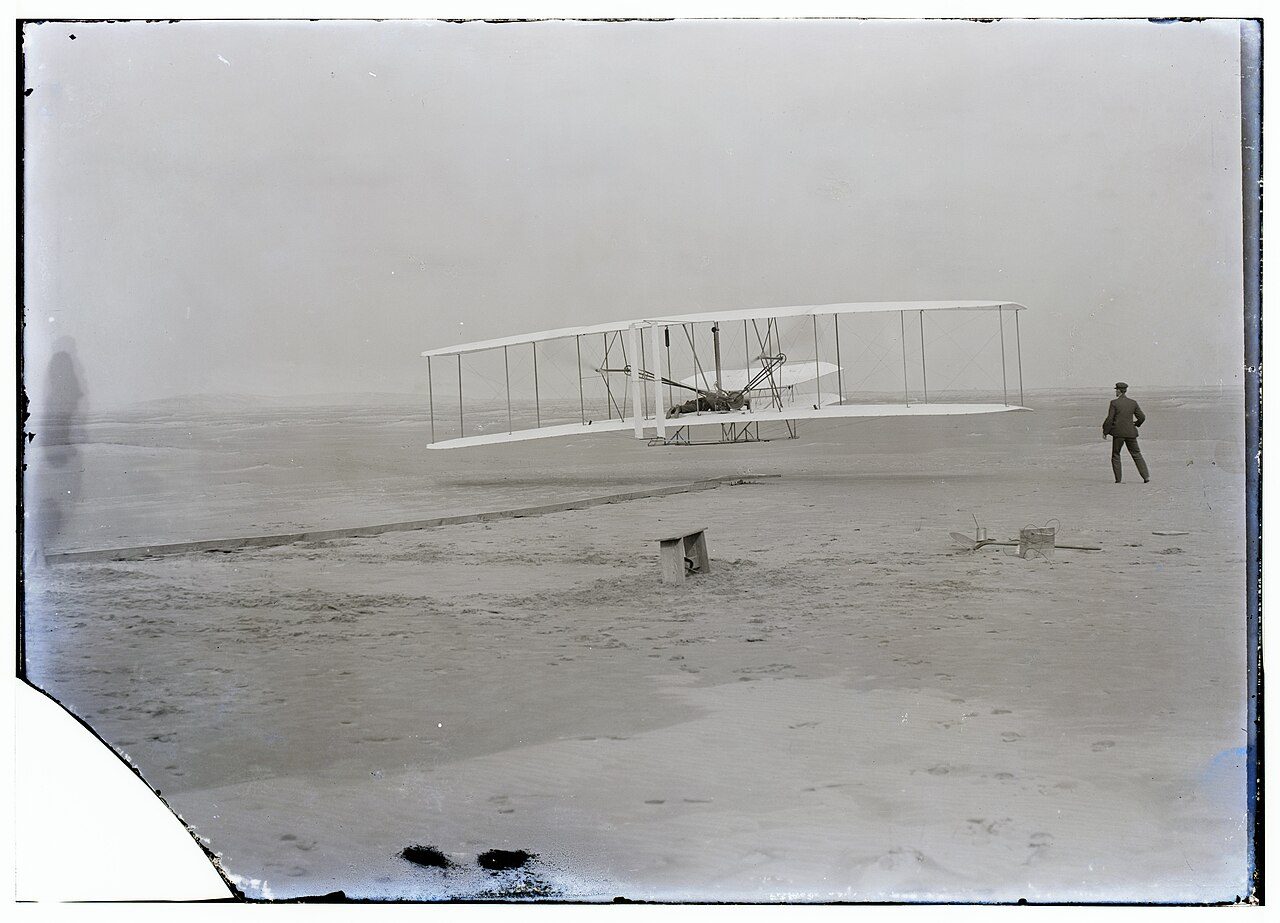
On 17 December 1903, at Kill Devil Hills in North Carolina, Orville Wright flew a powered aeroplane for twelve seconds over 120 feet — the first powered, sustained and controlled flight in history; by the fourth flight that morning his brother Wilbur stayed in the air 59 seconds. December 17 is also the day The Simpsons first aired as a series and Pope Francis was born.
Choose another date: open the On This Day calendar to browse events, births and deaths for any day of the year.
At a Glance
- First flight
- Orville Wright, 10:35 a.m., 17 December 1903 — 120 feet in 12 seconds, into a headwind gusting to 27 mph
- Longest flight
- Wilbur's fourth flight of the day — 852 feet in 59 seconds
- The machine
- The Wright Flyer, a 40-foot, 605-pound biplane whose homemade engine drove two pusher propellers by chain
- The real distance
- Into the headwind, Orville's 120 feet over the ground equalled roughly 540 feet travelled through the air
- The witnesses
- Five local men, mostly from the Kill Devil Hills lifesaving station; John T. Daniels took the famous photograph
- The end
- A gust overturned the Flyer after the fourth flight and wrecked it; it never flew again and is now in the Smithsonian
Events on this day
- 1538Pope Paul III excommunicates Henry VIII of England, completing the breach between the English crown and Rome.
- 1777France formally recognises the independence of the United States, the alliance that will bring French money, troops and ships into the Revolutionary War.
- 1862U.S. general Ulysses S. Grant issues General Order No. 11, expelling Jews from his military district — an order Lincoln revokes within weeks.
- 1892The first issue of Vogue is published in New York as a weekly society newspaper; it becomes the world's most influential fashion magazine.
- 1903Orville Wright makes the first powered, controlled aeroplane flight at Kill Devil Hills — the featured story above.
- 1963The Clean Air Act becomes law in the United States, the first major federal legislation to control air pollution nationwide.
- 1989The Simpsons airs its first full episode, a Christmas special; it becomes the longest-running American animated series and sitcom.
- 2010Tunisian street vendor Mohamed Bouazizi sets himself on fire in protest at police harassment; his act ignites the Tunisian revolution and the Arab Spring.
- 2011North Korean leader Kim Jong Il dies; his son Kim Jong Un succeeds him, extending the family's rule into a third generation.
- 2014The United States and Cuba announce the restoration of diplomatic relations after more than half a century.
Born on this day
- 1760Deborah Sampson — American woman who fought in the Revolutionary War disguised as a man, serving more than a year before being discovered.
- 1807John Greenleaf Whittier — American Quaker poet and abolitionist, one of the popular 'Fireside Poets'.
- 1874W. L. Mackenzie King — Canada's longest-serving prime minister, who led the country through the Second World War.
- 1903Erskine Caldwell — American novelist of Tobacco Road and God's Little Acre, chronicler of the rural Southern poor.
- 1936Pope Francis (Jorge Mario Bergoglio) — Argentine-born pope from 2013, the first from the Americas and the first Jesuit to hold the office.
Died on this day
- 1663Queen Nzinga — ruler of Ndongo and Matamba in Angola, who resisted Portuguese colonisation for decades.
- 1830Simón Bolívar — the Liberator who led the independence of much of South America from Spain, dead in Colombia at 47, a year after his project of continental unity collapsed.
- 2011Kim Jong Il — North Korean leader, dead at 69 after 17 years of absolute rule.
The featured story: the Wright brothers' first powered flight, 17 December 1903
The aeroplane was invented not by a university or a government laboratory but in a bicycle shop in Dayton, Ohio. Wilbur and Orville Wright, who built and repaired bicycles for a living, approached flight as an engineering problem with three parts — lift, power and, above all, control. From 1900 they tested gliders each autumn at Kill Devil Hills, near Kitty Hawk on North Carolina's Outer Banks, chosen for its steady winds, soft sand and privacy. Over a thousand glides taught them to fly; their decisive invention was three-axis control, a system of warping wings and rudders that let a pilot steer and balance a machine in the air. By late 1903 they had built a powered Flyer: a biplane with a 40-foot wingspan, weighing 605 pounds, driven by a homemade petrol engine turning two pusher propellers.
The first attempt, on 14 December, nearly ended the story. The brothers tossed a coin for the honour; Wilbur won, took off down the launching rail, oversteered, stalled and dove into the sand after 105 feet. Repairs took three days. On the morning of Thursday 17 December the weather was bitter — freezing temperatures, puddles iced over, a wind gusting to 27 miles per hour — but the brothers decided not to wait. It was Orville's turn. He had set up a camera on a tripod, aimed at the end of the rail, and asked John T. Daniels of the Kill Devil Hills lifesaving station to squeeze the shutter bulb if anything happened. At 10:35 a.m. Orville released the restraining wire and the Flyer moved down the rail, Wilbur running alongside steadying a wing — and rose into the air.
The flight lasted twelve seconds and covered 120 feet over the ground — though into that headwind the machine had flown some 540 feet through the air, at an airspeed the brothers reported as over thirty miles per hour. The brothers took turns for three more flights, each longer than the last, learning the machine's manners as they went. On the fourth, just before noon, Wilbur flew 852 feet in 59 seconds. Then, with the Flyer back on the sand, a gust caught it and rolled it over, wrecking it beyond repair; it never flew again. The Wrights sent their father a telegram whose plainness has become famous: 'Success four flights Thursday morning all against twenty one mile wind started from level with engine power alone average speed through air thirty one miles longest 57 seconds inform press home Christmas.'
The world was slow to believe them — there had been no crowd, no press, only five witnesses and Daniels's photograph, which became the most famous image in aviation. The brothers kept working in near-secrecy, and by 1905 had a practical aeroplane that could turn, circle and stay up for half an hour. What happened at Kill Devil Hills was not the longest or highest flight of its year; it was something more fundamental — the first time a powered machine had taken off, flown under complete control and landed at a point as high as where it started, ready to do it again. Every aircraft since, from biplanes to airliners to the machines that landed on the Moon, descends from those twelve seconds over the sand.
Why this date matters
December 17 is a date for new worlds announcing themselves. France recognises a republic that does not yet securely exist; a fashion weekly appears that will define a century's taste; a cartoon family debuts in a Christmas special and never leaves the air; a Tunisian vendor's despair lights a fire that crosses the Arab world. And at its centre stands the date's purest instance: two bicycle mechanics on an empty beach, in a freezing wind, proving in twelve seconds that the oldest dream of the species — to fly — was now a machine, a method and a fact. December 17 is the calendar's day for beginnings nobody quite believes at first.
Sources
- Encyclopaedia Britannica — On This Day: December 17
- HISTORY — This Day in History: December 17
- Encyclopaedia Britannica — Wright brothers
- Smithsonian National Air and Space Museum — First Flight?
- National Park Service — 1903: The First Flight
The facts on this page were checked against these sources on 19 November 2026. The History Trail's permanent pages are researched and written for this site; the live profiles elsewhere on The History Trail are assembled automatically from Wikipedia and Wikidata.
About the Author
Researched and written by the The History Trail Editorial Team — the accountable editorial function behind this site's permanent story pages. The team works from the published sources cited on each page; it does not invent historians, reviewers or credentials, and it corrects errors openly.
Fact Check
Every load-bearing fact on this page traces to one of the sources listed above, and significant claims link to their source in the text. Our checking method is described on the methodology page; errors can be reported via the corrections page.
Sources & Citations
Cite this page as: The History Trail Editorial Team, The History Trail — this article's title, publication and update dates are shown beneath its headline. The full source list appears under Sources above; the site's source standards are on the sources page.