
On This Day
April 10 in History
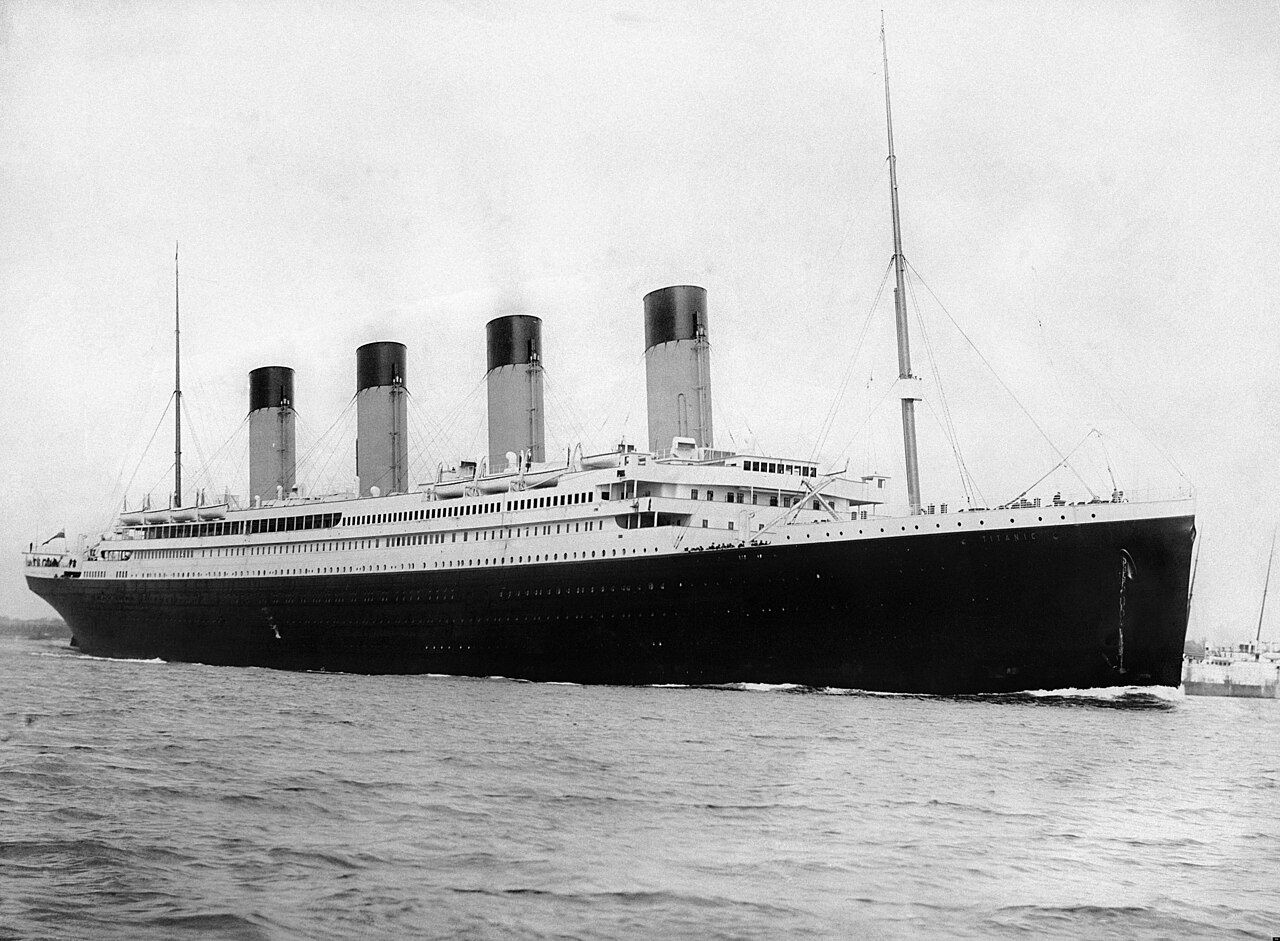
On 10 April 1912 RMS Titanic departed Southampton on her maiden voyage to New York, five days before she struck an iceberg and sank with the loss of more than 1,500 lives. April 10 is also the day The Great Gatsby was published in 1925 and the Good Friday Agreement signed in 1998.
Choose another date: open the On This Day calendar to browse events, births and deaths for any day of the year.
At a Glance
- The ship
- Built by Harland and Wolff in Belfast for the White Star Line; 882 feet long
- The route
- Southampton, then Cherbourg and Queenstown, bound for New York
- The people
- Some 2,200 passengers and crew aboard for the maiden crossing
- The near-miss
- Her suction tore the liner New York from its moorings as she departed
- The captain
- Edward Smith, commodore of the White Star fleet
- The end
- She struck an iceberg on 14 April and sank with the loss of more than 1,500 lives
Events on this day
- 1849American inventor Walter Hunt patents the safety pin, a design he is said to have devised in an afternoon to settle a fifteen-dollar debt.
- 1866The American Society for the Prevention of Cruelty to Animals (ASPCA) is founded in New York by Henry Bergh.
- 1912RMS Titanic departs Southampton on her maiden voyage to New York — the featured story above.
- 1925F. Scott Fitzgerald's novel The Great Gatsby is published in New York.
- 1938Austrians vote in a referendum staged by Nazi Germany to approve the Anschluss, the annexation of Austria into the Reich.
- 1953House of Wax, the first colour 3D feature film from a major studio, opens in New York, launching the 1950s 3D craze.
- 1970Paul McCartney announces he is leaving the Beatles, effectively ending the group.
- 1971The U.S. table-tennis team arrives in China, the first American delegation invited since 1949, opening 'ping-pong diplomacy'.
- 1998The Good Friday Agreement is signed in Belfast, setting the terms that end the Northern Ireland Troubles.
Born on this day
- 1847Joseph Pulitzer — Hungarian-born American newspaper publisher whose prizes still define American journalism.
- 1887Bernardo Houssay — Argentine physiologist, Nobel laureate for his work on the pituitary gland.
- 1917Robert Burns Woodward — American chemist, master of organic synthesis and Nobel laureate.
- 1924Kenneth Noland — American painter of colour-field targets and stripes.
- 1927Marshall Nirenberg — American biochemist who helped crack the genetic code.
- 1934David Halberstam — American journalist and historian, chronicler of Vietnam and of American power.
- 1936John Madden — American football coach and broadcaster whose name later fronted a video-game empire.
Died on this day
- 1931Kahlil Gibran — Lebanese-American poet and artist, author of The Prophet, dead in New York at 48.
- 1966Evelyn Waugh — English novelist of Brideshead Revisited and Scoop, dead at 62.
- 1975Walker Evans — American photographer of the Great Depression for the Farm Security Administration, dead at 71.
The featured story: the Titanic sails on her maiden voyage, 10 April 1912
Shortly after noon on 10 April 1912, RMS Titanic pulled away from the dock at Southampton and began her maiden voyage, the largest moving object human beings had ever built, bound for Cherbourg, then Queenstown in Ireland, then New York. As Britannica's account for young readers puts it, she had been built in Belfast by Harland and Wolff for the White Star Line, 882 feet long and fitted out as a floating palace, and some 2,200 people were aboard for the crossing, from the millionaires of first class to the emigrants below decks seeking a new life in America.
The departure nearly supplied its own omen. As Titanic moved down the channel, the suction of her hull pulled the moored liner New York from its berth, snapping its lines and swinging it toward the great ship; only quick work by tugs and a pause on Titanic's engines averted a collision in the first hour of the voyage. The crowd on the quay cheered the near-miss as a good story. She crossed to Cherbourg that evening, took on more passengers, and the next day called at Queenstown, where the last photographs of her under way were taken from the tender.
The ship was the product of a race for size and luxury between the great Atlantic lines, and her publicity had called her practically unsinkable, a claim her sixteen watertight compartments seemed to justify: she could float with any two, or the first four, flooded. She carried lifeboats for about half the people aboard, which was more than the regulations of 1894 required, and her maiden crossing was sold as the safest passage afloat: she was to maintain a full schedule of sailings through the season, and the White Star Line's chairman, J. Bruce Ismay, was travelling aboard her himself, the surest public sign that the company regarded the voyage as a triumph to be witnessed rather than a risk to be managed. Her captain, Edward Smith, was the most experienced commodore of the White Star fleet, making what was expected to be his final crossing before retirement.
Four days out, on the night of 14 April, Titanic struck an iceberg in the North Atlantic and sank in under three hours, with the loss of more than 1,500 lives; about 700 survivors were picked up by the Carpathia. The disaster rewrote maritime law, lifeboat rules, ice patrols and wireless watch-keeping all descend from it, and fixed 10 April in memory as the day the unsinkable ship sailed smiling out of Southampton, photographed, cheered and five days from the bottom of the sea.
Why this date matters
April 10 holds beginnings of very different weights: an animal-protection society in 1866, a novel in 1925 that would come to define its country, a peace agreement in 1998 that closed thirty years of killing, and the most famous departure in maritime history in 1912. It also shows a hinge of the Cold War turning quietly, ping-pong players doing in 1971 what diplomats could not, and the biggest band in the world ending with a press release in 1970. But the date belongs to the ship: the last morning the twentieth century's favourite disaster was still a triumph.
Sources
- Encyclopaedia Britannica — On This Day: April 10
- HISTORY — What Happened on April 10
- Britannica Kids — Titanic
- Wikipedia — April 10
The facts on this page were checked against these sources on 19 November 2026. The History Trail's permanent pages are researched and written for this site; the live profiles elsewhere on The History Trail are assembled automatically from Wikipedia and Wikidata.
About the Author
Researched and written by the The History Trail Editorial Team — the accountable editorial function behind this site's permanent story pages. The team works from the published sources cited on each page; it does not invent historians, reviewers or credentials, and it corrects errors openly.
Fact Check
Every load-bearing fact on this page traces to one of the sources listed above, and significant claims link to their source in the text. Our checking method is described on the methodology page; errors can be reported via the corrections page.
Sources & Citations
Cite this page as: The History Trail Editorial Team, The History Trail — this article's title, publication and update dates are shown beneath its headline. The full source list appears under Sources above; the site's source standards are on the sources page.