
Animals
Red Panda
The red panda is a cinnamon-furred tree climber of the eastern Himalayas, an animal so distinct that science eventually gave it a family entirely of its own. It was also the first panda: the giant panda inherited its name, not the other way round.
At a Glance
- Scientific name
- Ailurus fulgens — roughly, 'fire-coloured cat'
- Family
- Ailuridae — the red panda is its only living member
- Range
- Mountain forests of Nepal, India, Bhutan, China and Myanmar, mostly above 4,000 feet
- Diet
- Mostly bamboo leaves and shoots; it eats 20 to 30 percent of its body weight a day
- Signature adaptation
- An enlarged wrist bone that works as a 'false thumb' for gripping bamboo
- Population
- Probably around 10,000 adults, though estimates vary widely
- Conservation status
- Endangered; numbers fell by about 40 percent in two decades
Introduction
Few animals have caused taxonomists as much trouble as the red panda. It has the ringed tail of a raccoon, the bamboo diet of a giant panda and the face of neither, and for years it was shuffled between families before DNA studies settled the argument: the red panda belongs to a family of its own, Ailuridae, and it is that family's only living member. Its closest fossil relatives are millions of years gone.
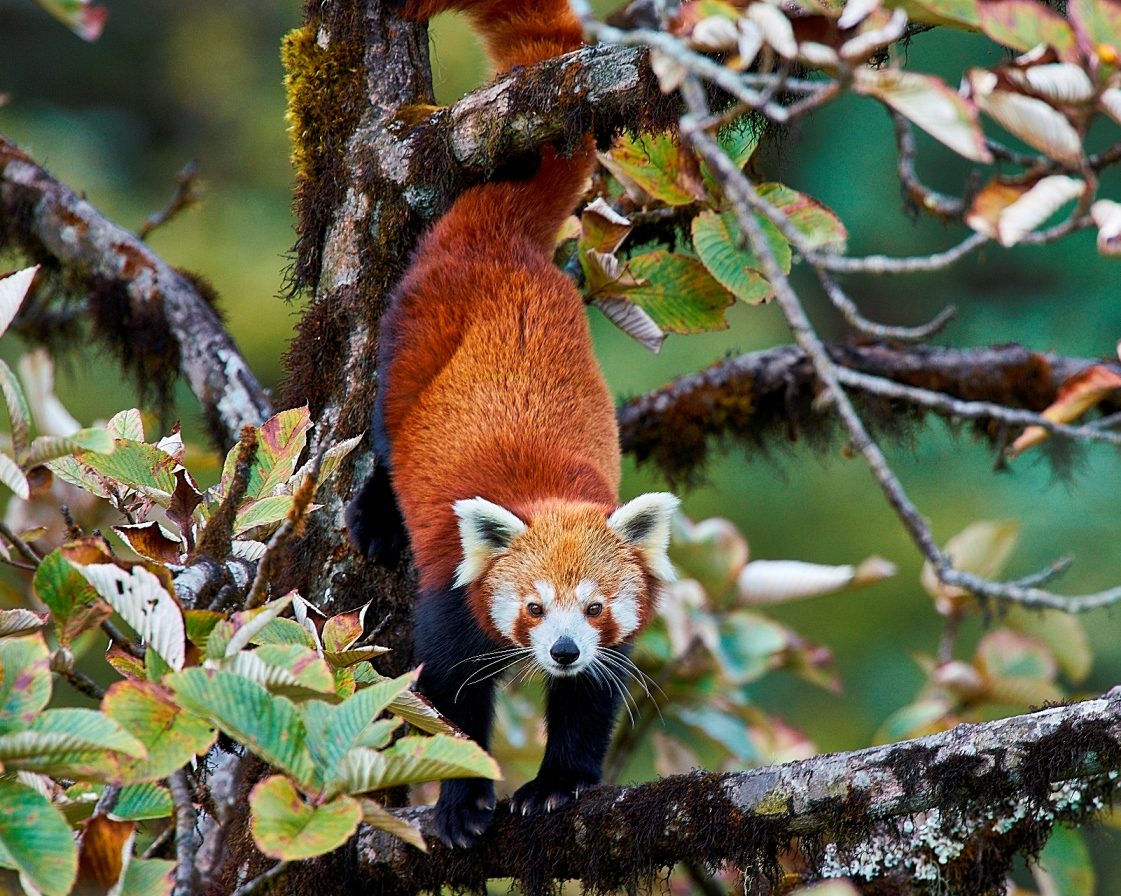
The animal itself is built for life in cold, high forests. A thick cinnamon coat camouflages it among the red moss and white lichen of its home trees, a long, bushy, ringed tail works as both balance pole and blanket, and furred soles let it grip wet branches and icy rock. It spends most of its time in the trees, active mainly at dawn and dusk, and descends headfirst — a trick few mammals of its size can manage.
Background
The red panda's world is the temperate mountain forest of the eastern Himalayas and southwestern China: Nepal, India, Bhutan, Myanmar and China, in small, isolated territories mostly above 4,000 feet where a thick understory of bamboo grows beneath the canopy. That bamboo is close to being the whole story of its life. Bamboo makes up the great bulk of its diet, yet it is poor, hard-to-digest food — a red panda digests only about a quarter of what it eats, so it must consume two to four pounds of leaves and shoots a day and spend much of its waking life feeding.
To handle the bamboo, red pandas evolved a device they share, by convergence, with the giant panda: an enlarged wrist bone, a 'false thumb', that presses stems against the paw so leaves can be stripped. Powerful molars grind the tough leaves. It is a specialist's toolkit, and it ties the species absolutely to forests where bamboo, water, cover and altitude all coincide — a combination that is becoming harder to find.
Timeline
- About 5 million years ago
Red panda fossils of this age have been found in North America — the lineage once ranged far beyond Asia.
- 1825
French zoologist Frédéric Cuvier formally describes the western red panda, calling it the most beautiful animal he had ever seen and naming it Ailurus fulgens.
- 1873
The giant panda is catalogued by science — 48 years after the red panda, which is why the red panda is called the original panda.
- 1897
F. W. Styan identifies a second, larger and more brightly coloured form in China, later named Styan's red panda.
- 1940
San Diego Zoo imports four red pandas caught in Nepal via India; the zoo's first litter is born the following year.
- 1962
The Smithsonian's National Zoo begins the breeding record that has since produced more than 100 surviving red panda cubs.
- 2015
The IUCN lists the red panda as Endangered on its Red List of Threatened Species.
- Past two decades
Researchers estimate the total population has declined by about 40 percent, driven by habitat loss, degradation, human interference and poaching.
Significance
The red panda matters to science out of proportion to its size. As the sole survivor of the Ailuridae, it is a living branch of the carnivore family tree with no close relatives — lose it, and an entire family's tens of millions of years of separate evolution goes with it. Its fossil record, reaching as far as North America, also makes it a clue to how Asia's mountain faunas were assembled.
It matters just as much as a flagship. Red pandas are legally protected in all five range countries and live in dozens of protected areas — 35 in China, 20 in India, eight in Nepal and five in Bhutan — yet logging, livestock grazing, firewood collection, farming and free-ranging dogs still eat into those refuges. Conservation groups such as the Red Panda Network now train local 'forest guardians' to monitor the animals and build support in the villages that share their forest.
Legacy
In zoos, the red panda has become one of the great ambassadors for Himalayan conservation, breeding with some reliability in North America, Europe and Asia — a deliberate insurance population as the wild one shrinks. The Smithsonian's programme alone has produced more than 100 surviving cubs since 1962, and each generation teaches researchers more about a species that is hard to study in clouded, vertical forest.
The wild story is unresolved. The adult population is probably around 10,000, some estimates run far lower, and the decline is expected to continue while habitat fragments and isolated groups inbreed. The red panda's legacy will be decided in the bamboo understory: whether the protected forests of five countries can be kept connected enough for a small, solitary, fire-coloured cat to keep its ancient line alive.
Sources
- Smithsonian's National Zoo and Conservation Biology Institute — Red panda
- San Diego Zoo Wildlife Alliance — Red Panda
- Wikipedia — Red panda (corroboration)
The facts on this page were checked against these sources on 19 November 2026. The History Trail's permanent pages are researched and written for this site; the live profiles elsewhere on The History Trail are assembled automatically from Wikipedia and Wikidata.
About the Author
Researched and written by the The History Trail Editorial Team — the accountable editorial function behind this site's permanent story pages. The team works from the published sources cited on each page; it does not invent historians, reviewers or credentials, and it corrects errors openly.
Fact Check
Every load-bearing fact on this page traces to one of the sources listed above, and significant claims link to their source in the text. Our checking method is described on the methodology page; errors can be reported via the corrections page.
Sources & Citations
Cite this page as: The History Trail Editorial Team, The History Trail — this article's title, publication and update dates are shown beneath its headline. The full source list appears under Sources above; the site's source standards are on the sources page.