
Animals
Emperor penguin
Every other Antarctic animal leaves or sleeps through the winter. The emperor penguin walks inland across the new ice and breeds in it — males balancing a single egg on their feet through two months of darkness while their mates are at sea.
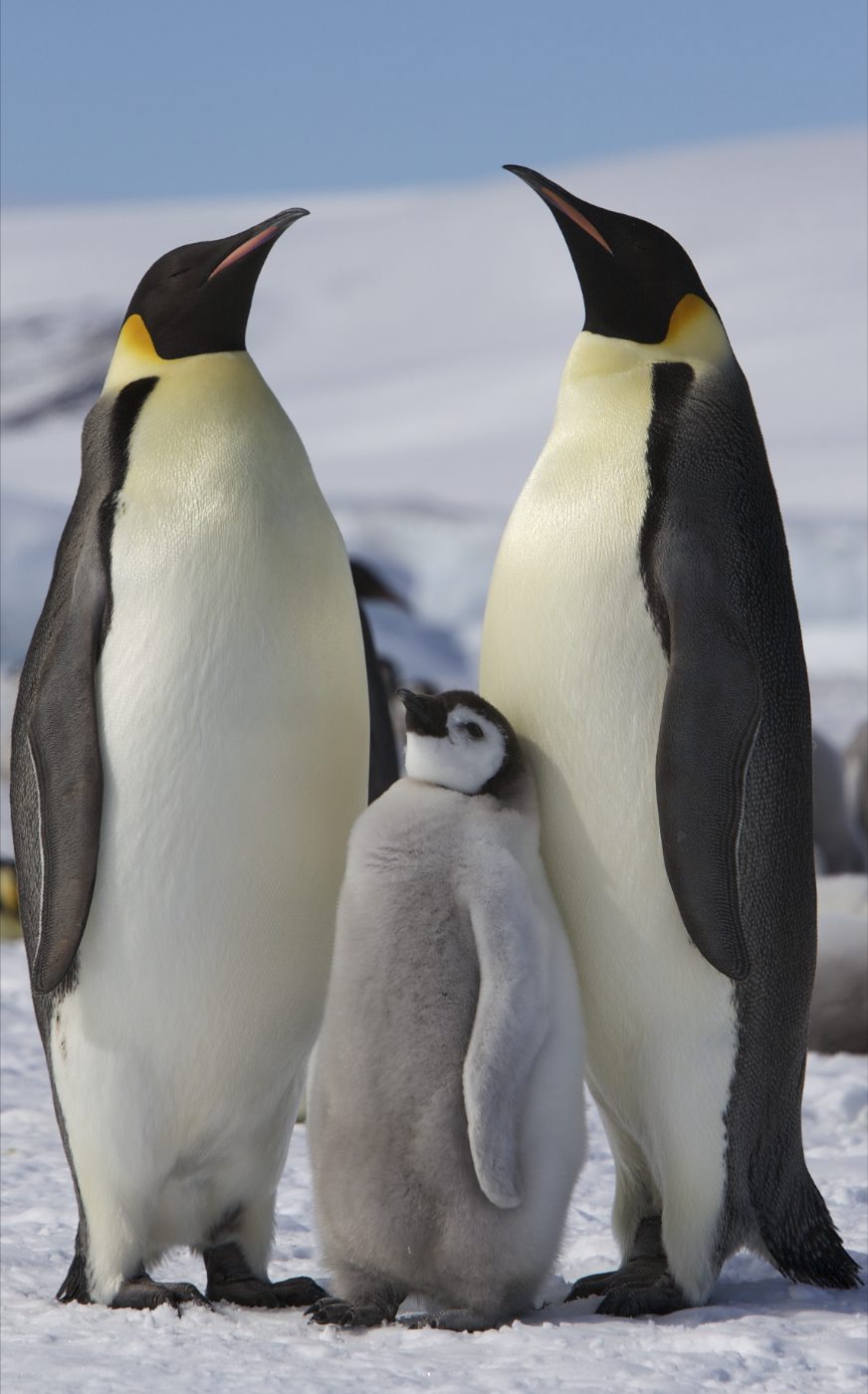
At a Glance
- Scientific name
- Aptenodytes forsteri
- Size
- Largest of the 18 penguin species; adults up to 40 kg at the start of breeding
- Range
- Colonies around the coast of Antarctica, mostly on fast ice
- Breeding
- The only animal that breeds during the Antarctic winter; males alone incubate
- Deepest dive recorded
- 565 metres; longest dive on record 22 minutes
- Diet
- Antarctic silverfish, krill and squid; 2–3 kg a day, up to 6 kg when fattening
- Huddles
- Up to 10 birds per square metre; the inside of a huddle can reach +24°C
- Conservation status
- Endangered; projected to decline with sea-ice loss
Introduction
The emperor penguin is the largest of the eighteen living penguin species, standing well over a metre tall and weighing up to 40 kilograms at the start of the breeding season. Its closest relatives are the king penguins, and like all penguins it is flightless — its wings have become flippers for a life spent mostly in the sea. What sets the emperor apart is not its size but its calendar: it is the only animal that breeds during the Antarctic winter, raising its single chick through months of darkness, blizzards and cold that would kill almost anything else.
That winter breeding is a deliberate trade. By laying in autumn and incubating through the worst of the year, emperors ensure their chicks grow through the spring and are ready to enter the water in the summer, when food is most abundant. The cost is paid almost entirely by the male, who incubates the egg alone while the female returns to the sea to feed.
Background
Emperors breed in colonies scattered around the Antarctic continent, ranging from a few hundred pairs to more than 20,000 pairs, most of them on the fast ice locked between islands or grounded icebergs. Their insulation is extraordinary: several layers of scale-like feathers that even winds above 110 kilometres per hour struggle to ruffle, large reserves of body fat, and small bills and flippers that lose little heat. Arteries and veins lie close together, recycling body heat on its way to and from the extremities, and special fats in their feet keep them from freezing to the ice.
At sea they are among the most capable divers of any bird. Most foraging dives reach 150 to 250 metres, but the deepest dive recorded reached 565 metres, and the longest lasted 22 minutes. They feed on Antarctic silverfish, krill and squid, eating 2 to 3 kilograms a day — and up to 6 kilograms a day when fattening before a moult or the breeding season. Some emperors live beyond forty years, though most do not survive that long in the wild.
Timeline
- About 40 million years ago
The evolution of flightless penguins is traced to the Eocene Epoch, from fossils found on Seymour Island off the Antarctic Peninsula and elsewhere.
- March–April
As autumn closes in, adult emperors leave the sea and travel across the forming fast ice to their traditional colony sites.
- May–June
The female lays a single egg and passes it quickly to the male; if the transfer fumbles, the embryo can freeze within moments.
- June–August
The male incubates the egg on his feet, under a fold of skin, for about two months through the polar night, while the female forages at sea.
- July–August
The chick hatches in midwinter. If the female has not returned, the male can feed it briefly on a secretion from his own crop.
- September–November
Both parents now share chick-rearing, taking turns to fetch food, while chicks gather in crèches for warmth and protection.
- December–January
Chicks shed their grey down, grow waterproof feathers and fledge — just as the fast ice they were raised on begins to break up.
- 2018–2022
Satellite studies record partial or total breeding failure at a series of colonies after the sea ice beneath them broke up too early.
- 2026
The emperor penguin is listed as Endangered, with populations projected to decline as the sea ice it depends on retreats under climate change.
Significance
The emperor's huddle is one of the great cooperative behaviours in nature. Facing katabatic winds and blizzards of up to 200 kilometres per hour, incubating males pack together — as many as ten birds to a square metre — cutting their heat loss by as much as half. The inside of a huddle can reach +24°C while the air outside is far below freezing. No bird holds the warm centre for long: individuals peel off the windward edge, shuffle down the flanks with their eggs on their feet, and rejoin on the sheltered side, so the whole huddle slowly circulates and drifts downwind.
Because the emperor depends on sea ice for breeding, moulting and access to food, it has also become a sentinel species for the Antarctic itself. A bird that needs the ice to form on time, hold through spring and break up only after its chicks can swim is exquisitely exposed to a warming climate. The breeding failures recorded when ice broke up early — chicks in down, unable to swim, lost with the floes — are the mechanism behind the projections that moved the species to Endangered.
Legacy
Emperors were once out-sized even by their own family's standards: the Australian Antarctic Program notes that some extinct penguin species may have weighed around 100 kilograms, more than twice a modern emperor, before vanishing tens of thousands of years ago. The emperor is the last of the giants, and its future now depends on a variable no conservation reserve can fence off — the winter sea ice of an entire continent.
Research programmes such as Australia's long-running emperor studies exist to read that future early: how the birds live, where they travel, and what they need to survive. The emperor's legacy may be as the species that taught us to see Antarctic sea ice not as scenery but as habitat — a platform that must arrive on schedule, every year, or the largest penguin on Earth has nowhere to raise its young.
Sources
- Australian Antarctic Program — Emperor penguin
- Australian Antarctic Program — This week at Mawson: Emperors at Mawson
- Encyclopaedia Britannica — Penguin
- Encyclopaedia Britannica — Antarctica: Animal life
The facts on this page were checked against these sources on 19 November 2026. The History Trail's permanent pages are researched and written for this site; the live profiles elsewhere on The History Trail are assembled automatically from Wikipedia and Wikidata.
About the Author
Researched and written by the The History Trail Editorial Team — the accountable editorial function behind this site's permanent story pages. The team works from the published sources cited on each page; it does not invent historians, reviewers or credentials, and it corrects errors openly.
Fact Check
Every load-bearing fact on this page traces to one of the sources listed above, and significant claims link to their source in the text. Our checking method is described on the methodology page; errors can be reported via the corrections page.
Sources & Citations
Cite this page as: The History Trail Editorial Team, The History Trail — this article's title, publication and update dates are shown beneath its headline. The full source list appears under Sources above; the site's source standards are on the sources page.