
Years
1789 in History
1789 is the year of two revolutions — one being completed, one beginning. In America, George Washington was unanimously elected, the Constitution took effect, and the new federal government assembled itself piece by piece in New York. In France, the Estates-General met for the first time since 1614, the Third Estate swore the Tennis Court Oath, a Paris crowd seized the Bastille, and the National Assembly proclaimed the Declaration of the Rights of Man and of the Citizen.
At a Glance
- Defining event
- The fall of the Bastille, 14 July — a political crisis in France becomes the French Revolution
- In America
- George Washington, unanimously elected with all 69 electoral votes, takes the oath as first president on 30 April
- The oath
- The Tennis Court Oath, 20 June — 576 of 577 Third Estate deputies swear not to disband until France has a constitution
- The declaration
- France's National Assembly approves the Declaration of the Rights of Man and of the Citizen, 26 August
- Building a government
- Congress creates the Treasury and passes the Judiciary Act; the Bill of Rights is approved on 25 September
- At sea
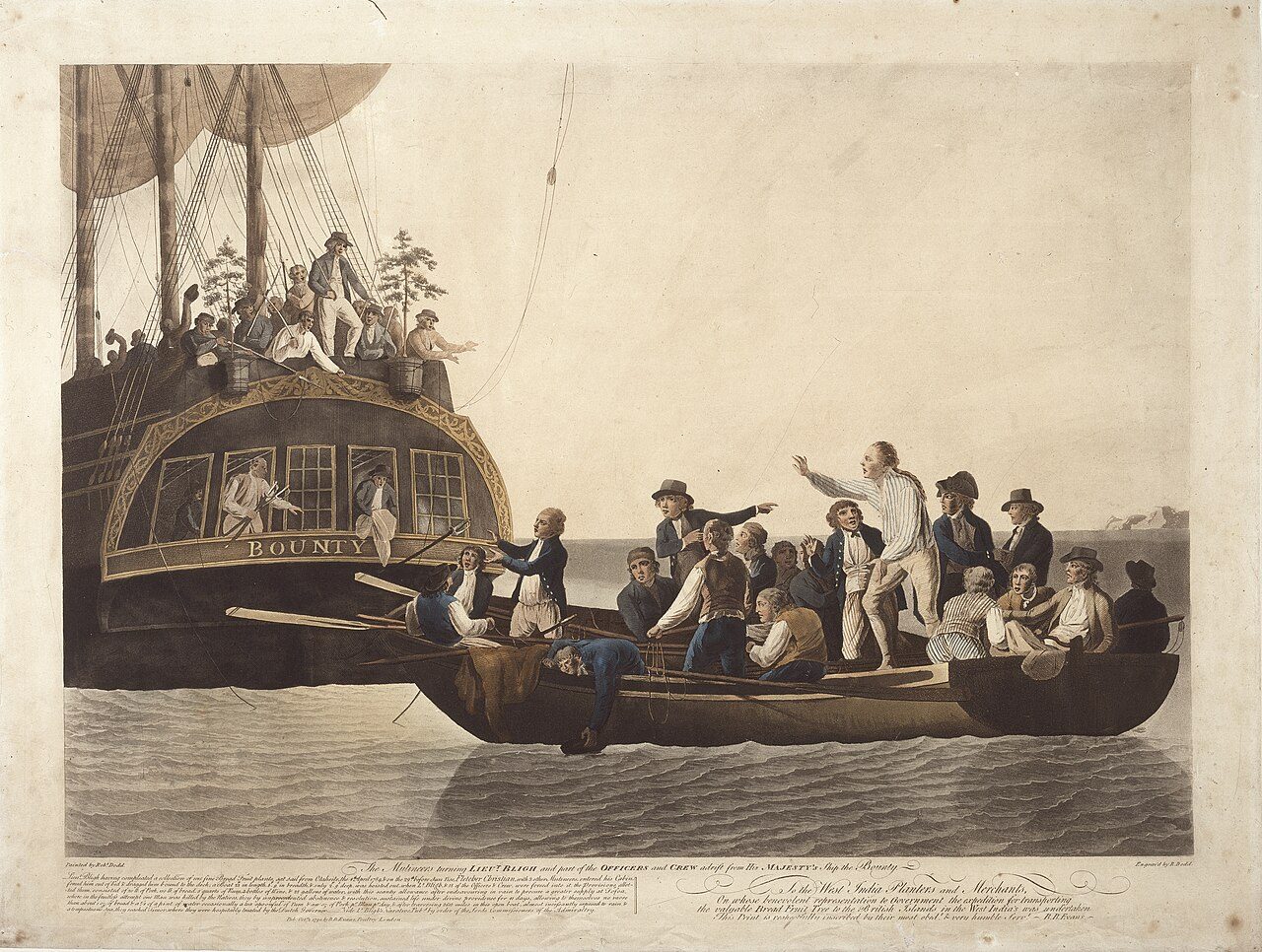
- The mutiny on HMS Bounty, 28 April — Fletcher Christian sets Bligh adrift in the Pacific
The defining story: the French Revolution begins
France in 1789 was broke, hungry and arguing about who should rule it. The Estates-General — the kingdom's assembly of clergy, nobility and commoners — convened at Versailles on 5 May for the first time since 1614, summoned to solve a financial crisis and immediately deadlocked over how it should vote. On 17 June the deputies of the Third Estate declared themselves the National Assembly, the representatives not of an estate but of the French nation. Three days later, on the morning of 20 June, they arrived at their hall to find the doors locked and guarded, the court pleading preparations for a royal session. In the rain they regrouped at the nearest large indoor space, the royal tennis court in the Rue du Jeu de Paume, and there, standing on chairs and a table, all but one of the 577 deputies swore never to separate, and to reassemble wherever circumstances required, until the constitution of the kingdom was established on firm foundations. Only Joseph Martin-Dauch of Castelnaudary refused, signing the register 'opponent'. Within the week the king's attempt to disperse the Assembly had failed.
The king answered pressure with troops. Royal regiments gathered around Paris, and on 11 July Louis XVI dismissed his popular finance minister, Jacques Necker. To many Parisians it looked like a coup: the Assembly would be arrested and the city starved into obedience. What the crowd needed was weapons and gunpowder — and two days earlier the Bastille's governor, Bernard-René de Launay, had taken delivery of 250 barrels of gunpowder transferred from the Arsenal. On the morning of 14 July about nine hundred Parisians converged on the medieval fortress on the city's eastern edge, a state prison since 1659 whose cannon commanded the surrounding streets. Delegates negotiated through the morning, and de Launay even withdrew the cannon from the walls — but before that concession could be announced, two men cut the chains of a drawbridge, part of the crowd surged into the outer yard, and the garrison opened fire. A misunderstanding had become a battle. The Bastille surrendered, de Launay was killed, and a political crisis had become a revolution — the event France still celebrates as its national day.
The Assembly moved fast on the revolution's principles. On 26 August it approved the Declaration of the Rights of Man and of the Citizen, and in October the revolution moved the king himself: a Paris crowd marched on Versailles and compelled Louis XVI to move to Paris, where the revolution could watch him. Across the Atlantic, the same months were spent building a government rather than storming one. American voters chose presidential electors in January; on 4 February Washington was unanimously elected, winning all 69 electoral votes cast; on 4 March the first Congress met in New York as the Constitution took effect; and on 30 April Washington took the oath on the balcony of Federal Hall, becoming the first president of the United States. James Madison introduced the proposed constitutional amendments in June, Congress approved the Bill of Rights — twelve amendments, ten of which were ratified — on 25 September, founded the Department of the Treasury on 2 September, and passed the Judiciary Act on 24 September, creating the federal courts, the attorney general's office and a six-member Supreme Court. John Jay took the oath as first chief justice on 19 October, and on 26 November the first national Thanksgiving Day was observed, on the day Washington had proclaimed.
The year's third drama played out on the other side of the world. HMS Bounty had sailed to Tahiti to collect breadfruit saplings for the Caribbean, and stayed five months while the plants were potted; her crew lived ashore and built second lives they were then ordered to forget. Before dawn on 28 April, near Tofua, master's mate Fletcher Christian led a mutiny, seized the ship from Lieutenant William Bligh, and set him and 18 loyal men adrift in a 23-foot open launch with a few days' bread and water, a compass and a quadrant, but no charts. Most aboard expected to die. Instead Bligh navigated the launch 3,618 nautical miles to Timor — one of the greatest survival voyages ever made — while the Bounty sailed into legend.
Timeline of 1789
- 7 January
American voters choose presidential electors in the first United States presidential election.
- 4 February
George Washington is unanimously elected the first president of the United States, winning all 69 electoral votes cast.
- 4 March
The first Congress meets in New York as the United States Constitution takes effect.
- 28 April
Fletcher Christian leads the mutiny on HMS Bounty and sets Bligh and 18 men adrift in the Pacific.
- 30 April
Washington takes the oath on the balcony of Federal Hall in New York, becoming the first president.
- 5 May
The Estates-General convenes at Versailles for the first time since 1614 — the opening act of the French Revolution.
- 8 June
James Madison introduces proposed amendments to the US Constitution in Congress — the proposals that become the Bill of Rights.
- 20 June
Deputies of the Third Estate, locked out of their hall, swear the Tennis Court Oath at Versailles.
- 14 July
A Paris crowd seizes the Bastille; its governor, Bernard-René de Launay, is killed after its surrender.
- 26 August
France's National Assembly approves the Declaration of the Rights of Man and of the Citizen.
- 24 September
Congress passes the Judiciary Act, creating the federal court system and a six-member Supreme Court.
- 25 September
Congress approves the Bill of Rights — twelve proposed amendments, ten of which are ratified.
- 6 October
A Paris crowd marches on Versailles and compels Louis XVI to move to Paris.
- 26 November
The first national Thanksgiving Day is observed in the United States, on Washington's proclaimed day.
Why 1789 still matters
1789 still matters because it is the year the modern political world was drafted twice, in two different tempers. In New York the work was architectural: a constitution already written was given a president, a treasury, courts and, within months, a bill of rights — revolution converted into administration. In Paris the work was insurrectionary: an assembly invented itself in a locked-out hall, a crowd discovered it could take a fortress, and a declaration announced that men are born free and equal in rights. The two projects shared a vocabulary — rights, constitutions, the nation — and spent the next two centuries arguing over what it meant, often with each other's examples in hand.
The year also shows how revolutions actually begin: not with manifestos but with locked doors, dismissed ministers and gunpowder stored in the wrong fortress. The Bastille held only seven prisoners, and the government was already planning to demolish it and replace it with a park; its fall mattered because it proved that royal authority in Paris rested on consent that had been withdrawn. The Tennis Court Oath, the revolution's founding act, was an improvisation in a sports hall in the rain. Between the oath in June and the king's forced move to Paris in October, France's old order did not so much collapse as discover, step by step, that nobody would defend it — while in New York, on a balcony in April, the newer order quietly swore itself in.
1789 on The History Trail
1789 fills The History Trail from the Pacific to Paris, with two featured stories and the founding months of two republics.
- June 20 in History — the Tennis Court Oath, the founding act of the French Revolution.
- July 14 in History — the fall of the Bastille, still France's national day.
- April 28 in History — the mutiny on the Bounty and Bligh's open-boat voyage.
- April 30 in History — Washington's first inauguration at Federal Hall, New York.
- August 26 in History — the Declaration of the Rights of Man and of the Citizen is approved.
- United States Constitution — the constitution that took effect in March 1789 and gained its Bill of Rights that September.
- Human rights — the idea proclaimed in Paris in August 1789 and argued over ever since.
- Paris — the city whose crowd took the Bastille and marched its king home from Versailles.
Sources
- Encyclopaedia Britannica — On This Day: January 7
- Encyclopaedia Britannica — On This Day: February 4
- Royal Museums Greenwich — William Bligh
- Encyclopaedia Britannica — On This Day: April 30
- Encyclopaedia Britannica — On This Day: May 5
- Encyclopaedia Britannica — On This Day: June 20
- Encyclopaedia Britannica — Storming of the Bastille
- Encyclopaedia Britannica — On This Day: August 26
The facts on this page were checked against these sources on 19 November 2026. The History Trail's permanent pages are researched and written for this site; the live profiles elsewhere on The History Trail are assembled automatically from Wikipedia and Wikidata.
About the Author
Researched and written by the The History Trail Editorial Team — the accountable editorial function behind this site's permanent story pages. The team works from the published sources cited on each page; it does not invent historians, reviewers or credentials, and it corrects errors openly.
Fact Check
Every load-bearing fact on this page traces to one of the sources listed above, and significant claims link to their source in the text. Our checking method is described on the methodology page; errors can be reported via the corrections page.
Sources & Citations
Cite this page as: The History Trail Editorial Team, The History Trail — this article's title, publication and update dates are shown beneath its headline. The full source list appears under Sources above; the site's source standards are on the sources page.