
Vehicles
Mayflower
The Mayflower was an ordinary English merchant ship of about 180 tons that, in 1620, carried 102 passengers across the Atlantic in 66 days to found the Plymouth colony. No detailed description of her survives — yet the brief government drafted aboard her outlasted the ship herself.
At a Glance
- Type
- Square-rigged merchant sailing ship; no detailed description of the original survives
- Estimated size
- About 180 tons and 90 feet (27 metres) long, by marine archaeologists' estimates
- Master
- Christopher Jones, who had purchased the ship in 1608
- Final departure
- Plymouth, England, 16 September 1620, sailing alone after the Speedwell proved unseaworthy
- Voyage
- 66 days; first landed 21 November 1620 at Cape Cod, in present-day Provincetown, Massachusetts
- Passengers
- 102 settlers, deposited at the site of Plymouth the day after Christmas 1620
- Return and fate
- Sailed back to England in April 1621; her true fate is unknown
Introduction
The Mayflower was the ship that carried the Pilgrims from England to North America in 1620, where they established Plymouth — the first permanent New England colony. She was not a naval vessel or a purpose-built emigrant ship but a working merchantman, square-rigged, estimated by marine archaeologists at about 180 tons and 90 feet (27 metres) long. Chartered by a group of London merchants known as the London Adventurers, she left Plymouth, England, on 16 September 1620 with 102 passengers, endured a storm-battered crossing of 66 days, and anchored off Cape Cod on 21 November, far north of her intended destination near the Hudson River.
Almost everything famous about the Mayflower happened because of that navigational failure. Landing outside the territory covered by their patent, the settlers needed a legal basis for governing themselves, and before going ashore their leaders drafted the Mayflower Compact — a document of about 200 words that Britannica describes as the first framework of government written and enacted in the territory that became the United States. The ship then served as the colony's shelter and storehouse through its deadly first winter before sailing home in April 1621.
Origins: A Working Ship and a Troubled Start
No detailed description of the original vessel exists, and even her beginnings are partly conjectural. Some sources suggest she was built at Harwich, England, shortly before the merchant Christopher Jones purchased her in 1608; Jones was her master on the famous voyage. For a dozen years she did the unglamorous work of a merchant sailing ship before the Adventurers chartered her in 1620 to carry a mixed company of religious Separatists — many of them returning from exile in Holland — and other settlers, servants and crew across the Atlantic to plant a colony in the northern part of Virginia, as the grant then defined it.
The voyage nearly failed before it began. The Separatists from Holland arrived on the Speedwell, a smaller vessel that was to accompany the Mayflower, and the two ships set out together from Southampton on 15 August 1620. The Speedwell proved unseaworthy and was twice forced back into port. The expedition consolidated: some passengers gave up, the rest crowded aboard the Mayflower with what supplies could be transferred, and on 16 September the Mayflower sailed from Plymouth, England, alone — late in the season, into the autumn Atlantic, with more than a hundred people packed into a cargo ship. Among her best-known passengers were William Bradford, the colony's future governor, and Captain Myles Standish, its military leader.
Timeline
- 1608
English merchant Christopher Jones purchases the Mayflower, a square-rigged merchant ship probably built at Harwich shortly before.
- 15 August 1620
The Mayflower and the smaller Speedwell leave Southampton together, carrying the Pilgrims toward North America.
- 16 September 1620
After the Speedwell twice turns back as unseaworthy, the Mayflower sails alone from Plymouth, England, with 102 passengers.
- 21 November 1620
After a 66-day voyage through rough seas and storms, the Mayflower anchors at Cape Cod, at present-day Provincetown, Massachusetts.
- November 1620
Before going ashore, the settlers' leaders draft the Mayflower Compact, agreeing to frame just and equal laws for the colony.
- 26 December 1620
The day after Christmas, the ship deposits its 102 settlers at the site they name Plymouth, across the bay from Cape Cod.
- Winter 1620–1621
The Mayflower remains in port through the first winter, serving the colony while sickness kills nearly half of the settlers.
- April 1621
Her passengers ashore and houses built, the Mayflower leaves New England and sails back to England.
- 1957
A full-scale replica, Mayflower II, is built in England and sails to Massachusetts, commemorating the original voyage.
Significance
The Mayflower's significance begins with what her passengers did aboard her. Because storms had carried the ship beyond the bounds of the Virginia grant, the settlers had no charter under which to govern themselves — and some among them reportedly argued they owed obedience to no one once ashore. The Compact answered that problem in advance: its signers covenanted to combine into a civil body politic and to enact, constitute and frame such just and equal laws as the colony's general good required. It was a practical instrument, not a declaration of independence — the signers professed loyalty to King James — but it grounded a government's authority in the agreement of the governed, in writing, before a single house was built.
The voyage also fixed the geography of English America. Had the ship reached the Hudson River as planned, the Separatists would have been absorbed into Virginia's orbit. Instead, Plymouth became a separate colony with its own institutions, its own alliance with the Wampanoag, and its own story — the story that, two centuries later, Americans would choose as the nation's founding parable. The ship that missed her destination gave New England its beginning.
Myths and disputes
The Mayflower's fate is genuinely unknown, and the claims made for it should be labelled as such. Britannica records that her true fate remains unknown, while noting the argument of some historians that she was scrapped for timber that was reused in a barn at Jordans, in Buckinghamshire. Other accounts place her breaking-up at Rotherhithe, in London, a few years after Captain Jones's death, when an appraisal valued the worn ship at little more than a hundred pounds. No evidence conclusively supports either story, and no authenticated timber of the Mayflower survives to be pointed to.
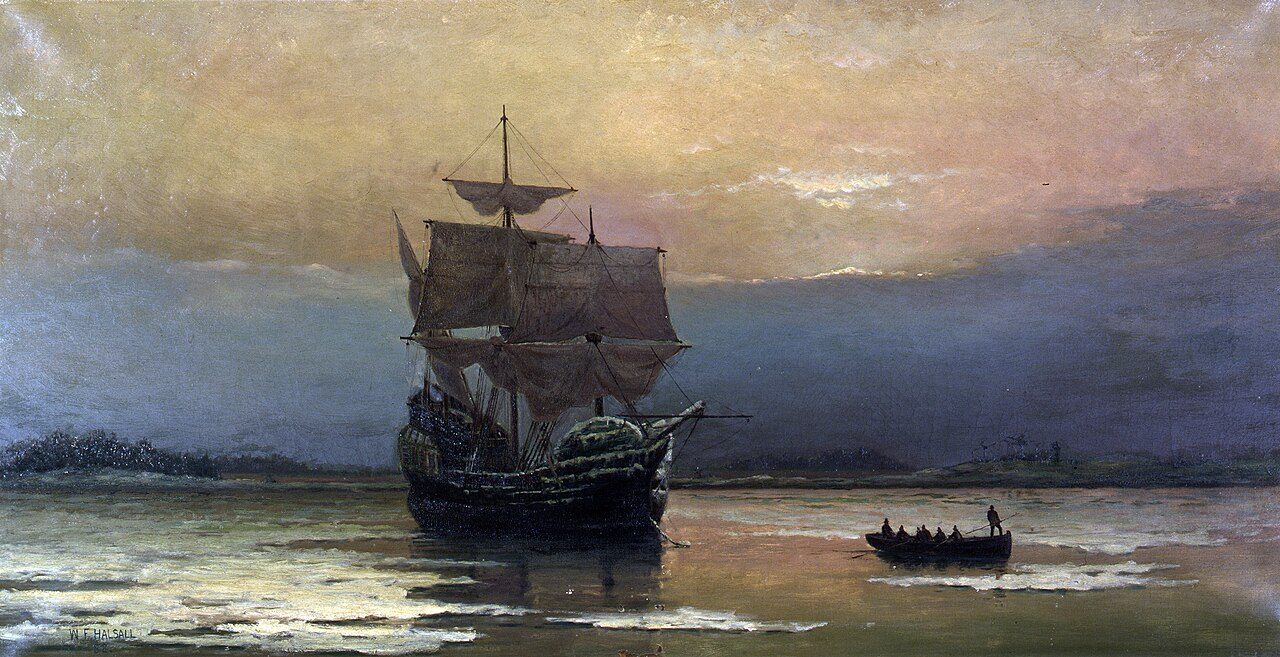
A related caution applies to every picture of the ship, including the famous replica. Because no detailed description, plan or contemporary portrait of the original exists, Mayflower II — built in England and sailed to Massachusetts in 1957 — is an informed reconstruction of a typical merchant ship of her size and period, not a copy. The paintings, models and the replica herself show what a 180-ton ship of 1620 probably looked like. The real Mayflower's exact appearance went unrecorded, which is part of why she could become a symbol: almost any generation can rebuild her in its own image.
Legacy
The Mayflower left Plymouth in April 1621 and passed out of the record, but her name never did. Plymouth colony grew, the Compact was remembered as a founding text of self-government, and the ship became the central icon of America's colonial origin story — commemorated in 1957 by the replica's Atlantic crossing and visited ever since at Plymouth, Massachusetts. Millions of people today trace descent from her 102 passengers, a number that gives the small merchantman a genealogical reach no warship of her century can match.
Her legacy is also contested ground. For the Wampanoag, whose homeland the ship's passengers settled, the Mayflower marks the beginning of colonisation and its costs, a perspective marked each year in the National Day of Mourning at Plymouth. The ship thus carries two histories at once: a founding voyage in the American story, and an arrival with devastating consequences in the Wampanoag one.
Sources
- Encyclopaedia Britannica — Mayflower: History, Voyage, Landing, & Facts
- Britannica Kids — Mayflower
- Smithsonian Magazine — How to Tell the Thanksgiving Story on Its 400th Anniversary
- Smithsonian National Museum of the American Indian — Timeline: The First Thanksgiving
- Plimoth Patuxet Museums — What did they eat at the 1621 harvest celebration?
The facts on this page were checked against these sources on 19 November 2026. The History Trail's permanent pages are researched and written for this site; the live profiles elsewhere on The History Trail are assembled automatically from Wikipedia and Wikidata.
About the Author
Researched and written by the The History Trail Editorial Team — the accountable editorial function behind this site's permanent story pages. The team works from the published sources cited on each page; it does not invent historians, reviewers or credentials, and it corrects errors openly.
Fact Check
Every load-bearing fact on this page traces to one of the sources listed above, and significant claims link to their source in the text. Our checking method is described on the methodology page; errors can be reported via the corrections page.
Sources & Citations
Cite this page as: The History Trail Editorial Team, The History Trail — this article's title, publication and update dates are shown beneath its headline. The full source list appears under Sources above; the site's source standards are on the sources page.