
Timelines
Evolution of the Telephone
The telephone evolved in three great moves: an instrument (Bell's patent and first call in 1876), a network (exchanges, transcontinental lines in 1915, a transatlantic service in 1927 and a cable in 1956), and then freedom from the wire (the first handheld mobile call in 1973, the first commercial mobile phone in 1983, and the smartphone in 2007). This timeline follows all three moves in fifteen verified milestones.
At a Glance
- Span
- 1861 to 2007 - from Reis's tone instruments to the iPhone
- The founding patent
- US Patent 174,465, granted to Alexander Graham Bell on 7 March 1876
- The network begins
- First commercial exchange, New Haven, Connecticut, 28 January 1878
- The ocean crossed
- Commercial transatlantic service opens 7 January 1927; first cable, TAT-1, opens 25 September 1956
- The wire cut
- First handheld mobile call, 3 April 1973; first commercial handheld mobile, the Motorola DynaTAC, 1983
- The merger
- Apple's iPhone, announced 9 January 2007, fuses the telephone with the computer
Introduction
Most inventions have a birthday; the telephone has a biography. It began as a laboratory instrument that could barely carry a voice across a room, became a wired network that could carry one across an ocean, and ended by leaving the wall altogether and moving into the pocket, where it absorbed the camera, the map and the computer. Each stage solved the previous stage's defining limit: first distance, then reach, then the wire itself.
The milestones below are the load-bearing ones - the dates after which the telephone was a different thing from the day before. Together they trace a single arc: a voice learned to travel, then learned to travel anywhere, then learned to travel with you.
Origins: Speech Learns to Travel
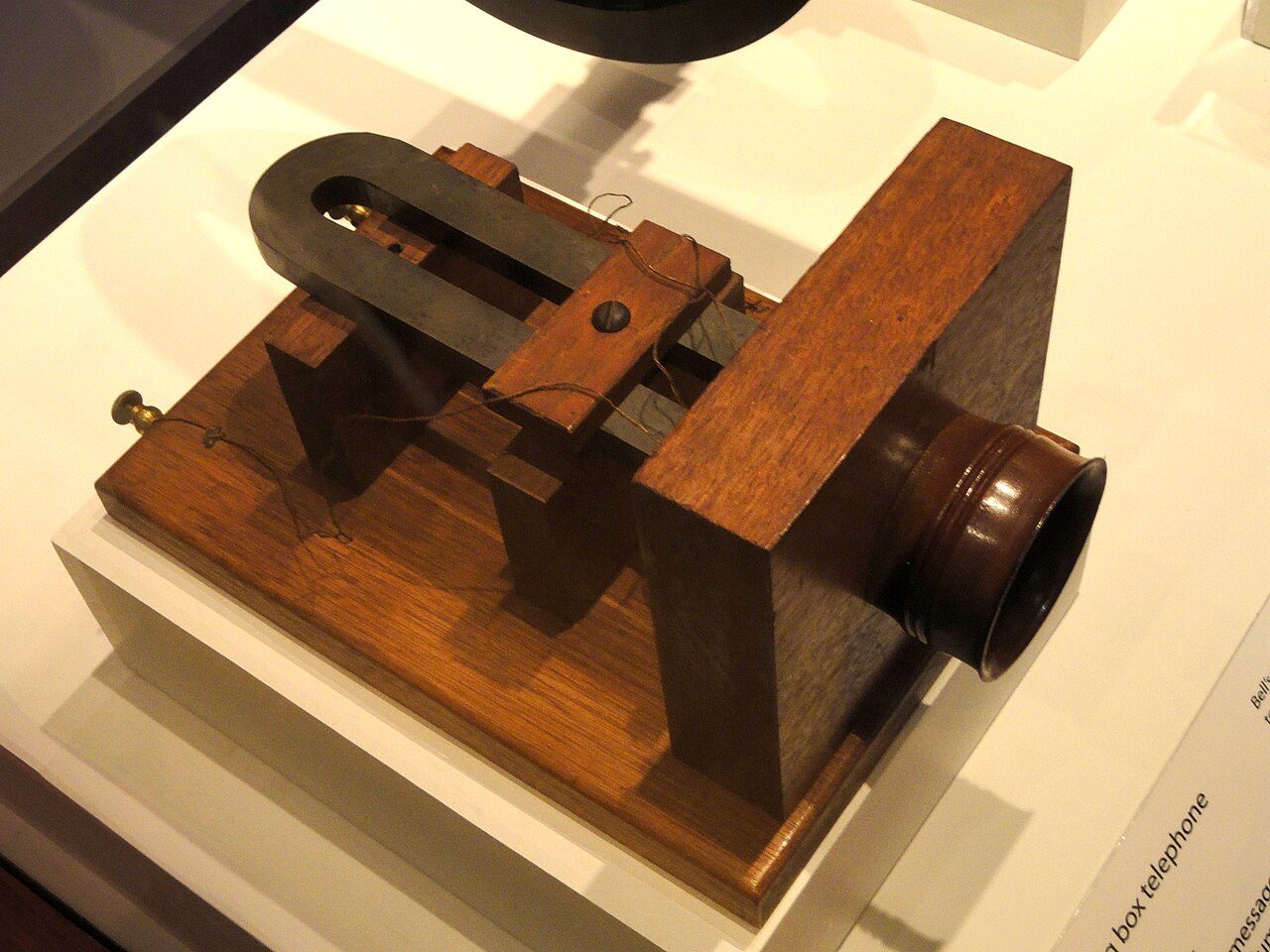
The telephone's prehistory is a story of near misses. Johann Philipp Reis built instruments in Germany in 1861 that could send musical tones down a wire but not the complex waveforms of speech. Antonio Meucci demonstrated voice devices at home in the 1850s without securing a full patent. What Alexander Graham Bell added, working with Thomas Watson in Boston, was the crucial principle - a current that varied continuously, as air pressure varies in speech - plus the legal and commercial machinery to exploit it: a patent filed on 14 February 1876, granted on 7 March, and a working demonstration three days later, on 10 March 1876, when Bell summoned Watson from the next room.
An instrument, however, is not yet a telephone system. The second invention was the exchange: a switchboard where any subscriber could be connected to any other. When the first commercial exchange opened in New Haven in January 1878 with 21 subscribers, the telephone stopped being a private wire between two points and became a network - and networks grow more valuable with every person who joins. Everything after 1878 is the working out of that idea at larger and larger scales.
Timeline
- 1861
Johann Philipp Reis builds instruments in Germany that transmit musical tones electrically, but cannot reproduce the complex waveforms of speech.
- 7 March 1876
Alexander Graham Bell is granted US Patent 174,465 for transmitting vocal sounds telegraphically - the founding patent of the telephone.
- 10 March 1876
Bell speaks the first intelligible sentence by telephone, summoning his assistant Thomas Watson from the next room in their Boston workshop.
- 1877
The Bell Telephone Company is formed to exploit the patent; its descendant is AT&T.
- 28 January 1878
The world's first commercial telephone exchange opens in New Haven, Connecticut, with 21 subscribers - the telephone becomes a network.
- 1892
The long-distance line between New York and Chicago opens, with Bell himself speaking at the ceremony - intercity calling becomes practical.
- 25 January 1915
The first transcontinental telephone service opens: Bell in New York repeats his famous summons to Watson, now in San Francisco, 3,400 miles away.
- October 1915
Speech is sent one-way by radio from Arlington, Virginia, to the Eiffel Tower in Paris - the first voice to cross the Atlantic.
- 7 January 1927
The first commercial transatlantic telephone service opens between New York and London, by radio: one circuit, and $75 for three minutes.
- 25 September 1956
TAT-1, the first transatlantic telephone cable, opens between Scotland and Newfoundland with 36 circuits, replacing temperamental radio with a wire under the sea.
- 3 April 1973
Motorola engineer Martin Cooper makes the first call from a handheld mobile phone, in New York - pointedly, to his rival at Bell Labs.
- 1979
NTT launches the world's first commercial cellular network, in Japan - mobile calls become a service, not a demonstration.
- 1983
The Motorola DynaTAC 8000X becomes the first commercially available handheld mobile phone, approved in 1983 and sold from 1984 at $3,995.
- 2000s
Voice begins moving onto the internet as data: voice-over-IP services turn calls into packets, detaching the telephone call from the telephone network.
- 9 January 2007
Steve Jobs announces Apple's iPhone, merging the telephone with a widescreen iPod and an internet communicator in one touchscreen device - the smartphone era begins.
The Network Era: Exchanges, Continents, Oceans
Between 1878 and 1956 the telephone's story is the story of reach. Exchanges multiplied, directories appeared, and long-distance lines stitched cities together: New York to Chicago in 1892, coast to coast in 1915, when the transcontinental line's single copper circuit carried exactly one call at a time across 3,400 miles. The ocean took longer, because a voice is far harder to send than a telegraph signal. Radio bridged it first - one-way in 1915, as a commercial service in 1927 at $75 for three minutes on a single circuit - and the cable age began only in 1956, when TAT-1's submerged repeaters made an undersea voice cable practical and 36 simultaneous conversations replaced one.
Inside the home, the same era quietly cut the telephone's other cord. Cordless handsets freed callers from the instrument's short wire, letting a conversation wander from room to room and into the garden. The phone was still fixed to the house by its line, but the idea that a call belonged to a place, rather than a person, had begun to loosen - the conceptual step the mobile phone would complete.
The Mobile Turn: The Number Becomes a Person
On 3 April 1973 Martin Cooper of Motorola stood on a New York street and called Joel Engel, head of the rival cellular programme at Bell Labs, from a handheld prototype - the first public call from a phone held in one hand. A decade of network-building followed: NTT opened the first commercial cellular network in Japan in 1979, and in 1983 the Motorola DynaTAC 8000X became the first handheld mobile phone anyone could buy, at $3,995. Cellular networks divided cities into cells, each served by its own base station, so the same frequencies could be reused across a city - the trick that let mobile telephony scale from thousands of users to billions.
The final transformation was a merger. In the 2000s, voice itself became data, carried over the internet by voice-over-IP services, and on 9 January 2007 Apple announced the iPhone: a telephone, a music player and an internet device in one touchscreen object. After 2007 the question was no longer what a telephone could do, but why a computer should not also be one. Bell's instrument had spent 131 years travelling from the wall to the pocket; in the pocket, it stopped being only a telephone at all.
Legacy
Read end to end, the timeline shows one pattern repeating: every generation removed a constraint and called the result obvious. Speech without presence (1876), conversation without an operator's fixed pair of wires (1878), a continent (1915), an ocean (1927), a cable's reliability (1956), a location (1973), and finally a single purpose (2007). The telephone's evolution is therefore not mainly a history of handsets. It is a history of what a voice is allowed to do - and each milestone above is a date on which the answer got bigger.
Sources
- Smithsonian Institution - Alexander Graham Bell's Large Box Telephone
- Encyclopaedia Britannica - Telephone: development of the telephone instrument
- Library of Congress - First Official Transatlantic Telephone Call (National Recording Registry essay)
- Science Museum Blog (BT Archives) - Global Telephone Calls For All
- Apple Newsroom - Apple Reinvents the Phone with iPhone (9 January 2007)
The facts on this page were checked against these sources on 19 November 2026. The History Trail's permanent pages are researched and written for this site; the live profiles elsewhere on The History Trail are assembled automatically from Wikipedia and Wikidata.
About the Author
Researched and written by the The History Trail Editorial Team — the accountable editorial function behind this site's permanent story pages. The team works from the published sources cited on each page; it does not invent historians, reviewers or credentials, and it corrects errors openly.
Fact Check
Every load-bearing fact on this page traces to one of the sources listed above, and significant claims link to their source in the text. Our checking method is described on the methodology page; errors can be reported via the corrections page.
Sources & Citations
Cite this page as: The History Trail Editorial Team, The History Trail — this article's title, publication and update dates are shown beneath its headline. The full source list appears under Sources above; the site's source standards are on the sources page.