
People
Alexander Graham Bell
Alexander Graham Bell (1847-1922) was a Scottish-born teacher of the deaf who received the first United States patent for the telephone in 1876 and, three days later, spoke the first intelligible sentence through it. The telephone made his name, but he insisted he was a teacher of the deaf first - while also sending speech down a beam of light and building the fastest boat in the world.
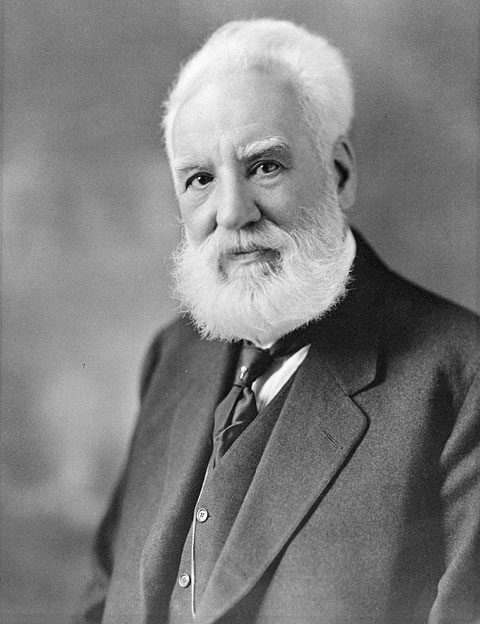
At a Glance
- Born
- 3 March 1847, Edinburgh, Scotland
- Died
- 2 August 1922, Beinn Bhreagh, Nova Scotia, Canada, aged 75
- Family trade
- Speech and elocution: his father Alexander Melville Bell devised Visible Speech, a system for teaching deaf people to speak
- Deafness at home
- His mother Eliza was nearly deaf; his wife Mabel Hubbard, his former pupil, had been deaf since scarlet fever at the age of five
- The patent
- US Patent 174,465, granted 7 March 1876; first intelligible telephone call followed on 10 March 1876
- The company
- Bell Telephone Company, formed 1877; its descendant is AT&T
- The prize
- France's Volta Prize, 1880 - 50,000 francs, which funded his Volta Laboratory in Washington, D.C.
- Beyond the telephone
- The photophone (speech on a beam of light, 1880) and the HD-4 hydrofoil, world water-speed record holder in 1919
Introduction
Bell is usually introduced as the inventor of the telephone, and the description is accurate as far as it goes: he filed the patent, built the instrument that first carried intelligible speech, and founded the company that turned it into an industry. But it leaves out the motive. Bell did not come to the telephone from electrical engineering. He came from a family that had spent two generations teaching deaf people to speak, and he understood the telephone as a machine for helping people hear.
That background explains both his breakthrough and his restlessness afterwards. The patent of 1876 made him famous and wealthy, yet he kept returning to deaf education for the rest of his life, and filled his notebooks with other machines: a telephone that worked on light, improved sound recording, aircraft, and a boat that rose out of the water on wings. He died in 1922 in Nova Scotia, still experimenting.
Edinburgh: A Family Built Around Sound
Alexander Bell - he added 'Graham' at the age of eleven - was born in Edinburgh on 3 March 1847, the second son of Alexander Melville Bell and Eliza Grace Symonds. His father and grandfather were teachers of elocution, and his father had devised Visible Speech, a set of symbols describing how the mouth and throat form each sound, intended to let deaf pupils learn speech they could not hear. His mother was a gifted pianist who was herself nearly deaf; the young Bell learned to tap conversations out on her hand so she could follow them.
In 1870, after both of Bell's brothers had died of tuberculosis, the family emigrated to Canada and settled near Brantford, Ontario. Bell moved on to Boston in 1871 to teach deaf pupils, and in 1873 became professor of vocal physiology at Boston University. Among his private pupils was Mabel Hubbard, deafened by scarlet fever at five, whose father, the lawyer Gardiner Greene Hubbard, became a backer of his experiments. Teaching paid the bills; in the evenings Bell worked on sending several telegraph messages down one wire.
The Race to Patent the Telephone
Bell's harmonic telegraph used reeds tuned to different pitches, and work on it led him to the insight that mattered: if a membrane could vibrate with all the complexity of a human voice, it could shape an electric current in the same complex way, and a matching membrane at the far end could turn that current back into speech. With his assistant Thomas Watson he spent 1875 testing membrane instruments. On 14 February 1876 his patent application was filed in Washington; hours later, Elisha Gray filed a caveat describing a similar device. The patent, US Patent 174,465, was granted on 7 March 1876.
Three days later, on 10 March 1876, using a liquid transmitter in his Boston workshop, Bell spoke the sentence that made the telephone real - a summons to Watson, in the next room, to come to him - and Watson heard it clearly. In June 1876 Bell demonstrated the telephone at the Centennial Exposition in Philadelphia, and in 1877 the Bell Telephone Company was formed to exploit the patent. On 11 July 1877 Bell married Mabel Hubbard. The patent was challenged in hundreds of lawsuits and upheld, but the closeness of the race has kept the argument about who 'invented' the telephone alive ever since.
Timeline
- 3 March 1847
Alexander Bell is born in Edinburgh, Scotland, second son of elocution teacher Alexander Melville Bell.
- 1870
The Bell family emigrates to Canada, settling near Brantford, Ontario; Bell moves to Boston the following year to teach deaf pupils.
- 14 February 1876
Bell's telephone patent application is filed in Washington; Elisha Gray files a caveat for a similar device the same day.
- 7 March 1876
US Patent 174,465 for transmitting vocal sounds telegraphically is granted to Bell.
- 10 March 1876
Bell speaks the first intelligible sentence by telephone to Thomas Watson in the next room of their Boston workshop.
- 1877
The Bell Telephone Company is formed; Bell marries Mabel Hubbard on 11 July.
- 1880
France awards Bell the Volta Prize of 50,000 francs; with Charles Sumner Tainter he demonstrates the photophone, sending speech on a beam of light.
- 1881
Bell uses the Volta Prize money to establish the Volta Laboratory in Washington, D.C.
- 9 September 1919
The HD-4 hydrofoil, built by Bell and Casey Baldwin, sets a world water-speed record of 70.86 miles per hour on Bras d'Or Lake.
- 2 August 1922
Bell dies at Beinn Bhreagh, his estate near Baddeck, Nova Scotia, aged 75.
The Volta Prize and a Second Career in Sound
In 1880 the French government awarded Bell the Volta Prize - 50,000 francs, roughly 10,000 dollars - for the invention of the telephone. Bell used the money to found the Volta Laboratory in Washington, D.C., a workshop where invention, not business, came first. There, with Chichester Bell and Charles Sumner Tainter, he improved Edison's phonograph by recording on wax instead of tinfoil, work that fed into the modern recording industry, and pursued devices for the deaf, including the audiometer for measuring hearing.
The laboratory's most striking product was the photophone, developed with Tainter in 1880, which transmitted speech on a beam of light to a receiver hundreds of yards away. Bell called it his proudest achievement - greater, he thought, than the telephone - because it proved speech could travel without any wire at all. It was impractical in sunlight and fog, but it is a direct ancestor of fibre-optic communication. Bell also founded the Volta Bureau in Washington to share information about deafness; it grew into today's Alexander Graham Bell Association for the Deaf and Hard of Hearing.
Kites, Aircraft and the Fastest Boat in the World
From the 1890s Bell's base was Beinn Bhreagh, his estate near Baddeck on Cape Breton Island, Nova Scotia. He served as second president of the National Geographic Society from 1898 to 1903 and as a regent of the Smithsonian Institution. In 1907, with funding from Mabel, he co-founded the Aerial Experiment Association; its Silver Dart made the first powered flight in Canada in February 1909.
His last great machine was built with the engineer Casey Baldwin. The HD-4 was a hydrofoil - a boat lifted clear of the water on underwater wings, which Bell called hydrodromes. On 9 September 1919, powered by two aircraft engines supplied by the US Navy, it reached 70.86 miles per hour on Bras d'Or Lake, a world water-speed record that stood for a decade. Bell, by then 72, watched from the shore. He died of complications from diabetes at Beinn Bhreagh on 2 August 1922.
Myths and disputes
Did Bell really invent the telephone? The honest answer is that he patented it first, built a working instrument, and built the industry - but he was not the only person closing in on it. Johann Philipp Reis in Germany had built instruments by 1861 that transmitted tones, though not the complex waveforms of speech. Antonio Meucci, an Italian inventor in New York, demonstrated voice devices in the 1850s and filed a patent caveat in 1871, but let it lapse for want of money. Elisha Gray's same-day caveat remains the closest call of all.
What the courts decided is a matter of record: Bell's patent survived hundreds of challenges, and the Bell company defended its monopoly for the life of the patent. What historians still debate is the harder question of credit. The safest summary is the one Bell's career supports: several inventors understood that speech might travel by wire, but Bell was the first to reduce it to a patented, working, commercial system - and that combination is what changed the world.
Legacy
Bell's deepest legacy may be the one he valued most. He identified himself, to the end of his life, as a teacher of the deaf, and his fortune and fame were repeatedly spent on that work - the Volta Bureau, support for schools, and decades of advocacy. His views on deaf education were of their time and remain debated within the deaf community, particularly his promotion of oral teaching over sign language; honest accounts include that debate.
The rest of the legacy is the modern world he helped start: a telephone network that became AT&T, speech carried on light a century before fibre optics, sound recording on wax, and a hydrofoil record that announced the age of fast marine craft. Few inventors are remembered for one machine. Bell's problem was the opposite - he kept building new ones.
Sources
- Encyclopaedia Britannica - Alexander Graham Bell
- Smithsonian Institution - Alexander Graham Bell's Large Box Telephone
- Smithsonian National Museum of American History - Boat Model, Alexander Graham Bell's HD-4 Hydrodrome
- Dictionary of Canadian Biography - Bell, Alexander Graham
- Science Museum - Ahoy! Alexander Graham Bell and the first telephone call
- Alexander & Mabel Bell Legacy Foundation - Alexander Graham Bell Biography
The facts on this page were checked against these sources on 19 November 2026. The History Trail's permanent pages are researched and written for this site; the live profiles elsewhere on The History Trail are assembled automatically from Wikipedia and Wikidata.
About the Author
Researched and written by the The History Trail Editorial Team — the accountable editorial function behind this site's permanent story pages. The team works from the published sources cited on each page; it does not invent historians, reviewers or credentials, and it corrects errors openly.
Fact Check
Every load-bearing fact on this page traces to one of the sources listed above, and significant claims link to their source in the text. Our checking method is described on the methodology page; errors can be reported via the corrections page.
Sources & Citations
Cite this page as: The History Trail Editorial Team, The History Trail — this article's title, publication and update dates are shown beneath its headline. The full source list appears under Sources above; the site's source standards are on the sources page.