
Things
The Walkman: Sony's Little Box That Privatised Music
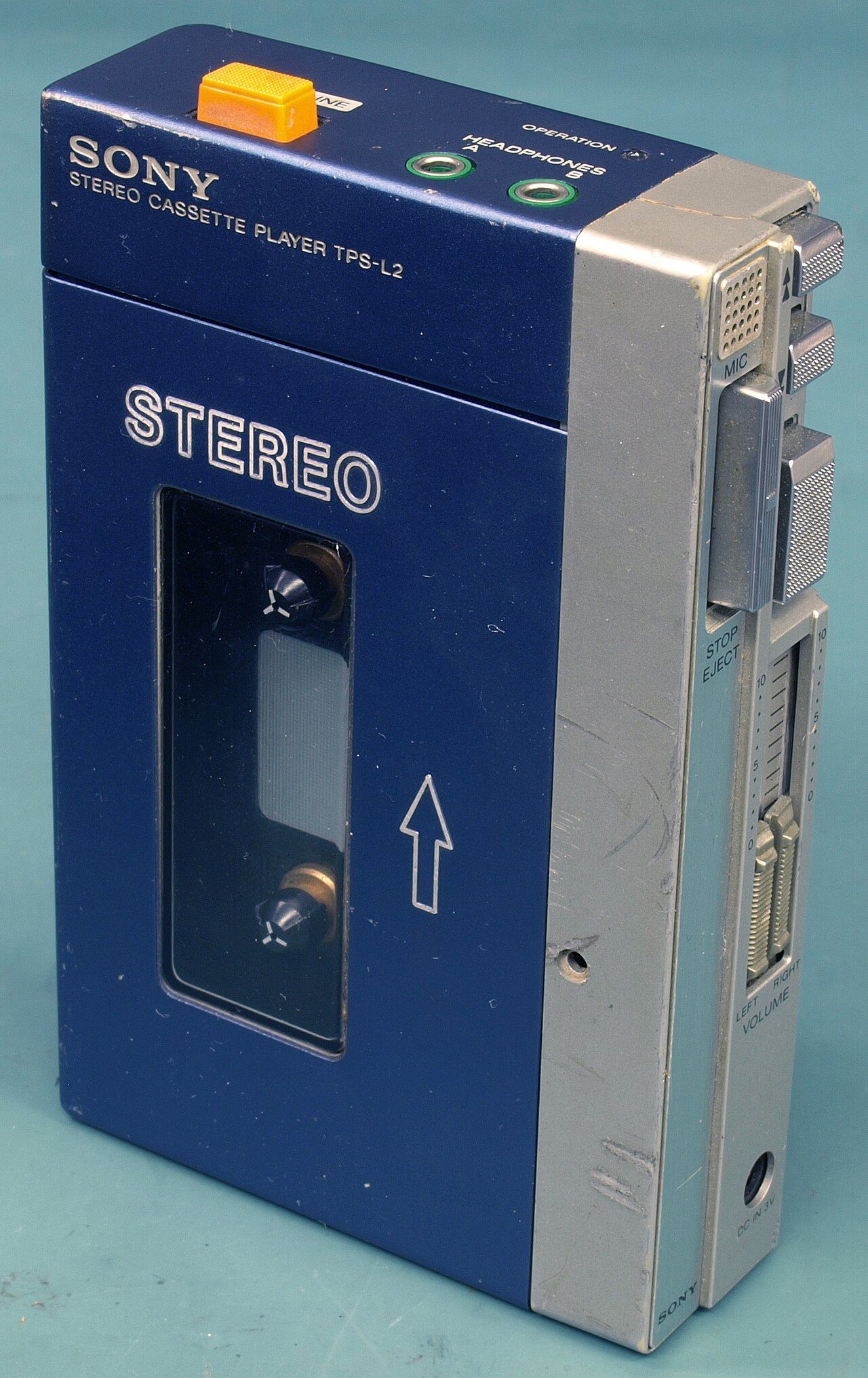
Sony's first Walkman could not record and had no speaker, and sceptics said it would fail. Instead the TPS-L2 detached music from the living room and attached it to the listener — an idea every portable player since has copied.
At a Glance
- Maker
- Sony
- First model
- TPS-L2
- Launch
- 1 July 1979, Japan
- Launch price
- 33,000 yen
- Idea proposed by
- Masaru Ibuka, Sony co-founder
- Championed by
- Akio Morita, Sony co-founder
- Format
- Compact Cassette (Philips, 1963)
- Cassette Walkmans sold
- More than 220 million; 385 million Walkmans across all formats
A Tape Player With No Speaker
On 1 July 1979 Sony put a small blue-and-silver box on sale in Japan. It played stereo cassettes through lightweight headphones, and that was all it did: it could not record, and it had no speaker. Many inside and outside the company doubted that anyone would buy a tape player missing the features tape players were supposed to have. Instead, the TPS-L2 — the first Walkman — sold 30,000 units in its first two months and went on to sell 50 million within a decade.
The Walkman's importance is not really about fidelity. It is about a change in the geography of listening. Before 1979, music mostly happened where the equipment was: a living room, a concert hall, a car. The Walkman detached music from place and attached it to a person, so a commute, a run or a walk to school could have a private soundtrack. Portable, personal and chosen by the listener — the pattern set in 1979 is the pattern the iPod and the streaming phone later inherited.
The Compact Cassette Was Already Waiting
The Walkman needed a medium, and the medium already existed. In 1963 Lou Ottens and his team at Philips presented the Compact Cassette in Berlin: a small, pocketable tape cartridge, originally aimed at dictation, that Philips licensed widely. Cassettes were cheap, recordable and durable enough to live in a coat pocket — everything a personal music format needed to be, a decade and a half before anyone built the player that exploited it.
The player itself began as a favour. Sony co-founder Masaru Ibuka travelled constantly and listened to music on tape recorders that were too heavy to count as portable; he wanted something he could use on long flights. Sony's audio engineers adapted the Pressman, a compact mono recorder the company made for journalists, stripping out the recording mechanism and speaker and fitting stereo playback instead. According to one detailed account, the first prototype was assembled in about four days. Co-founder Akio Morita championed the result against internal scepticism — and insisted the missing record button was not a flaw but the whole point.
Timeline
- 1963
Lou Ottens' team at Philips presents the Compact Cassette at an electronics fair in Berlin — the small tape format the Walkman will be built around.
- February 1979
Masaru Ibuka asks Sony's audio division for a small stereo player for his flights; engineers rebuild a Pressman journalist's recorder as a playback-only prototype.
- 1 July 1979
The TPS-L2 goes on sale in Japan for 33,000 yen, in a metallic blue finish Sony says was meant to echo the era's blue jeans.
- September 1979
Sales reach 30,000 units in the first two months, settling the argument about whether a player that cannot record could sell.
- June 1980
The Walkman reaches the United States, initially under the name 'Soundabout' because Sony doubted 'Walkman' would travel.
- 1984
Sony launches the D-50, the world's first portable CD player, extending the Walkman idea to the new digital disc.
- By 1989
A decade after launch, cumulative Walkman sales pass 50 million units.
- 1992
The MZ-1 becomes the first MiniDisc Walkman, adding recording and anti-skip technology.
- 2001
The MZ-N1 brings NetMD high-speed transfer from a PC, bridging the cassette era and the download era.
- October 2010
Sony ends Japanese sales of the cassette Walkman after more than 220 million cassette units; the Walkman name continues on digital players, with 385 million sold across all formats.
Headphones and the Privatisation of Public Space
The Walkman privatised public space. With headphones on, a listener could be physically present on a train or a street and mentally somewhere else entirely, a behaviour so novel in 1979 that it attracted commentary, anxiety and eventually a name of its own in cultural studies. Listening became a portable, everyday act rather than an appointment, and the total hours people spent with music — their own music, chosen track by track — expanded enormously.
It also reordered the electronics industry around the person. The TPS-L2's design treated fashion as a feature, from its denim-blue case to the featherweight headphones developed for it, and Sony's successors shrank the formula relentlessly: CD, MiniDisc, memory stick and flash players all wore the Walkman badge. When Apple launched the iPod in 2001 it was executing, brilliantly, a playbook written in Tokyo in 1979 — and Sony's own announcement that cassette Walkman sales would end in Japan came, by coincidence, in the same October week nine years later.
220 Million Cassette Walkmans Later
Sony sold more than 220 million cassette Walkmans and 385 million Walkmans in total across formats, and the word itself entered dictionaries as the generic name for a personal stereo. The cassette models are gone from Japanese shops, but the brand survives on high-resolution digital players, and the TPS-L2 sits in museum collections as a design landmark — an original was included in the Museum of Modern Art's 2025 exhibition on turning points in design.
The deeper legacy is a habit of mind. The Walkman taught a generation to expect entertainment to be personal, portable and on demand, and to carry a private world in a pocket. Every playlist on a run, every podcast on a commute and every pair of earbuds on a crowded train is a descendant of a blue metal box that could not even record.
Sources
- Sony Australia — Sony Walkman revolutionised the way we listen to music on the go
- Sony — Getting to Know Sony by the Numbers: '2' (the TPS-L2's twin headphone jacks)
- TU Delft — Lou Ottens, inventor of the Compact Cassette
- AFP via Phys.org — Sony presses 'stop' on Walkman in Japan (October 2010)
- Sound & Vision — Flashback 1979: Sony's iconic Walkman is born
The facts on this page were checked against these sources on 18 November 2026. The History Trail's permanent pages are researched and written for this site; the live profiles elsewhere on The History Trail are assembled automatically from Wikipedia and Wikidata.
About the Author
Researched and written by the The History Trail Editorial Team — the accountable editorial function behind this site's permanent story pages. The team works from the published sources cited on each page; it does not invent historians, reviewers or credentials, and it corrects errors openly.
Fact Check
Every load-bearing fact on this page traces to one of the sources listed above, and significant claims link to their source in the text. Our checking method is described on the methodology page; errors can be reported via the corrections page.
Sources & Citations
Cite this page as: The History Trail Editorial Team, The History Trail — this article's title, publication and update dates are shown beneath its headline. The full source list appears under Sources above; the site's source standards are on the sources page.