
Things
Sirius
Sirius outshines every other star in Earth's night sky, and ancient Egypt built a calendar around its dawn return. Yet the point of light we see is a pair: a luminous blue-white star and a dense, Earth-sized companion that mathematics revealed eighteen years before any telescope could.
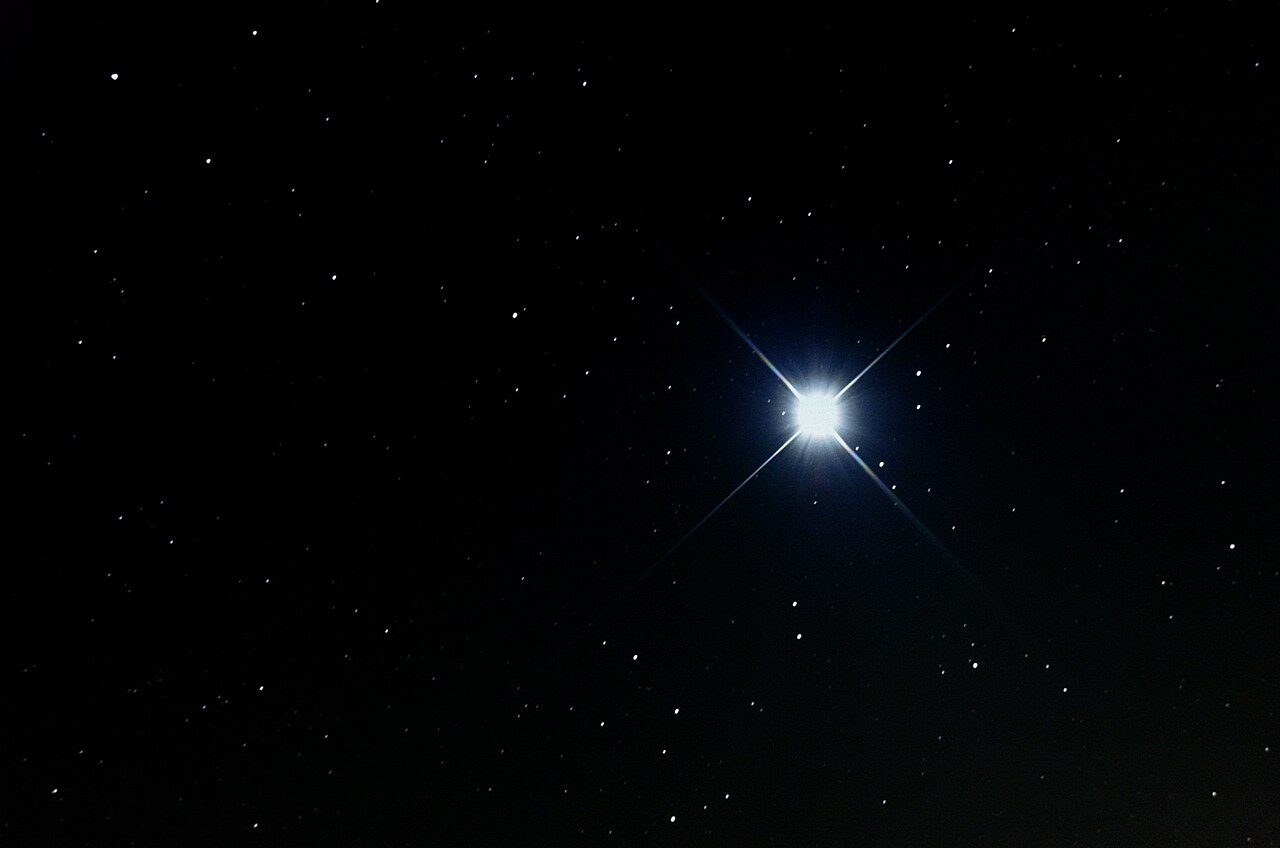
At a Glance
- Constellation
- Canis Major, the Greater Dog
- Apparent magnitude
- -1.46, the brightest star in the night sky
- Distance
- 8.6 light-years from Earth
- System
- Binary: Sirius A (main-sequence) and Sirius B (white dwarf)
- Sirius A
- About twice the Sun's mass; surface about 10,000 degrees C
- Sirius B
- Smaller than Earth, yet 98 percent of the Sun's mass; surface about 25,000 degrees C
- Orbital period
- About 50 years
- Companion found
- Predicted by Friedrich Bessel in 1844; first seen by Alvan Graham Clark in 1862
Introduction
Sirius is the brightest star in the night sky, shining at magnitude -1.46, almost twice as bright as Canopus, its nearest rival. It sits in the constellation Canis Major, the Greater Dog, which is why it is nicknamed the Dog Star. Its brilliance is a partnership of power and proximity: the visible star, Sirius A, is intrinsically luminous, and at only 8.6 light-years away the system is one of the nearest to Earth, close enough that its light has been a landmark for every culture that ever looked up.
What the naked eye reads as one star is in fact two. Sirius A is a blue-white main-sequence star about twice as massive as the Sun, with a surface near 10,000 degrees Celsius. Circling it is Sirius B, a white dwarf smaller than Earth yet carrying 98 percent of the Sun's mass, its exposed surface glowing at some 25,000 degrees. The two swing around each other roughly every fifty years, and the fainter partner spends its life drowned in the brighter one's glare.
Background
Long before telescopes, Sirius organised human time. In ancient Egypt the star was Sopdet, and its heliacal rising, its first brief appearance in the dawn sky after about seventy days hidden in the Sun's glow, fell just before the annual flooding of the Nile on which all farming depended. Egyptians anchored their calendar to that return and worshipped the star as a goddess tied to fertility and renewal. For the Greeks, the season that followed the same rising brought the hottest days of summer, a phrase that survives in English as the dog days.
The star kept its secrets until precision astronomy arrived. In 1844 the German astronomer Friedrich Wilhelm Bessel, tracking Sirius against the background sky, found that it did not travel in a straight line but wove a slow wobble, as if tugged by something unseen. He announced that Sirius must have an invisible companion. Bessel died before anyone saw it, but on 31 January 1862 the American telescope-maker Alvan Graham Clark, testing a new large refractor, caught the faint spark beside the blaze and proved the mathematics right.
Timeline
- Ancient Egypt
Egyptians track the heliacal rising of Sirius, called Sopdet, whose dawn return heralds the Nile flood and anchors their calendar.
- Ancient Greece
Greek writers tie the season following Sirius's dawn rising to the fiercest heat of summer, the origin of the phrase the dog days.
- 10 August 1844
Friedrich Wilhelm Bessel reports that Sirius wobbles in its proper motion and deduces the existence of an unseen companion star.
- 31 January 1862
Alvan Graham Clark first observes the faint companion, Sirius B, while testing a new 18.5-inch refracting telescope.
- 1915
Spectroscopic work shows Sirius B is extremely dense and hot for its size, making it one of the first recognised white dwarfs.
- 2005
Astronomers using the Hubble Space Telescope isolate Sirius B's light and measure its gravitational redshift, weighing it precisely.
- 2017
A Hubble astrometry study refines the orbit and masses of both stars, tightening the system's age and history.
Significance
Sirius B changed what astronomers thought a star could be. Here was a body smaller than Earth holding nearly the Sun's whole mass, matter compressed so far beyond ordinary experience that explaining it required the new physics of electron degeneracy pressure. As the nearest white dwarf to Earth, it became the test case for the theory of how stars end: burn, collapse, and cool slowly as embers. The Hubble measurement of its gravitational redshift, light stretched as it climbs out of that intense gravity, also gave Einstein's general relativity one of its cleanest stellar confirmations.
The system's nearness makes it a laboratory as well as a landmark. Because Sirius is so close and so bright, astronomers can measure its orbit, masses and temperatures with unusual precision, and use the pair to calibrate how stars of different masses live and die on different clocks. Sirius A is only a few hundred million years old, far younger than the Sun, yet its companion has already completed an entire stellar life, having begun as the larger star of the two.
Legacy
Sirius remains what it has always been: the sky's most reliable bright marker, a vertex of the Winter Triangle, a navigation star for Pacific voyagers in earlier centuries, and the first star most new stargazers learn to find by following Orion's Belt downward. Its Egyptian name, its Greek dog days and its place in story traditions on several continents make it arguably the most culturally loaded star in the sky.
Its scientific legacy is still growing. Each refinement of the pair's orbit sharpens our picture of white dwarf cooling and of the age of the solar neighbourhood itself. And the star is slowly approaching: Sirius is moving toward the Sun and will brighten slightly over the next sixty thousand years, remaining the night sky's brightest star for far longer than any human calendar will run.
Sources
- ESA/Hubble — Astronomers use Hubble to 'weigh' Dog Star's companion (heic0516)
- Wikipedia — Sirius
- Constellation Guide — Sirius: The Dog Star
The facts on this page were checked against these sources on 19 November 2026. The History Trail's permanent pages are researched and written for this site; the live profiles elsewhere on The History Trail are assembled automatically from Wikipedia and Wikidata.
About the Author
Researched and written by the The History Trail Editorial Team — the accountable editorial function behind this site's permanent story pages. The team works from the published sources cited on each page; it does not invent historians, reviewers or credentials, and it corrects errors openly.
Fact Check
Every load-bearing fact on this page traces to one of the sources listed above, and significant claims link to their source in the text. Our checking method is described on the methodology page; errors can be reported via the corrections page.
Sources & Citations
Cite this page as: The History Trail Editorial Team, The History Trail — this article's title, publication and update dates are shown beneath its headline. The full source list appears under Sources above; the site's source standards are on the sources page.