
Things
Romeo and Juliet
Romeo and Juliet is William Shakespeare's tragedy of two young lovers from feuding Veronese families, written about 1594-96 from Arthur Brooke's 1562 poem and William Painter's prose tale. First printed in an unauthorised quarto in 1597 and in a fuller text in 1599, it became the world's defining love story - though its lovers are fictional and Verona's famous balcony was built in the 1930s.
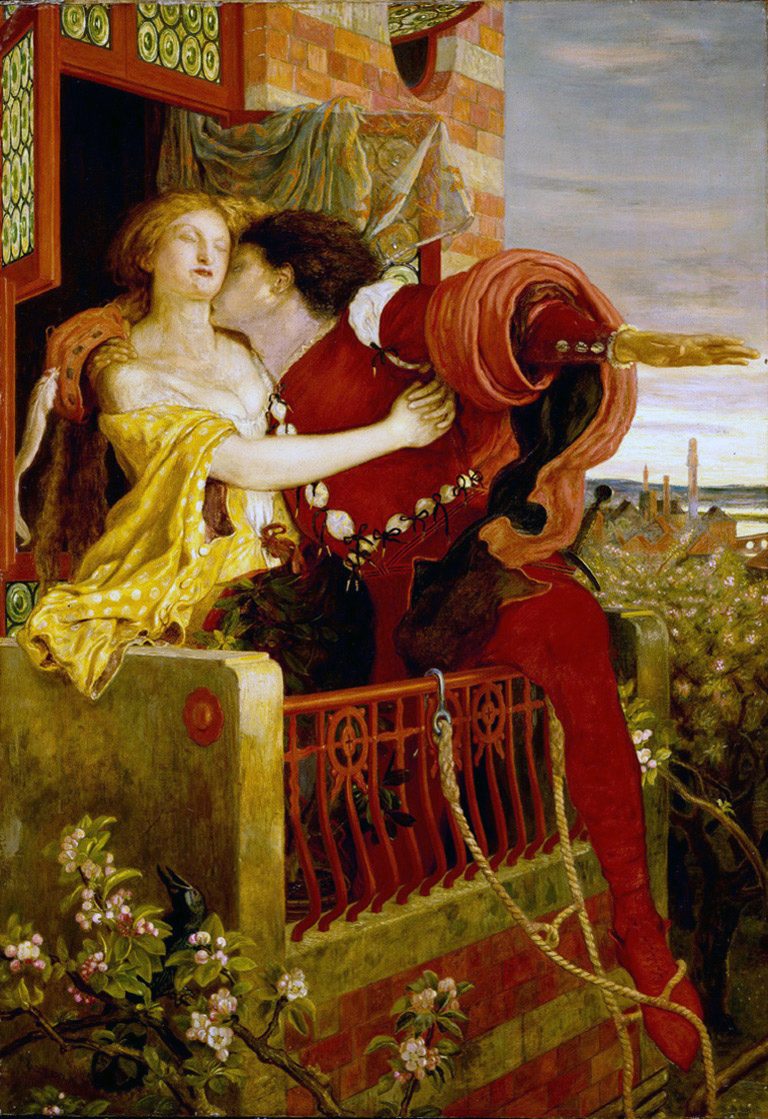
At a Glance
- Author
- William Shakespeare, written about 1594-1596, early in his career
- Kind
- A tragedy in five acts - a work of fiction, set in Verona and Mantua in Italy
- Principal source
- Arthur Brooke's poem The Tragicall Historye of Romeus and Juliet (1562), from Italian tales by Luigi da Porto and Matteo Bandello
- Second source
- William Painter's prose version in The Palace of Pleasure (1567), probably used for details
- First printing
- The unauthorised first quarto of 1597, printed by John Danter; the fuller, corrected second quarto followed in 1599
- The plot in brief
- Romeo Montague and Juliet Capulet marry in secret across their families' feud; a failed message and a sleeping potion end in their suicides
- Juliet's balcony
- Not in the play - Juliet speaks from a window. Verona's famous balcony was added to a medieval house in the 1930s
Introduction
Romeo and Juliet is a play - a work of fiction - by William Shakespeare, and this page traces the documented history of the play itself: the older stories it was built from, its first printings, and the afterlife that made it the world's model of a love story. Its prologue announces the whole plot in advance: two households, both alike in dignity, in fair Verona, whose feud drives their children - Romeo Montague and Juliet Capulet, the star-crossed lovers - to secret marriage and then to suicide in the Capulet tomb, which finally reconciles the families.
Shakespeare did not invent the story. He took it from an English poem already thirty years old, compressed its months into a few days, and turned a moralising tale about disobedient children into something far more sympathetic to the lovers. The play was popular from the start - its first printed title page boasts that it had been often, with great applause, played publicly - and it has never left the stage since.
The Story Before Shakespeare: Italy, France, England
The tale grew in Italy. Luigi da Porto told it in the 1530s, setting it in Verona and naming the feuding families Montecchi and Capelletti; Matteo Bandello's fuller version of the 1550s added the machinery the play still uses: the secret marriage, the Nurse, the Friar with his potion, the message that goes astray and the deaths in the tomb. Pierre Boaistuau's French version of 1559 tightened the ending - in his telling, as in Shakespeare's, Romeo dies before Juliet wakes.
England received the story twice. Arthur Brooke published The Tragicall Historye of Romeus and Juliet in 1562, a long poem translated from Boaistuau and the first English version; William Painter retold it in prose in his Palace of Pleasure in 1567. Brooke is Shakespeare's immediate source - the Royal Shakespeare Company notes the verbal echoes running through the play - while Painter probably supplied details, and likely the name Romeo where Brooke had Romeus. Brooke wrote as a moralist, warning young readers against disobedience; Shakespeare kept his plot and discarded his sermon.
Writing and First Printings
The play was written in the mid-1590s - Britannica dates it about 1594 to 1596, and the Royal Shakespeare Company judges 1595-96 likeliest, from its lyrical style, shared with A Midsummer Night's Dream and Richard II. Shakespeare's great change was speed: where Brooke's lovers conduct their affair over several months, the play crams meeting, marriage, killing, banishment and death into a few frantic days. He also deepened the supporting world - Mercutio, barely a presence in the sources, becomes the play's wittiest voice, and Juliet, nearly sixteen in Brooke, is not yet fourteen in the play, a change the British Library notes makes her parents' control a far sharper engine of the tragedy.
Print preserved the play in stages. The first quarto of 1597, printed by John Danter, was unauthorised - a so-called bad quarto, probably reconstructed from memory by actors, shorter and rougher than what was played. The second quarto of 1599 was substantially longer and more reliable, advertising itself as newly corrected, augmented and amended, and it is the foundation of the text read today. The editors of the First Folio of 1623, the collected edition of Shakespeare's plays, based their text on a third quarto.
Timeline
- 1530s
Luigi da Porto's Italian novella tells of Romeo and Giulietta in Verona, with the feuding Montecchi and Capelletti families.
- 1550s
Matteo Bandello publishes his version, adding the Nurse, the Friar's potion, the lost message and the tomb ending.
- 1559
Pierre Boaistuau's French version appears; his Romeo dies before Juliet wakes, the ending Shakespeare will keep.
- 1562
Arthur Brooke publishes The Tragicall Historye of Romeus and Juliet, the first English version and Shakespeare's immediate source.
- 1567
William Painter retells the story in prose in The Palace of Pleasure, a second English source Shakespeare probably used.
- About 1594-1596
Shakespeare writes Romeo and Juliet, compressing Brooke's months-long affair into a few days of stage action.
- 1597
The first quarto is printed by John Danter - an unauthorised, shortened text, probably reconstructed from performance.
- 1599
The second quarto appears, much longer and advertised as newly corrected, augmented and amended; it underlies modern editions.
- 1623
The play is included in the First Folio, the first collected edition of Shakespeare's plays, printed from the third quarto.
- 1662
The earliest documented performance: William Davenant's staging, in the era when adaptation of Shakespeare was the fashion.
- 1957
West Side Story, by Leonard Bernstein, Arthur Laurents and Stephen Sondheim, moves the feud to New York street gangs.
- 20th century
Verona builds Juliet's House as a tourist shrine; the famous balcony is added to a medieval house in the 1930s.
Significance
The Folger Shakespeare Library calls the play the quintessential story of young love, and notes the paradox: its world is one of street violence and blood feud, yet audiences everywhere have taken it as the story of their own first love. The reason is largely verbal. Shakespeare gives the lovers language of formal beauty unmatched in his early work - their first exchange is shaped as a shared sonnet - and makes their haste feel like the tempo of youth itself.
It also fixed a template. The prologue's star-crossed lovers, the secret marriage, the sleeping potion, the message that fails to arrive: these devices, inherited from the sources but fused by Shakespeare into a single accelerating mechanism, became the standard machinery of tragic romance. When later writers rewrite the play - as West Side Story did with New York gangs - it is that machinery they are reusing.
Myths and disputes
Were Romeo and Juliet real? No evidence says so, and this page states it plainly: they are fictional characters. Da Porto presented his novella as a true story, as storytellers did, but no document records such lovers, such a feud or such deaths in Verona, and the tale can be traced, version by version, through Bandello, Boaistuau, Brooke and Painter to Shakespeare's desk. Verona's connection is literary, not historical - there is no record that Shakespeare ever visited Italy at all.
That includes the balcony. In the play, Juliet speaks from a window above the Capulet orchard; Shakespeare wrote no balcony, and the word belongs to later staging. The famous balcony at Juliet's House, Via Cappello 23 in Verona, is a twentieth-century construction: the building is a genuine medieval house of the Dal Capello family - whose name resembles Capulet - bought by the city in 1905, and in the 1930s, under museum director Antonio Avena, its courtyard facade was remodelled in romantic medieval style and the balcony, assembled from older stone, was added to give the story a home. The bronze Juliet in the courtyard is likewise a modern work, by the sculptor Nereo Costantini. Verona presents the house as the home of the legend - but visitors who treat the balcony as a survivor from the story's own time are mistaken.
A smaller dispute belongs to the text itself. The 1597 quarto is often called simply corrupt, but it is better described as a performance reconstruction: different from the fuller 1599 text, and valuable as evidence of how the play was actually staged.
Legacy
No play of Shakespeare's has soaked deeper into ordinary language. Star-crossed lovers is now used by people who have never seen the play; Romeo has become a common noun for a lover; and Verona receives a river of letters addressed simply to Juliet. The story has been filmed, danced as ballet, set as opera and rewritten for gangland New York, and each version sends audiences back to the text of 1599.
Its legacy in Verona shows both the power and the risk of that fame. A city Shakespeare probably never saw has built its most visited shrine to his fiction, balcony and all - a monument not to two historical teenagers, who never existed, but to what four centuries of audiences have felt about them. That is the documented history: an Italian tale, an English poem, a London stage, and a story that outgrew every one of them.
Sources
- Folger Shakespeare Library - About Shakespeare's Romeo and Juliet
- Royal Shakespeare Company - Dates and Sources: Romeo and Juliet
- Encyclopaedia Britannica - Romeo and Juliet
- The British Library - Juliet's Eloquence
- VeronaCard - Juliet's House in Verona: History, Myths, and How to Visit
The facts on this page were checked against these sources on 19 November 2026. The History Trail's permanent pages are researched and written for this site; the live profiles elsewhere on The History Trail are assembled automatically from Wikipedia and Wikidata.
About the Author
Researched and written by the The History Trail Editorial Team — the accountable editorial function behind this site's permanent story pages. The team works from the published sources cited on each page; it does not invent historians, reviewers or credentials, and it corrects errors openly.
Fact Check
Every load-bearing fact on this page traces to one of the sources listed above, and significant claims link to their source in the text. Our checking method is described on the methodology page; errors can be reported via the corrections page.
Sources & Citations
Cite this page as: The History Trail Editorial Team, The History Trail — this article's title, publication and update dates are shown beneath its headline. The full source list appears under Sources above; the site's source standards are on the sources page.