
People
William Shakespeare
William Shakespeare was baptised at Stratford-upon-Avon on 26 April 1564; tradition celebrates his birthday on 23 April, St George's Day, and he died on 23 April 1616. He became the most performed playwright in the world — though the man himself must be pieced together from records, not letters.
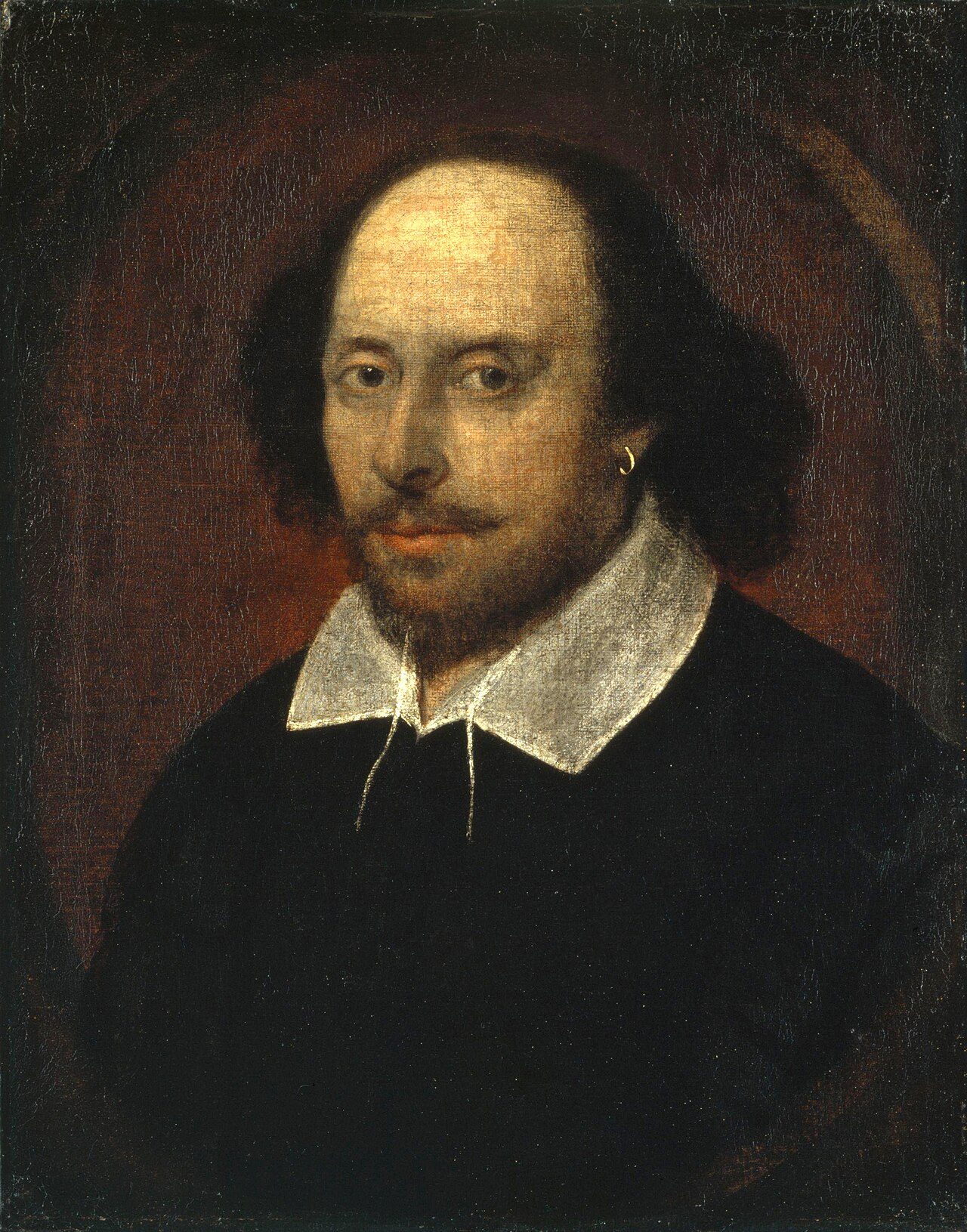
At a Glance
- Baptised
- 26 April 1564, Holy Trinity Church, Stratford-upon-Avon; birth traditionally celebrated 23 April
- Died
- 23 April 1616, Stratford-upon-Avon; cause unknown
- Family
- Married Anne Hathaway in 1582; children Susanna, and twins Hamnet (died aged 11) and Judith
- Company
- Lord Chamberlain's Men, renamed the King's Men in 1603 — actor, playwright and business partner
- Works
- About 37 plays by general consensus, and 154 sonnets
- Property
- Bought New Place, Stratford's second-largest house, in 1597
- First Folio
- Collected plays published 1623, seven years after his death, by his King's Men colleagues
Introduction
William Shakespeare was an English playwright, poet and actor, widely regarded as the greatest writer in the English language. Baptised in Stratford-upon-Avon in April 1564, he built a London career as an actor and shareholder-playwright; his surviving works — about 39 plays, 154 sonnets and several longer poems — are performed more often than those of any other dramatist. The birthday the world celebrates, 23 April, is tradition rather than record: the documents give the baptism on 26 April — and a death on 23 April 1616.
What is missing is almost as famous as what survives. No letters in his hand, no manuscripts of the plays, no diary: the biography is assembled from parish registers, legal documents, property deals and colleagues' testimony. That scarcity seeds both Shakespeare scholarship and the fringe industry doubting he wrote the plays — addressed, with the evidence, below.
Background
Shakespeare grew up in Stratford-upon-Avon, a market town about 100 miles north-west of London. His father John was a glover who rose to be an alderman and bailiff before falling into debt; his mother, Mary Arden, came from a prosperous farming family. He almost certainly attended the King's New School in Stratford, where the curriculum was Latin grammar, rhetoric and classical authors — the schooling visible throughout the plays. At eighteen he married Anne Hathaway, twenty-six and expecting their first child; daughter Susanna was baptised in May 1583, and twins Hamnet and Judith followed in February 1585.
Then the record goes quiet. The years between the twins' baptism in 1585 and Shakespeare's emergence in London by 1592 are the famous lost years: the Shakespeare Birthplace Trust states plainly that there is no documentary evidence of what he did in them. Later stories filled the gap — deer-poaching at Charlecote Park, school-teaching in the country — but both are tradition, not evidence. What is documented is the destination: by 1592 Robert Greene was attacking an 'upstart crow' of an actor-playwright in London — Shakespeare.
The Company, the Globe and the Fire
In 1594 Shakespeare became a founding member of the Lord Chamberlain's Men, the company he stayed with for his whole career — as actor, playwright and, crucially, shareholder, taking a cut of profits rather than selling plays outright. The arrangement made him prosperous. In 1597 he bought New Place, one of Stratford's largest houses; in 1599 he was among the partners who built the Globe on the Thames' south bank — the open-air 'wooden O' of Henry V — where most of his plays were first performed, before audiences of up to around 3,000 from every level of society.
In 1603 the new king, James I, took the company under royal patronage as the King's Men. On 29 June 1613, during Henry VIII, a stage cannon set the Globe's thatch alight and it burned down — nobody was killed, though one man's breeches caught fire and were doused with ale. It was rebuilt within a year, with a tile roof.
Timeline
- 26 April 1564
Baptised at Holy Trinity Church, Stratford-upon-Avon; his birthday is traditionally kept on 23 April.
- 1582
Marries Anne Hathaway; daughter Susanna is baptised in 1583, and twins Hamnet and Judith in 1585.
- 1585–1592
The lost years: no documentary evidence survives between the twins' baptism and his emergence in London.
- 1592
Robert Greene attacks an 'upstart crow' actor-playwright in London — the first clear sign of Shakespeare in the theatre.
- 1594
A founding member of the Lord Chamberlain's Men, his company for life.
- 1597
Buys New Place, one of Stratford's largest houses, from stage profits.
- 1599
The Globe Theatre opens on Bankside, with Shakespeare among its shareholder-builders.
- 1603
The company becomes the King's Men under James I.
- 1613
A stage cannon sets the Globe's thatch alight during Henry VIII; the theatre burns down and is rebuilt within a year.
- 1616
Revises his will on 25 March and dies on 23 April, aged 52; buried at Holy Trinity, Stratford.
- 1623
Heminges and Condell publish the First Folio: 36 plays, 18 in print for the first time.
Significance
The plays were written for that company and that stage: for known actors, a thrust stage and daylight performances. Hamlet, Othello, King Lear and Macbeth all belong to the King's Men years. His craftsmanship survives its conditions: soliloquies that let an audience overhear a mind thinking, villains given the best arguments, plots borrowed from chronicles and older plays and made unrecognisable by the borrowing.
The gifts behind the reputation are specific. Shakespeare combined intellectual rapidity, perceptiveness and poetic power, and applied them not to remote or abstract subjects but to human beings across their complete range of emotions and conflicts. He was astonishingly clever with words and images, and the art form his energies went into was not bookish but embodied: live actors commanding sympathy and inviting audiences to participate vicariously.
Print, Retirement and the Will
His poems reached print in his lifetime — Venus and Adonis (1593) was a bestseller, and the Sonnets appeared in 1609 — but the plays mostly did not: about half appeared in cheap quartos, some garbled versions reconstructed from memory. The book that saved the canon came seven years after his death. In 1623 two fellow actors, John Heminges and Henry Condell, published Mr. William Shakespeares Comedies, Histories, & Tragedies — the First Folio — with 36 plays, 18 printed for the first time, including Macbeth, Twelfth Night, Julius Caesar and The Tempest. Without it, half the plays would likely be lost.
Shakespeare had withdrawn gradually to Stratford, revised his will on 25 March 1616 — the document that leaves his wife Anne his second-best bed, an item endlessly debated and probably, as the Folger notes, a normal arrangement rather than an insult — and died on 23 April, aged 52. He was buried in Holy Trinity Church, Stratford, under a monument in place within a few years of his death, showing him as a writer, pen in hand.
Myths and disputes
The authorship question asks whether William Shakespeare of Stratford wrote the works that bear his name. The mainstream position of scholarship — held by the Folger, the universities and the documentary record — is that he did. The evidence is contemporary: his name appears on title pages from 1598; Francis Meres praised him by name that year; fellow actors Heminges and Condell, who knew him, edited his plays as his; Ben Jonson wrote of the 'Sweet Swan of Avon'; and the Stratford monument identified him as a writer within years of his death. The alternatives — Edward de Vere, Earl of Oxford; Francis Bacon; Christopher Marlowe — are a fringe position arising in the nineteenth century, resting on the argument that a glover's son could not have written so learnedly. Scholars answer that the plays' learning is exactly the grammar-school curriculum, that Oxford died in 1604 — before The Tempest was written — and that no contemporary document names anyone else.
Shakespeare invented thousands of words is the gentler myth. Dictionaries credit him with the first recorded use of over a thousand words and phrases — eyeball, bedroom, gossip, fashionable among them. But first recorded is not the same as invented: in an age when most speech went unrecorded, the first surviving written example of a word is often just the first time anyone wrote down what people were already saying. He certainly popularised and reshaped words — turning nouns into verbs with unmatched freedom — a different, better-evidenced claim.
Legacy
The Folio did its work. Through the eighteenth century he was edited, adapted and sometimes rewritten; through the nineteenth, exported with the British Empire and translated across Europe; since then, filmed, staged and quoted everywhere. His characters are common property now — Hamlet's hesitation, Lady Macbeth's ambition, Falstaff's appetite for life — and his phrases are used daily by people who have never seen a play.
He remains vital, finally, because his plays present people and situations we still recognise. The characters have an emotional reality that transcends time, and the fact that the plays are performed and adapted around the world underscores the universal appeal of the storytelling. The dusty documents are real; so is the miracle they cannot explain. Every April, Stratford still marks the tradition the documents only half support: baptised on the 26th, celebrated on the 23rd, and buried from the same church in between.
Sources
- Folger Shakespeare Library — Shakespeare's life
- Encyclopaedia Britannica — William Shakespeare
- British Library — Shakespeare's First Folio (Treasures Gallery)
- Shakespeare Birthplace Trust — Shakespeare's 'Lost Years'
- Royal Shakespeare Company — William Shakespeare's life and times
- Encyclopaedia Britannica — The Shakespeare Authorship Question
The facts on this page were checked against these sources on 19 November 2026. The History Trail's permanent pages are researched and written for this site; the live profiles elsewhere on The History Trail are assembled automatically from Wikipedia and Wikidata.
About the Author
Researched and written by the The History Trail Editorial Team — the accountable editorial function behind this site's permanent story pages. The team works from the published sources cited on each page; it does not invent historians, reviewers or credentials, and it corrects errors openly.
Fact Check
Every load-bearing fact on this page traces to one of the sources listed above, and significant claims link to their source in the text. Our checking method is described on the methodology page; errors can be reported via the corrections page.
Sources & Citations
Cite this page as: The History Trail Editorial Team, The History Trail — this article's title, publication and update dates are shown beneath its headline. The full source list appears under Sources above; the site's source standards are on the sources page.