
Things
Quartz
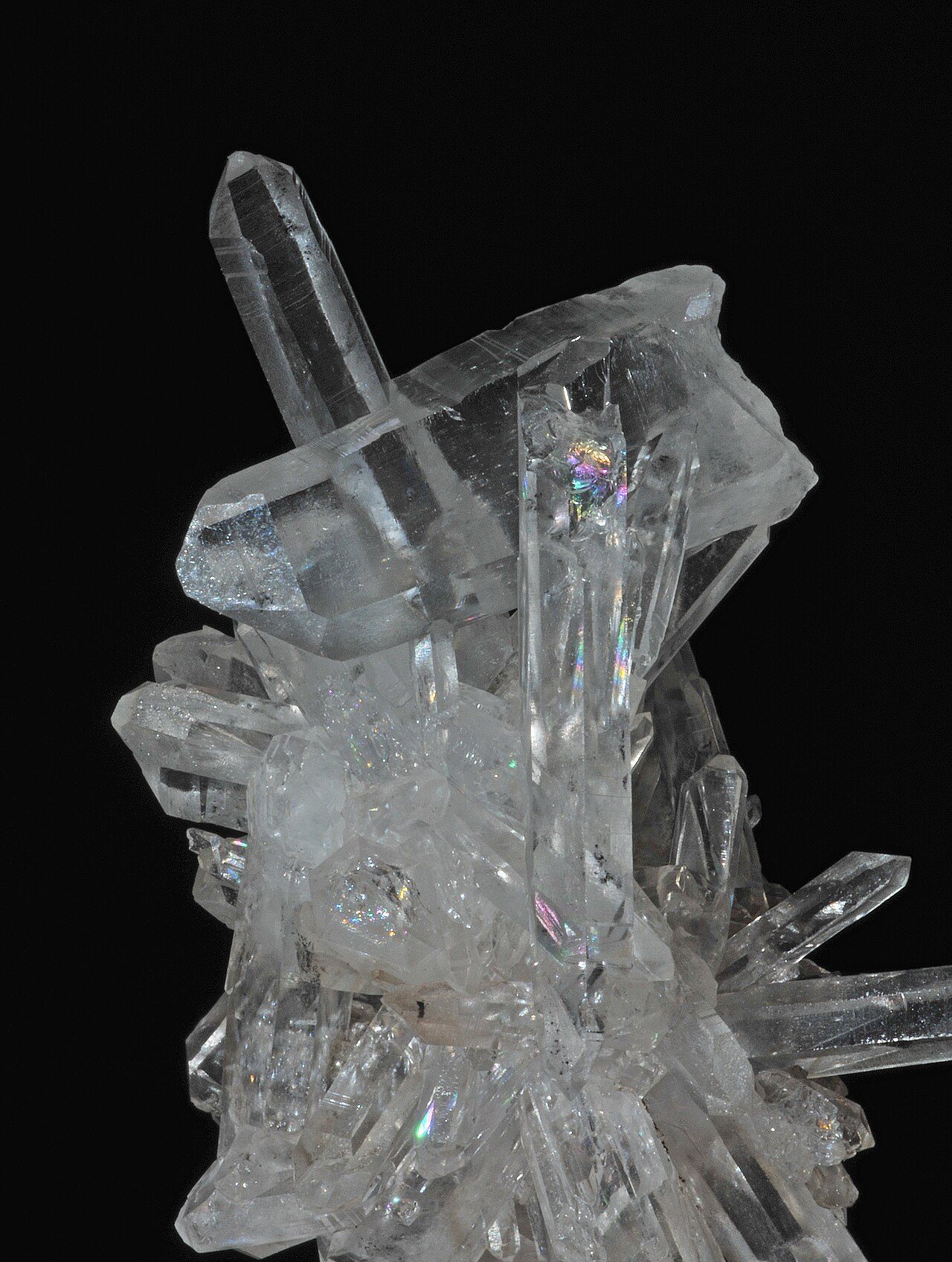
Quartz is silicon dioxide, SiO2, the second most abundant mineral in Earth's crust - and for most of human history its clear form, rock crystal, was treasured as a kind of permanent ice. In 1880 two French brothers found that squeezing it produced electricity. Ninety years later that property, built into a wristwatch in Tokyo, cut the Swiss watch industry's workforce by about two-thirds within a generation.
At a Glance
- What it is
- A mineral of silicon dioxide (SiO2); the second most abundant mineral in Earth's crust after feldspar
- Rock crystal
- Its clear, colourless variety; the ancient Greeks called it krystallos, their word for ice, believing it water frozen beyond melting
- The name quartz
- An old German word of uncertain origin, first used in print by Georgius Agricola in 1530
- Piezoelectricity
- Discovered in quartz by Jacques and Pierre Curie in 1880: pressure on the crystal produces an electric charge, and a charge makes it vibrate
- The first quartz clock
- Built at Bell Telephone Laboratories in 1927 by Warren Marrison and J. W. Horton; quartz clocks were the world's most accurate timekeepers until atomic clocks
- The watch
- Seiko's Quartz Astron 35SQ, on sale in Tokyo on 25 December 1969 at 450,000 yen - about the price of a car - accurate to about 5 seconds a month
- The crisis
- Swiss watch firms fell from about 1,600 in 1970 to about 600 by the mid-1980s, and industry jobs from about 90,000 to under 30,000
Introduction
Quartz is everywhere: it is the main mineral in beach sand, a component of granite and sandstone, and, in its coloured varieties, the gems amethyst, citrine, smoky quartz and rose quartz. Britannica notes that it has attracted attention from the earliest times. Yet the form that mattered most to ancient people was the one with no colour at all. Water-clear quartz - rock crystal - could be carved, polished and set, and it looked like nothing else in the ancient world except ice that never melted.
That resemblance shaped its history twice over. First it made rock crystal a luxury material, worked by Greek, Roman, Egyptian and many other craftspeople into vessels, seals and talismans. Then, in the nineteenth century, the same clear crystals became laboratory instruments, and a Paris experiment revealed that quartz could turn pressure into electricity and electricity into a perfectly regular vibration. The second discovery eventually put quartz inside almost every watch, clock, radio and computer on Earth.
Rock Crystal in the Ancient World
The Smithsonian's National Museum of Natural History explains the Greek view plainly: the Greeks referred to quartz as krystallos, meaning ice, and assumed the crystals were ice frozen so hard it would not melt - which is why our word crystal descends from this mineral. The Roman naturalist Pliny the Elder repeated the idea in the first century CE, writing that rock crystal was formed by intense freezing. The belief was wrong, but it was reasonable: the finest crystals came from high Alpine clefts, near glaciers, and felt cold and looked like ice.
Whatever its supposed origin, rock crystal was prized. Ancient civilisations used quartz crystals as talismans, and coloured varieties were cut as gems and seals. Because quartz is hard - 7 on the Mohs scale - and takes a fine polish, carved rock-crystal vessels and intaglios survive from antiquity in museum collections today. The mineral's scientific name came much later: quartz is an old German miners' word of uncertain origin, first used by Georgius Agricola in 1530, according to Britannica.
1880: The Curies Squeeze a Crystal
In 1880 the brothers Jacques and Pierre Curie, working in Paris, demonstrated that quartz is piezoelectric: when a crystal is squeezed or stretched, positive and negative electric charges appear on its faces. The name comes from the Greek piezein, to press. The following year the mathematician Gabriel Lippmann predicted the reverse effect - that applying a voltage should deform the crystal - and the Curies confirmed it. A quartz crystal fed with alternating current therefore vibrates at a precise frequency set by its size and cut, and it holds that frequency with remarkable stability.
That stability found uses in sequence. During the First World War, Paul Langevin used quartz in early sonar experiments. In the 1920s quartz oscillators began controlling radio transmitters, because a crystal could hold a station on its assigned frequency. In 1927 Warren Marrison and J. W. Horton at Bell Telephone Laboratories built the first quartz clock; for the next quarter-century, quartz clocks were the most accurate timekeepers in the world, until atomic clocks overtook them in the 1950s. The Second World War made crystals a mass industry, with tens of millions cut for military radios, almost all from natural Brazilian quartz - shortages that pushed Bell Labs to a commercial hydrothermal process for growing synthetic quartz by 1950.
Timeline
- Antiquity
The Greeks call clear quartz krystallos, ice, believing it water frozen beyond melting; rock crystal is carved into vessels, seals and talismans.
- 1st century CE
Pliny the Elder records the frozen-water theory of rock crystal in his Natural History.
- 1530
Georgius Agricola first uses the German miners' word quartz in print, according to Britannica.
- 1880
Jacques and Pierre Curie demonstrate the piezoelectric effect in quartz in Paris.
- 1881
Gabriel Lippmann predicts the reverse piezoelectric effect; the Curies confirm it experimentally.
- 1927
Warren Marrison and J. W. Horton build the first quartz clock at Bell Telephone Laboratories in New York.
- 1950
Bell Labs develops hydrothermal growth of synthetic quartz at commercial scale, easing dependence on natural Brazilian crystals.
- 1967
The Swiss Centre Electronique Horloger in Neuchatel unveils its Beta prototype quartz wristwatch movement.
- 25 December 1969
Seiko puts the Quartz Astron 35SQ on sale in Tokyo - the first quartz wristwatch sold - at 450,000 yen.
- 1970s-1980s
Cheap, accurate quartz watches flood the market; Swiss watch firms and jobs collapse in the Quartz Crisis.
- 1983
The Swatch, a cheap Swiss-made quartz watch, launches and leads the Swiss industry's recovery.
The Quartz Crisis
The Astron of Christmas Day 1969 was a luxury object - gold-cased, priced like a small car, accurate to about five seconds a month when a good mechanical watch drifted that much in a day. Its importance was what it proved: a battery and a vibrating crystal could beat two centuries of springs and gears, and could be manufactured ever more cheaply. Swiss engineers had seen it coming - their Beta 21 movement reached the market in 1970 - but Switzerland's industry was hundreds of small firms, and it could not convert as fast as Japan's large integrated makers.
The documented result was an industrial collapse. Commonly cited figures put Swiss watch companies at about 1,600 in 1970 and fewer than 600 by the mid-1980s, with employment falling from about 90,000 to somewhere under 30,000. Historians note the damage was worst at the industry's lower end, where cheap Swiss pin-lever movements met cheap quartz head-on. Recovery came through consolidation and through fighting quartz with quartz: the Swatch of 1983, a colourful plastic Swiss quartz watch, restored volume while the surviving firms rebuilt mechanical watchmaking as a luxury craft.
Questions readers ask
Is quartz the same as silicon? No, and the distinction matters. Quartz is silicon dioxide, SiO2 - silicon combined with oxygen. The silicon of computer chips is the purified element itself, obtained by reducing quartz or quartz-rich sand at high temperature; quartz is thus the raw material of the silicon age, not the same substance as the silicon in a chip. Quartz also serves electronics directly, as itself: the tiny tuning-fork crystal vibrating 32,768 times a second inside a quartz watch is synthetic quartz, grown for the purpose.
Did the Greeks really think it was ice? That is what the ancient sources say: krystallos was the Greek word for ice before it was a word for crystal, and Pliny states the freezing theory as fact. It is best presented as their genuine belief, recorded in their own texts, not as a later joke at their expense.
Legacy
Quartz's legacy is that the ancient world's imitation ice became modernity's heartbeat. A quartz oscillator times the watch on a wrist, the clock in a phone, the carrier wave of a radio broadcast and the operations of a computer processor. Almost all of it is now synthetic, grown hydrothermally to exact specifications - the Smithsonian notes synthetic quartz as a key ingredient in watches, radios and other electronics. The mineral that Pliny thought was frozen water turned out to be something stranger and more useful: a stone that keeps time.
Sources
- Encyclopaedia Britannica - Quartz
- Smithsonian Magazine - The Story Behind the New 8,000-Pound Quartz at the Smithsonian
- Smithsonian National Museum of Natural History - Quartz (var. smoky-citrine)
- Watches by SJX - An Engineer's Technical and Personal Perspectives on Quartz Timekeeping
- Gear Patrol - The Seiko Quartz Watch That Broke Switzerland
The facts on this page were checked against these sources on 19 November 2026. The History Trail's permanent pages are researched and written for this site; the live profiles elsewhere on The History Trail are assembled automatically from Wikipedia and Wikidata.
About the Author
Researched and written by the The History Trail Editorial Team — the accountable editorial function behind this site's permanent story pages. The team works from the published sources cited on each page; it does not invent historians, reviewers or credentials, and it corrects errors openly.
Fact Check
Every load-bearing fact on this page traces to one of the sources listed above, and significant claims link to their source in the text. Our checking method is described on the methodology page; errors can be reported via the corrections page.
Sources & Citations
Cite this page as: The History Trail Editorial Team, The History Trail — this article's title, publication and update dates are shown beneath its headline. The full source list appears under Sources above; the site's source standards are on the sources page.