
Things
Amethyst
Amethyst is the violet variety of quartz, and for most of human history it was a royal stone, valued beside ruby and emerald. Its Greek name, amethystos, means 'not drunk', from the ancient belief that the stone protected its wearer from intoxication. Then, in the nineteenth century, vast deposits in Brazil turned a jewel of kings into a stone almost anyone could own.
At a Glance
- What it is
- The violet to purple variety of quartz (silicon dioxide); a few atoms of iron, with natural radiation, produce the colour, the Smithsonian notes
- The name
- From the Greek amethystos, 'not intoxicated' - the ancient folk belief, recorded by Britannica, that the stone protects its owner against drunkenness
- Ancient use
- Carved into intaglios since ancient times; named in Exodus as one of the twelve stones of the high priest's breastplate
- The old sources
- Russia was the major source until the nineteenth century, GIA records; fine amethyst was scarce and costly
- The turning point
- Large deposits found in Brazil in the nineteenth century ended amethyst's rarity; Brazil, above all Rio Grande do Sul, remains a major supplier
- Today
- The February birthstone; major sources now include Brazil and Uruguay, with the Smithsonian holding a 401.52-carat untreated Brazilian amethyst
Introduction
Few stones carry their oldest story in their name. Amethyst is quartz - silicon and oxygen, two of the commonest elements in the Earth's crust - coloured violet by trace iron and natural radiation, as the Smithsonian's National Museum of Natural History explains. In its pure state quartz is colourless; with a few atoms of iron in place of silicon, it becomes the most prized gem variety of quartz. What made amethyst precious was never its chemistry. It was scarcity, and the meanings people loaded onto its wine-dark colour.
For thousands of years those meanings were grand ones. Egyptians carved it, Greek and Roman drinkers trusted it against wine itself, bishops wore it in their rings, and empresses collected it. Amethyst stood in the first rank of gems, as expensive as ruby and emerald, in GIA's summary - until the nineteenth century, when Brazil's geodes turned the royal stone into the most democratic of gems.
A Name Against Wine
The name comes from the Greek amethystos, 'not intoxicated'. Britannica states it plainly: the name expresses the ancient folk belief that the stone protects its owner against drunkenness. The Smithsonian gives the same derivation - a Greek word meaning 'not to intoxicate' - and adds the Roman myth that amethyst was coloured purple by the god of wine himself. Because the stone's colour is so close to wine's, early Greek mythology associated the gem with Bacchus, the Roman god of wine, and the belief followed naturally: wear amethyst, or drink from a vessel carved from it, and the wine would not master you.
The belief was a belief, and this page presents it as one - there is no evidence a quartz cup ever kept anyone sober. But as history it is real and consequential. It shaped how the stone was used for centuries: carved drinking vessels, amulets worn at feasts, and intaglios - engraved gems - which Britannica notes amethyst has been used for since ancient times. The stone was also credited with keeping its wearer clear-headed and quick-witted in battle and business, and Renaissance Europeans thought it calmed lovers overrun by passion. Amethyst is named in the Bible, in Exodus, as one of the twelve stones in the breastplate of the high priests.
The Stone of Bishops and Empresses
Through the Middle Ages and into the modern centuries, amethyst's purple - the colour of royalty since antiquity - kept it on the persons of the powerful. It became the stone of bishops, set in episcopal rings, where its reputation for clear-headedness suited an office that prized sobriety. It appears in royal collections across Europe and Asia, as GIA records, and among its most famous admirers was Catherine the Great of Russia, who, in GIA's words, had a penchant for the gem and decked herself in amethyst necklaces, earrings and other ornaments.
Russia's importance was geological as well as fashionable. Until the nineteenth century, Russia was the major source of amethyst, and supply was small enough that the stone stayed in the company of ruby and emerald. That long scarcity is the essential background to what happened next: amethyst's price rested not on any change in the stone, but on how little of it the world could find.
Brazil Breaks the Rarity
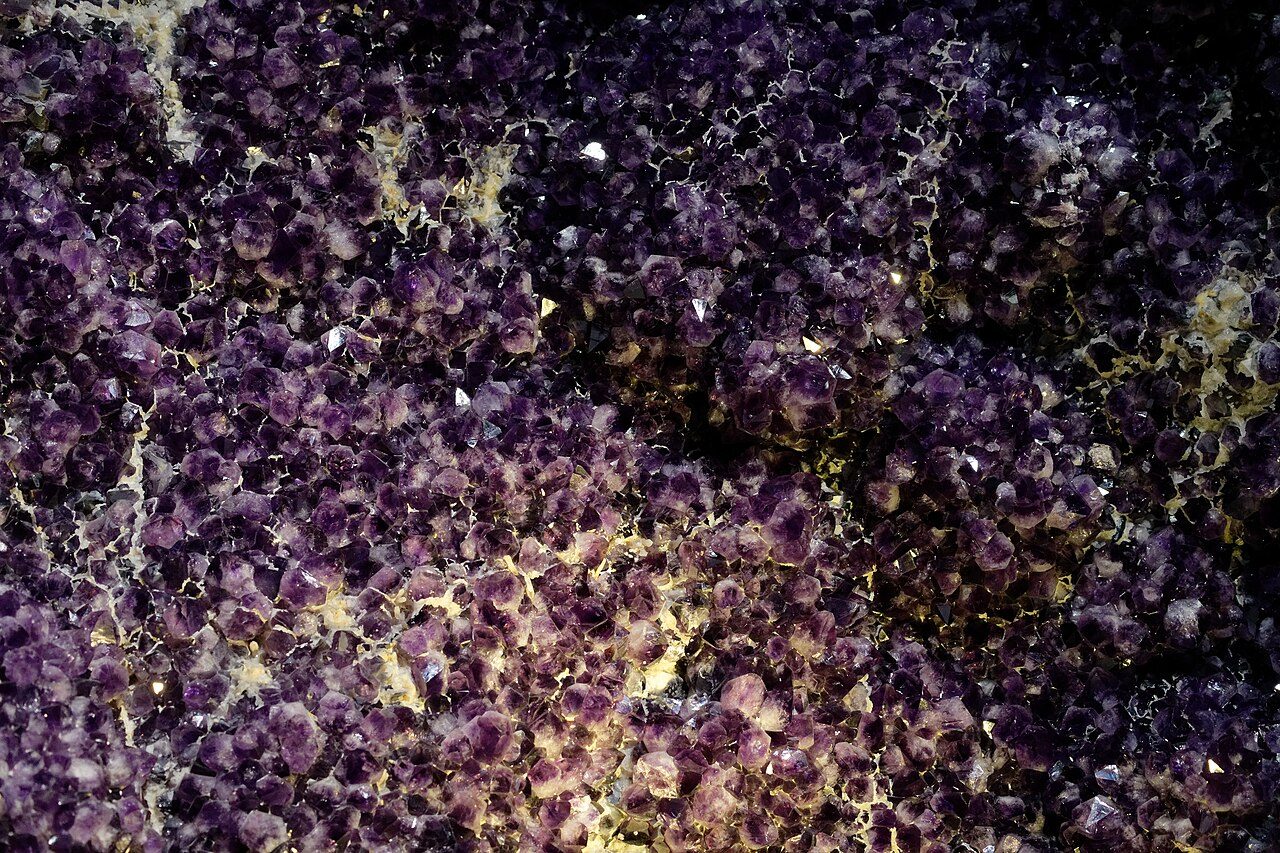
In the nineteenth century, large deposits were found in Brazil, and amethyst's history turns on that discovery. GIA's summary is blunt: amethyst was as expensive as ruby and emerald until the nineteenth century, when large deposits were found in Brazil. The Brazilian fields, above all in the southernmost state of Rio Grande do Sul, produced the stone not as rare single crystals but in hollow, crystal-lined geodes in volcanic rock - some, GIA notes, so large that a person can stand inside them.
Abundance rewrote the stone's social meaning. What had been a cardinal luxury became a semiprecious gem within reach of ordinary buyers, and it has stayed there: beautiful, historic, and comparatively affordable. The finest single stones still command attention - in 2012 the Smithsonian received an untreated Brazilian amethyst of 401.52 carats, described as the finest and one of the largest faceted amethysts in the National Gem Collection. Brazil had made amethyst common; it had not made great amethyst ordinary.
Timeline
- Ancient Egypt
Egyptians use amethyst in jewellery and carved gems; the stone is later named among the twelve stones of the high priest's breastplate in Exodus.
- Classical Greece and Rome
The stone takes its Greek name, amethystos, 'not intoxicated', from the belief that it protects the drinker; vessels and amulets are made from it.
- Middle Ages
Amethyst becomes a stone of the Church, set in bishops' rings, and remains a jewel of royalty across Europe.
- 18th century
Russia is the major source of fine amethyst; Catherine the Great of Russia (1729-1796) famously decks herself in amethyst jewellery.
- 19th century
Large deposits are found in Brazil. A stone once as expensive as ruby and emerald becomes abundant, and its rarity - and price - collapse.
- 1912
Amethyst takes its place as the February birthstone in the modern standard birthstone list adopted by the American trade.
- 1953
Wallis, Duchess of Windsor, wears a lavish Cartier amethyst bib necklace to a gala at Versailles, a landmark of amethyst's modern royal glamour.
- 2012
The Smithsonian's National Gem Collection receives a 401.52-carat untreated Brazilian amethyst, among the largest faceted amethysts in the collection.
Significance
Amethyst's significance is that it is the clearest case in gem history of value as a social fact. The stone did not change in the nineteenth century; the supply did, and a gem that had crowned bishops and empresses became a birthday present. Its story separates two things buyers often confuse: beauty, which amethyst kept, and rarity, which it lost. The purple quartz in a modern jeweller's window is the same material the Greeks trusted against wine - only the world around it is different.
It is also a record of how durable a belief can be. The sobriety legend is embedded in the stone's very name, repeated by Britannica and the Smithsonian alike, and it carried amethyst through three thousand years of changing religions and fashions.
Myths and disputes
Does amethyst prevent drunkenness? No. That is the founding belief, not a property of quartz, and no evidence supports it; this page treats it throughout as what ancient people believed, not what the stone does. A related Roman myth, noted by the Smithsonian, held that the god of wine coloured the stone purple - a story about the colour, offered here as mythology, not geology. The colour's actual cause, the Smithsonian states, is a few atoms of iron replacing silicon, combined with natural radiation.
London's Natural History Museum holds a stranger cautionary tale: the so-called Cursed Amethyst, an oval stone in a silver snake ring, said to have been looted from a temple in India in 1855 and to have ruined its owners. Its last owner, Edward Heron-Allen, locked it away with a warning letter - yet the Museum itself reports the rumour that he fabricated the curse to promote a short story he wrote in 1921. The curse is best read as Edwardian self-promotion that outlived its author.
Even amethyst's colour has a footnote of uncertainty: Britannica notes that experts believe the colour arises from its iron content, while other theories attribute it to manganese or hydrocarbons. On the central facts - the name, the belief, the Brazilian turning point - the sources agree.
Legacy
Amethyst's legacy is double. As the February birthstone and the gem of the sixth wedding anniversary, it remains woven into ordinary gift-giving - a fate its rarity once made impossible. And as a museum stone it still draws crowds: the great Brazilian geodes, some tall enough to stand inside, are among the most popular mineral exhibits in the world, while the Smithsonian's 401.52-carat Brazilian gem anchors its national collection.
The stone the Greeks named against drunkenness ended by teaching a sober lesson of its own: that preciousness is made by people, supply and story together - and that when the supply changes, only the story, and the beauty, remain.
Sources
- Encyclopaedia Britannica - Amethyst
- Smithsonian National Museum of Natural History - Quartz (var. amethyst)
- Gemological Institute of America - February Birthstone: Amethyst
- Natural History Museum, London - 10 weird and wonderful things to see at the Museum (the Cursed Amethyst)
The facts on this page were checked against these sources on 19 November 2026. The History Trail's permanent pages are researched and written for this site; the live profiles elsewhere on The History Trail are assembled automatically from Wikipedia and Wikidata.
About the Author
Researched and written by the The History Trail Editorial Team — the accountable editorial function behind this site's permanent story pages. The team works from the published sources cited on each page; it does not invent historians, reviewers or credentials, and it corrects errors openly.
Fact Check
Every load-bearing fact on this page traces to one of the sources listed above, and significant claims link to their source in the text. Our checking method is described on the methodology page; errors can be reported via the corrections page.
Sources & Citations
Cite this page as: The History Trail Editorial Team, The History Trail — this article's title, publication and update dates are shown beneath its headline. The full source list appears under Sources above; the site's source standards are on the sources page.