
Things
Pearl Harbor: The Attack That Brought America to War
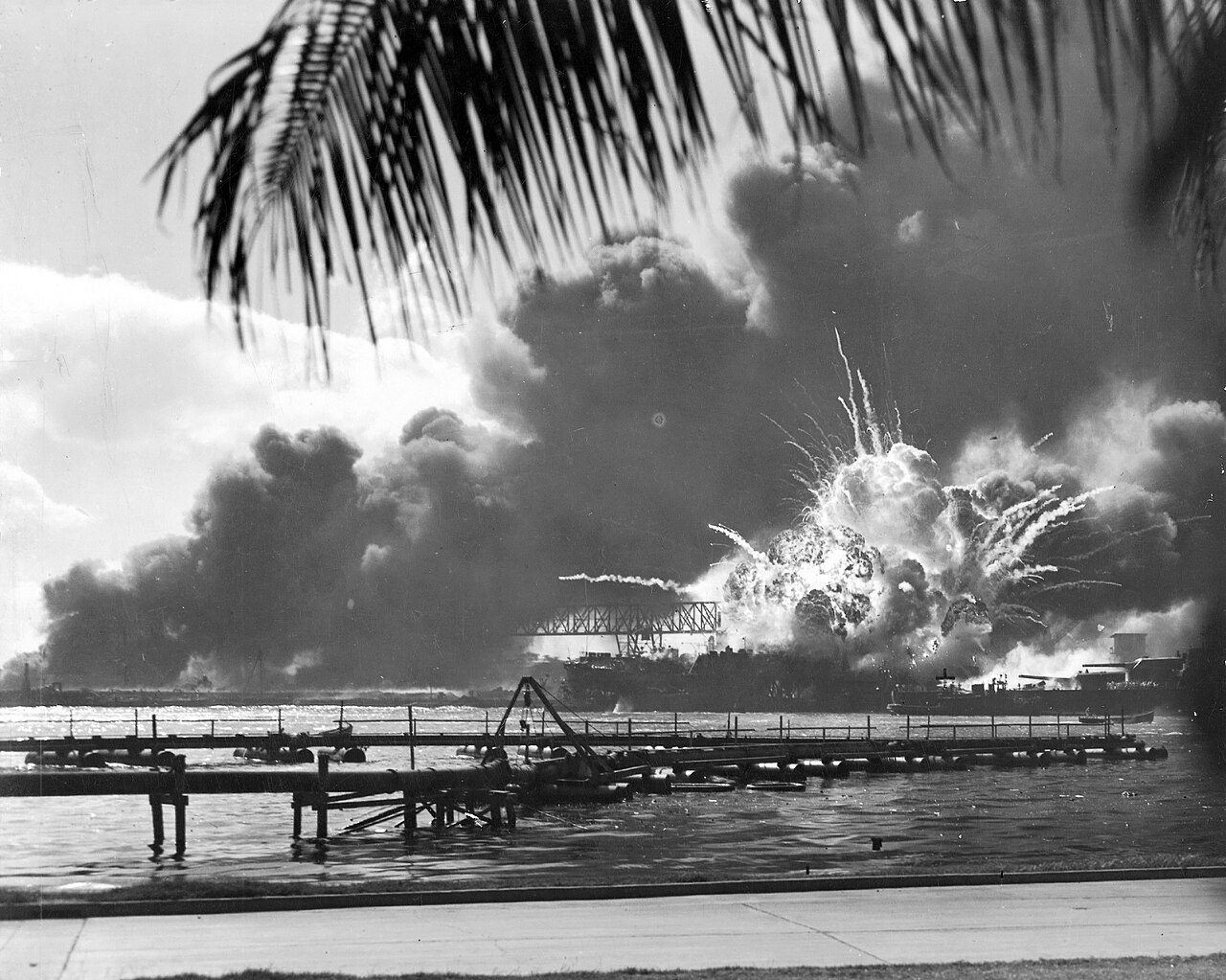
Shortly before 8:00 on a quiet Sunday morning, 7 December 1941, aircraft from six Japanese carriers fell on the United States Pacific Fleet at Pearl Harbor, Hawaii. In under two hours 2,403 Americans were dead, the battle fleet was shattered — and the United States was in the Second World War.
At a Glance
- Date
- Sunday, 7 December 1941; the first wave struck shortly before 8:00 a.m.
- Attacking force
- Imperial Japanese Navy — 353 aircraft launched from six aircraft carriers, in two waves
- American dead
- 2,403 killed, including 68 civilians; 1,178 wounded
- Ships
- 21 US ships sunk or damaged; all eight battleships present were hit and four were sunk
- Aircraft
- 188 American aircraft destroyed and 159 damaged, most on the ground
- Japanese losses
- 29 aircraft and fewer than 100 men
- What was missed
- All three Pacific Fleet aircraft carriers were at sea; the base's fuel storage and repair yards survived intact
- The day after
- 8 December 1941 — President Roosevelt's 'infamy' speech; Congress declares war on Japan
Introduction
What happened at Pearl Harbor was a surprise carrier air strike: on the morning of Sunday, 7 December 1941, the Imperial Japanese Navy attacked the United States naval base at Pearl Harbor on Oahu, Hawaii, where the US Pacific Fleet lay at anchor. Six Japanese aircraft carriers launched 353 aircraft in two waves against the fleet and the airfields around it. The attack began shortly before 8:00 a.m. and was over in less than two hours. It killed 2,403 Americans, sank or damaged 21 ships and destroyed 188 aircraft.
The raid was a tactical triumph and a strategic catastrophe for Japan. It was meant to knock the Pacific Fleet out of a war Japan was about to start in Southeast Asia. Instead it united American opinion overnight. The next day President Franklin D. Roosevelt told Congress that 7 December was 'a date which will live in infamy', and the United States declared war on Japan. Within four days it was also at war with Germany and Italy.
Background
The Pacific Fleet had been moved forward to Pearl Harbor as a deterrent while relations with Japan deteriorated over its war in China and its advance into Southeast Asia. Washington answered Japanese expansion with aid to China, a military build-up and, finally, embargoes on oil and other raw materials. Japan's leaders chose to seize the resources of Southeast Asia by force, and to open that campaign by crippling the one fleet that could interfere with it.
The plan was conceived by Admiral Isoroku Yamamoto, commander-in-chief of Japan's Combined Fleet, and executed by Vice Admiral Chuichi Nagumo's carrier striking force, the Kido Butai. The force assembled in the Kurile Islands and sailed on 26 November 1941 under radio silence, crossing the empty North Pacific to a launch point a little over 200 miles north of Oahu. American commanders in Hawaii, Admiral Husband E. Kimmel and Lieutenant General Walter C. Short, expected sabotage more than an air raid, and many American aircraft were parked close together as a guard against it — which made them easier targets from the air.
Timeline
- 26 November 1941
Nagumo's carrier force — six carriers with battleship, cruiser and destroyer escorts — sails from the Kurile Islands in strict secrecy and radio silence.
- Before dawn, 7 December 1941
The destroyer USS Ward attacks and reports sinking a Japanese midget submarine at the entrance to Pearl Harbor; the warning moves slowly and no general alarm follows.
- 7:00 a.m., 7 December 1941
An Army radar station at Opana spots the incoming first wave; the contact is assumed to be expected American bombers and is not acted on.
- Shortly before 8:00 a.m., 7 December 1941
The first wave of 181 aircraft strikes Battleship Row and the airfields at Hickam, Wheeler, Ford Island, Kaneohe, Ewa and Bellows, achieving complete surprise.
- About 8:10 a.m., 7 December 1941
An armour-piercing bomb ignites the forward magazine of the battleship USS Arizona. The explosion kills 1,177 of her crew — about half of all American dead that day.
- About 8:45 a.m., 7 December 1941
The second wave attacks through smoke and anti-aircraft fire, hitting ships in the navy yard, including the destroyer USS Shaw, which explodes in dry dock.
- Shortly before 10:00 a.m., 7 December 1941
The attack ends. Twenty-one ships have been sunk or damaged, 188 aircraft destroyed, and 2,403 Americans killed; Japanese losses are 29 aircraft and fewer than 100 men.
- 8 December 1941
Roosevelt addresses Congress — 'a date which will live in infamy' — and the United States declares war on Japan.
- 11 December 1941
Germany and Italy declare war on the United States, merging the Pacific and European conflicts into one global war.
Significance
The material damage, though shocking, was shallower than it looked. All eight battleships present were hit and four sank, but only the Arizona and the target ship Utah were permanent losses; the others were raised, repaired and mostly returned to service. More important was what the raiders never touched. The Pacific Fleet's three aircraft carriers were at sea and escaped entirely, and Nagumo withdrew without a further strike at the shore installations. Pearl Harbor's repair yards, dry docks and huge fuel storage tanks survived intact.
The Naval History and Heritage Command's judgment is that those neglected shore facilities went on to play an important role in the Allied victory: because the base still worked, damaged ships could be salvaged where they lay and the fleet could keep operating from Hawaii rather than falling back to the American West Coast. The attack also settled the future shape of naval war in a single morning. The battleships Japan had targeted turned out to be the past; the carriers it missed became the decisive weapon of the Pacific war.
Legacy
'Remember Pearl Harbor' became the rallying cry of the American war effort, and 7 December remains National Pearl Harbor Remembrance Day in the United States. The sunken Arizona, still holding most of her dead, became the centre of remembrance: the USS Arizona Memorial, dedicated in 1962, now forms part of Pearl Harbor National Memorial, administered by the National Park Service, and the harbour's other sites — the Oklahoma and Utah memorials, the battleship Missouri and the Pacific Fleet Submarine Museum — preserve the day from several sides.
The attack also left a permanent argument about warning and blame: the missed radar contact, the Ward's unheeded submarine report and the unread state of intelligence in Washington were investigated repeatedly during and after the war. What is not disputed is the hinge itself. Before 7 December 1941 the United States was a neutral arming other nations; after it, the country was a full belligerent, and the Second World War had become truly global.
Sources
- Naval History and Heritage Command — The Pearl Harbor Attack, 7 December 1941 (FAQ 66-1)
- The National WWII Museum — Pearl Harbor Attack, December 7, 1941
- Naval History and Heritage Command (via Navy CHIPS) — The Attack on Pearl Harbor
- Wikipedia — Attack on Pearl Harbor
The facts on this page were checked against these sources on 19 November 2026. The History Trail's permanent pages are researched and written for this site; the live profiles elsewhere on The History Trail are assembled automatically from Wikipedia and Wikidata.
About the Author
Researched and written by the The History Trail Editorial Team — the accountable editorial function behind this site's permanent story pages. The team works from the published sources cited on each page; it does not invent historians, reviewers or credentials, and it corrects errors openly.
Fact Check
Every load-bearing fact on this page traces to one of the sources listed above, and significant claims link to their source in the text. Our checking method is described on the methodology page; errors can be reported via the corrections page.
Sources & Citations
Cite this page as: The History Trail Editorial Team, The History Trail — this article's title, publication and update dates are shown beneath its headline. The full source list appears under Sources above; the site's source standards are on the sources page.