
Things
Pakistani rupee
The Pakistani rupee is one of the few currencies that can be dated to the birth of a nation. When Pakistan became independent in August 1947 it had no central bank and no notes of its own — so for its first months, the new country's money was Indian currency carrying a Pakistani name.
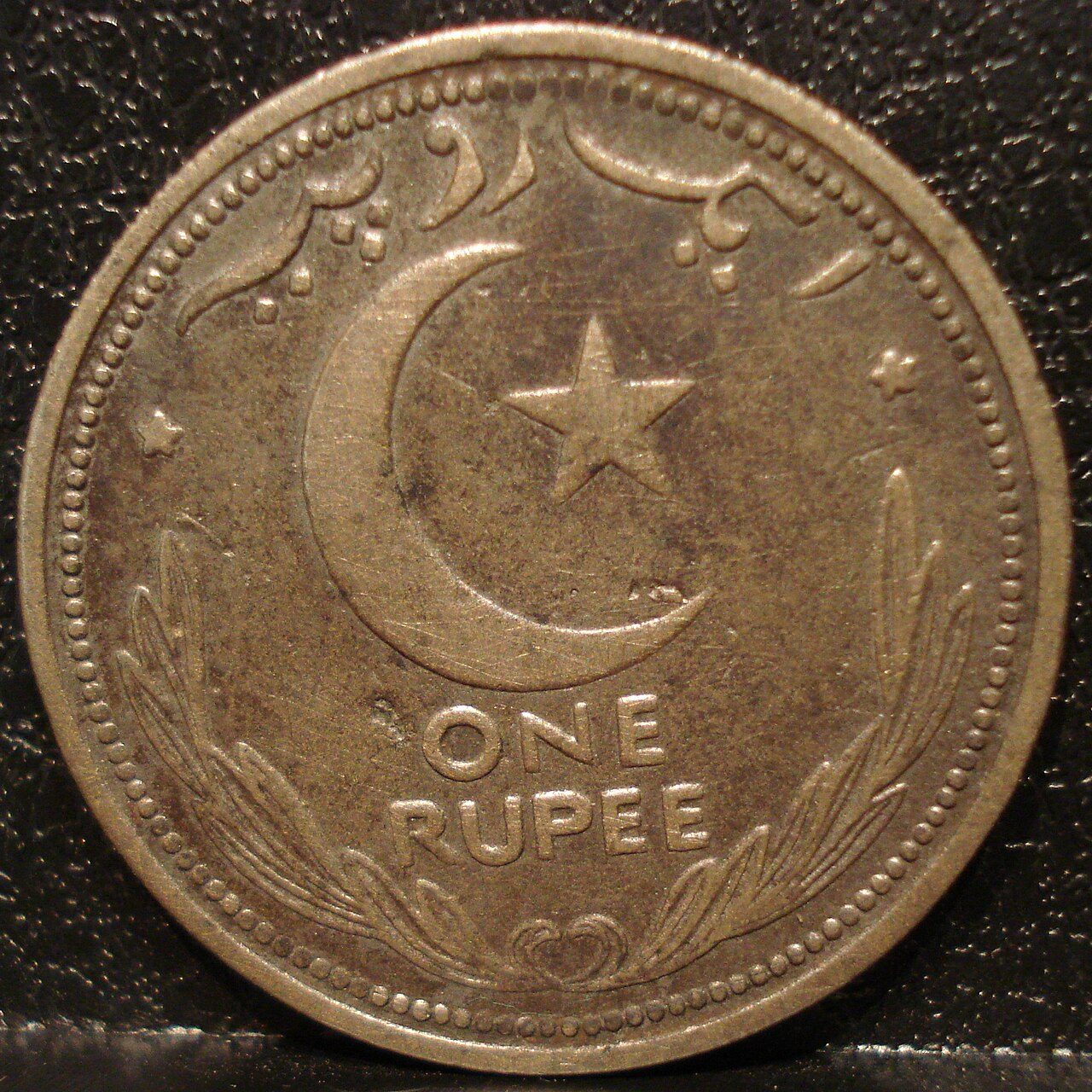
At a Glance
- Introduced
- 1947–48, at the creation of Pakistan
- Country
- Pakistan
- ISO code
- PKR
- Issued by
- State Bank of Pakistan (established 1 July 1948)
- First State Bank notes
- 1 October 1948 — Rs 5, 10 and 100
- Subdivision
- 100 paise (decimalised 1961)
- Portrait
- Quaid-i-Azam Muhammad Ali Jinnah, on notes since 1957
Introduction
Most currencies evolve; the Pakistani rupee had to be improvised. When Pakistan became independent on 14 August 1947, the new state inherited the Indian rupee, the Reserve Bank of India as its monetary authority, and no printing press or central bank of its own. Under the Pakistan (Monetary System and Reserve Bank) Order of 1947, Indian banknotes were modified for the new country: notes in denominations of one, two, five, ten and a hundred rupees carried two added inscriptions, 'Government of Pakistan' in English and the same words in Urdu, printed over the area normally reserved for the watermark.
That borrowed money bought Pakistan time to build the real thing. The State Bank of Pakistan was inaugurated on 1 July 1948 by the country's founder, Muhammad Ali Jinnah, and took over as sole issuing authority. On 1 October 1948 the government issued an emergency series of five, ten and hundred rupee notes, printed in London by Thomas De La Rue and signed by Ghulam Muhammad, Pakistan's first finance minister — notes made in such haste that they carried neither a watermark nor a security thread.
Background
The word rupee itself is far older than Pakistan. It descends from the Sanskrit rūpyakam, a silver coin, and silver rupees had circulated in the region since the sixteenth century, through Mughal, Afghan and British rule. What was new in 1947 was not the unit but the sovereignty behind it: for the first time, the rupee in the western half of the subcontinent answered to a Pakistani authority rather than to Delhi or London.
The State Bank's own first generation of notes began on 1 March 1949 with a two-rupee note printed by Bradbury Wilkinson, signed by the Bank's first governor, Zahid Hussain, and lettered in three languages — English, Urdu and Bengali, reflecting a country that then included East Pakistan. A one-rupee note appeared the same day. These notes introduced the security features the emergency issue had lacked, including a crescent-moon watermark and a security thread, and began the rupee's long procession of redesigns.
Timeline
- 14 August 1947
Pakistan becomes independent, still using Indian currency; the Reserve Bank of India remains its monetary authority under a transitional order.
- 1947
Indian notes are modified for Pakistan with 'Government of Pakistan' inscriptions in English and Urdu, in Rs 1, 2, 5, 10 and 100.
- 1 July 1948
The State Bank of Pakistan is inaugurated by Muhammad Ali Jinnah and becomes the country's currency-issuing authority.
- 1 October 1948
An emergency series of Rs 5, 10 and 100 notes, printed by Thomas De La Rue, is issued — without watermark or security thread.
- 1 March 1949
The State Bank issues its first-generation notes, beginning with the Rs 2 note in English, Urdu and Bengali, with watermark and security thread.
- 24 December 1957
A Rs 100 note bearing the portrait of Muhammad Ali Jinnah is issued, setting the pattern of the founder's portrait on Pakistani notes.
- 1961
Pakistan decimalises the rupee into 100 paise, replacing the old division into annas.
- 13 August 2005
A new-design series begins with the first-ever Rs 20 note, adding modern security features; the completed series runs to Rs 5,000.
- September 2022
A commemorative Rs 75 note marks 75 years of independence, with portraits of Jinnah, Fatima Jinnah, Iqbal and Sir Syed Ahmad Khan.
Significance
The rupee's first years are a case study in how a state is built out of paper. Currency is usually the most widely handled product of a government, and Pakistan's notes had to announce a new country — its languages, its founder, its symbols — while remaining familiar enough for bazaars to trust them at face value. The trilingual notes of 1949, and the arrival of Jinnah's portrait in 1957, turned pocket change into a daily statement of national identity for a country spread across two wings a thousand miles apart.
The currency also records Pakistan's ruptures. In June 1971, amid the crisis that ended with the secession of East Pakistan, notes bearing political inscriptions were declared no longer legal tender and the high denominations were withdrawn and replaced. And the rupee's value tells its own long story: at independence it stood at par with the Indian rupee, a link that broke in September 1949 when India devalued with sterling and Pakistan chose not to follow.
Legacy
Today the State Bank of Pakistan, from its museum and headquarters in Karachi, curates the complete run of Pakistani banknotes from 1947 onward — a gallery that doubles as a history of the state itself. The modern series, completed in 2008, unified eight denominations behind Jinnah's portrait and contemporary security printing, and commemorative issues such as the two different Rs 75 notes of 2022 and 2023 continue the habit of marking national milestones in cash.
The rupee's legacy is resilience under improvisation. Born as an overprint, printed abroad in an emergency, redesigned through five generations and decimalised along the way, it has nonetheless kept one name and one issuing authority since 1948. For the millions who send money home to Pakistan from abroad, the rupee remains what it was in 1947: the everyday proof that the country exists.
Sources
- State Bank of Pakistan — History of Pakistani Banknotes
- State Bank of Pakistan Museum — The Collections
- State Bank of Pakistan — Rs 75 Commemorative Banknote, 75 Years of Independence
- Wikipedia — Pakistani rupee
The facts on this page were checked against these sources on 19 November 2026. The History Trail's permanent pages are researched and written for this site; the live profiles elsewhere on The History Trail are assembled automatically from Wikipedia and Wikidata.
About the Author
Researched and written by the The History Trail Editorial Team — the accountable editorial function behind this site's permanent story pages. The team works from the published sources cited on each page; it does not invent historians, reviewers or credentials, and it corrects errors openly.
Fact Check
Every load-bearing fact on this page traces to one of the sources listed above, and significant claims link to their source in the text. Our checking method is described on the methodology page; errors can be reported via the corrections page.
Sources & Citations
Cite this page as: The History Trail Editorial Team, The History Trail — this article's title, publication and update dates are shown beneath its headline. The full source list appears under Sources above; the site's source standards are on the sources page.