
Things
Nutella
Nutella is a sweetened hazelnut and cocoa spread made by the Italian company Ferrero, first sold under that name in 1964. It was not a new invention that year. It was the third form of a paste Pietro Ferrero created in Alba, Piedmont, in 1946, when cocoa was scarce after the Second World War and he built a sweet food around the hazelnuts his region had in abundance instead.
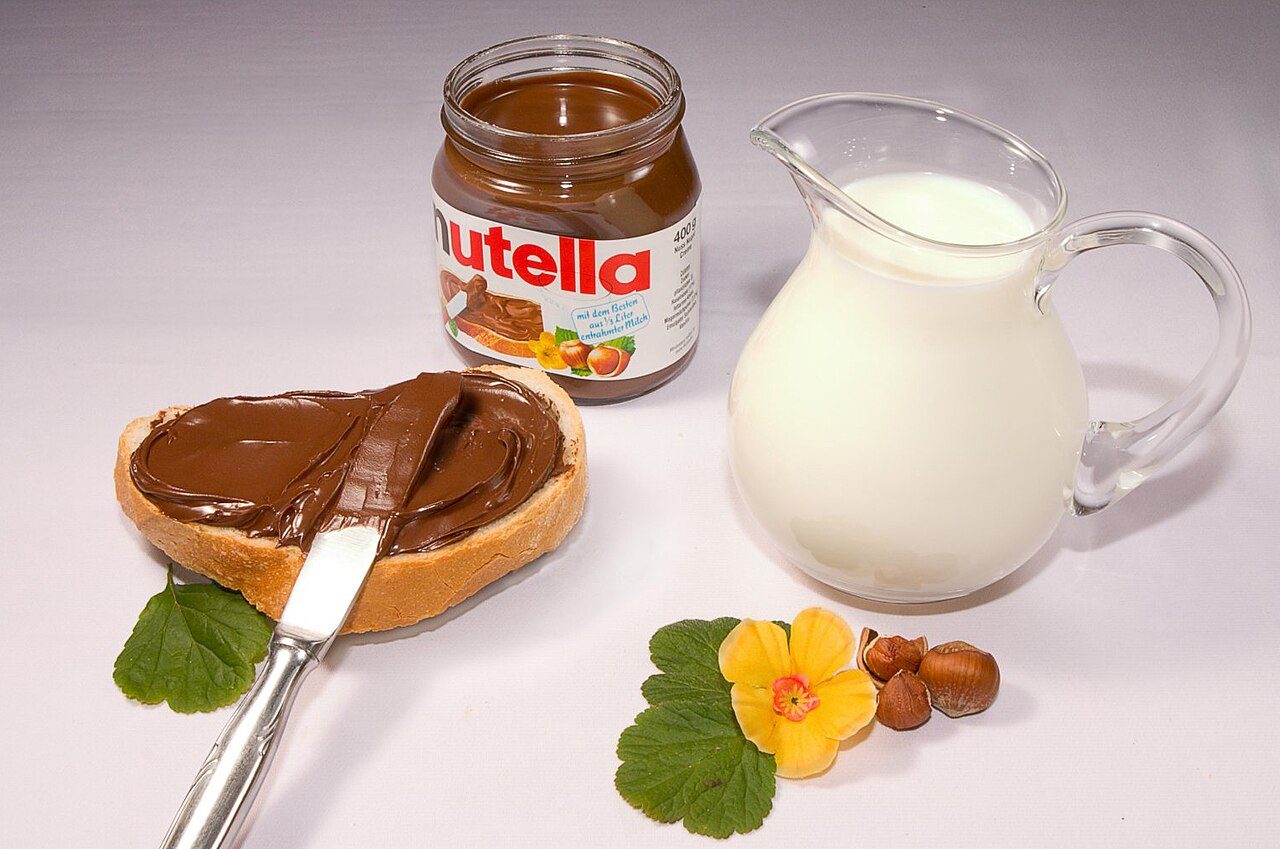
At a Glance
- What it is
- A sweetened hazelnut and cocoa spread, made by Ferrero of Italy and sold in a glass jar
- The ancestor
- Giandujot (1946), a solid hazelnut paste loaf that was sliced and laid on bread, named after a Piedmont carnival character
- The founder
- Pietro Ferrero, a pastry maker of Alba, Piedmont, who founded the Ferrero company in 1946
- The middle name
- Supercrema, the spreadable cream version launched in 1951
- Nutella itself
- The improved recipe renamed Nutella by Pietro's son Michele; the first jar left the Alba factory on 20 April 1964
- The name
- From the English word nut, for the hazelnut, joined to the Italian suffix -ella, according to the brand's own history
- Going global
- Germany 1965, France 1966, and a first plant outside Europe in Australia in 1978, per Ferrero's own timeline
Introduction
Few branded foods have a birthday as precise as Nutella's: Ferrero records that the first jar left its factory in Alba on 20 April 1964. Yet the spread inside that jar was already eighteen years old, and the idea behind it - stretching a little cocoa a long way with ground hazelnuts - was older still, a Piedmontese tradition Ferrero inherited rather than invented. Nutella's history is therefore a brand history with deep roots: a regional answer to scarcity, twice over, that a family firm turned into a product sold around the world. This page tells that history factually, as the record of a company and a recipe, not as an endorsement of either.
Gianduja: The Older Piedmont Tradition
Turin, the capital of Piedmont in north-western Italy, was a chocolate city long before Ferrero. Its chocolatiers made gianduja, a blend of chocolate with hazelnut paste - by the traditional recipe, roughly a third cocoa - using the hazelnuts that grew abundantly in the Langhe hills around Alba. The standard account dates gianduja to the Napoleonic era, when Napoleon's Continental System, imposed in 1806, choked off the cocoa supplies reaching Turin and chocolatiers stretched what they had with nuts. In 1852 the Turin maker Caffarel produced the gianduiotto, a small ingot-shaped gianduja chocolate. The name, in both its forms, comes from Gianduja, a carnival and marionette character who stands for the archetypal Piedmontese.
How much of the Napoleonic story is documented and how much is later embroidery is genuinely uncertain, and this page treats it as tradition rather than proven fact: the blend, the region and the carnival name are all real, but no contemporary record neatly ties gianduja's birth to the blockade. What is certain is that when cocoa ran short again, a century and a half later, Piedmont already had a tested answer ready.
Pietro Ferrero and the Postwar Loaf
Pietro Ferrero was a pastry maker in Alba, a town in hazelnut country. After the Second World War, cocoa was, in Ferrero's own words, extremely scarce, and chocolate was a luxury postwar Italians could rarely afford. In 1946 Pietro produced his answer: a sweet paste made predominantly from locally available hazelnuts, with sugar and just a little of the precious cocoa. He shaped it into a solid loaf, wrapped so it could be sliced and the slices laid on bread, and named it Giandujot, after the same carnival character. Ferrero's company history dates the firm's founding to that same year, 1946, in Alba.
The loaf was a sweet food working families could afford, and it sold. Pietro died in 1949, only three years after founding the company, and the business continued under his brother Giovanni, his widow Piera and, increasingly, his son Michele. In 1951 the family transformed the sliceable loaf into a creamy product that was easier to spread, sold as Supercrema. The knife that had cut the loaf became the knife that spread the cream - a small change that moved the product from a sliced confection towards the modern breakfast spread.
Michele Ferrero Makes It Nutella
Michele Ferrero, who had joined his father's firm as a young man, set out in the early 1960s to improve the recipe again and sell it across Europe. Working with the chemist Francesco Rivella, he reformulated Supercrema, and in 1964 the result was relaunched under a new, exportable name: Nutella, built, the brand says, from the English word nut and the Italian suffix -ella. The first jar left Alba on 20 April 1964.
The spread then travelled the route Ferrero's own timeline records: launched in Germany in 1965 in its now-familiar jar, it arrived in France in 1966, and in 1978 Ferrero opened its first plant outside Europe, at Lithgow near Sydney in Australia. Under Michele, who led the family firm for decades and became, by the time of his death in 2015, Italy's richest man, Ferrero also created Kinder, Tic Tac and Ferrero Rocher. Nutella remained the flagship: the product that had begun as a sliced loaf for postwar Alba became a fixture of breakfast tables far beyond Italy.
Timeline
- Napoleonic era
Gianduja, a blend of chocolate and hazelnut paste, is traditionally dated to Turin in this period, when blockade made cocoa scarce.
- 1852
The Turin chocolate maker Caffarel produces the gianduiotto, a small ingot-shaped gianduja chocolate.
- 1946
Pietro Ferrero sells his Giandujot, a sliceable hazelnut paste loaf with a little cocoa, in Alba; the Ferrero company is founded.
- 1949
Pietro Ferrero dies; the family business continues under his brother, his widow and his son Michele.
- 1951
The Giandujot paste is transformed into Supercrema, a creamy version made to be spread rather than sliced.
- 20 April 1964
The first jar of the improved recipe, renamed Nutella by Michele Ferrero, leaves the factory in Alba.
- 1965
Nutella is launched in Germany in its iconic jar design.
- 1966
Nutella arrives in France, where it becomes a lasting success.
- 1978
Ferrero opens its first plant outside Europe, at Lithgow near Sydney, Australia.
- 5 February 2007
Blogger Sara Rosso creates World Nutella Day, later adopted by fans and the brand.
- 14 February 2015
Michele Ferrero dies aged 89 in Monte Carlo; his son Giovanni leads the family company.
Significance
Nutella's significance is what it shows about how scarcity, handled well, can found an industry. Twice - under Napoleon, by tradition, and after 1945, on the record - Piedmont met a cocoa shortage not by going without chocolate flavour but by rebuilding it around a local crop. Pietro Ferrero's version of that old answer was cheap enough for working families in a ruined economy, and his son's version was consistent and branded enough for export. The result helped turn a small Alba pastry business into one of the world's largest sweet-food companies, still family-owned into its third generation, with brands sold, Ferrero says, in more than 170 countries.
It is also a case study in the modern branded food: a recipe kept as a house formula, a name invented to travel across languages, a distinctive jar, and a product whose meaning - childhood breakfasts, celebration days created by fans - is as much cultural as culinary.
Myths and disputes
Was Nutella invented in a single moment in 1964? No. The name and the final recipe date to 1964, but the product descends in a documented line from the 1946 Giandujot loaf through the 1951 Supercrema, and behind both stands Piedmont's much older gianduja tradition. A related popular tale, retold in Gigi Padovani's history of the brand, has a hot summer melting Giandujot loaves into a spreadable cream and so suggesting Supercrema; it is best read as a good story attached to a change the company records simply as a transformation of the product in 1951.
The modern dispute around Nutella concerns palm oil, the ingredient that gives the spread its smoothness and shelf life. In May 2016 the European Food Safety Authority said palm oil refined at temperatures above 200 degrees Celsius generated more of a potentially carcinogenic contaminant, known as GE, than other vegetable oils; it did not advise consumers to stop eating palm oil. Ferrero publicly defended its ingredient, telling Reuters that its palm oil is processed at controlled temperatures below that level and that making Nutella without palm oil would produce an inferior product. Campaigners and some Italian rivals took the opposite side. The facts on each side are as stated here; readers should treat both the risk claim and the company's reassurance as attributed positions, not settled verdicts.
Legacy
Nutella's legacy is the jar itself: a postwar expedient that outlived the scarcity that created it and became, for millions, simply what a chocolate spread is. It carried Piedmont's hazelnut tradition - a carnival character's name, a loaf sliced onto bread - into supermarkets on every continent, and it made the Ferrero family's fortune and reputation. The loaf of 1946 was designed to make a little cocoa go a long way. Eighty years on, the spread that grew from it is the measure of how far a regional answer to a shortage can travel when a family firm refuses to let it go.
Sources
- Ferrero Group - Nutella: A History of Passion, Invention and Positivity
- Nutella (Ferrero) - The History of Nutella
- INTHEBLACK (CPA Australia) - Nutella: From small family business to global spread
- Thomasnet - Why the World Can't Get Enough of Nutella for 60 Years and Counting
- Reuters via Malay Mail - Nutella maker Ferrero defends palm oil after cancer risk study
- The National - Michele Ferrero, maker of Nutella, dies at 89
The facts on this page were checked against these sources on 19 November 2026. The History Trail's permanent pages are researched and written for this site; the live profiles elsewhere on The History Trail are assembled automatically from Wikipedia and Wikidata.
About the Author
Researched and written by the The History Trail Editorial Team — the accountable editorial function behind this site's permanent story pages. The team works from the published sources cited on each page; it does not invent historians, reviewers or credentials, and it corrects errors openly.
Fact Check
Every load-bearing fact on this page traces to one of the sources listed above, and significant claims link to their source in the text. Our checking method is described on the methodology page; errors can be reported via the corrections page.
Sources & Citations
Cite this page as: The History Trail Editorial Team, The History Trail — this article's title, publication and update dates are shown beneath its headline. The full source list appears under Sources above; the site's source standards are on the sources page.