
Things
Croissant
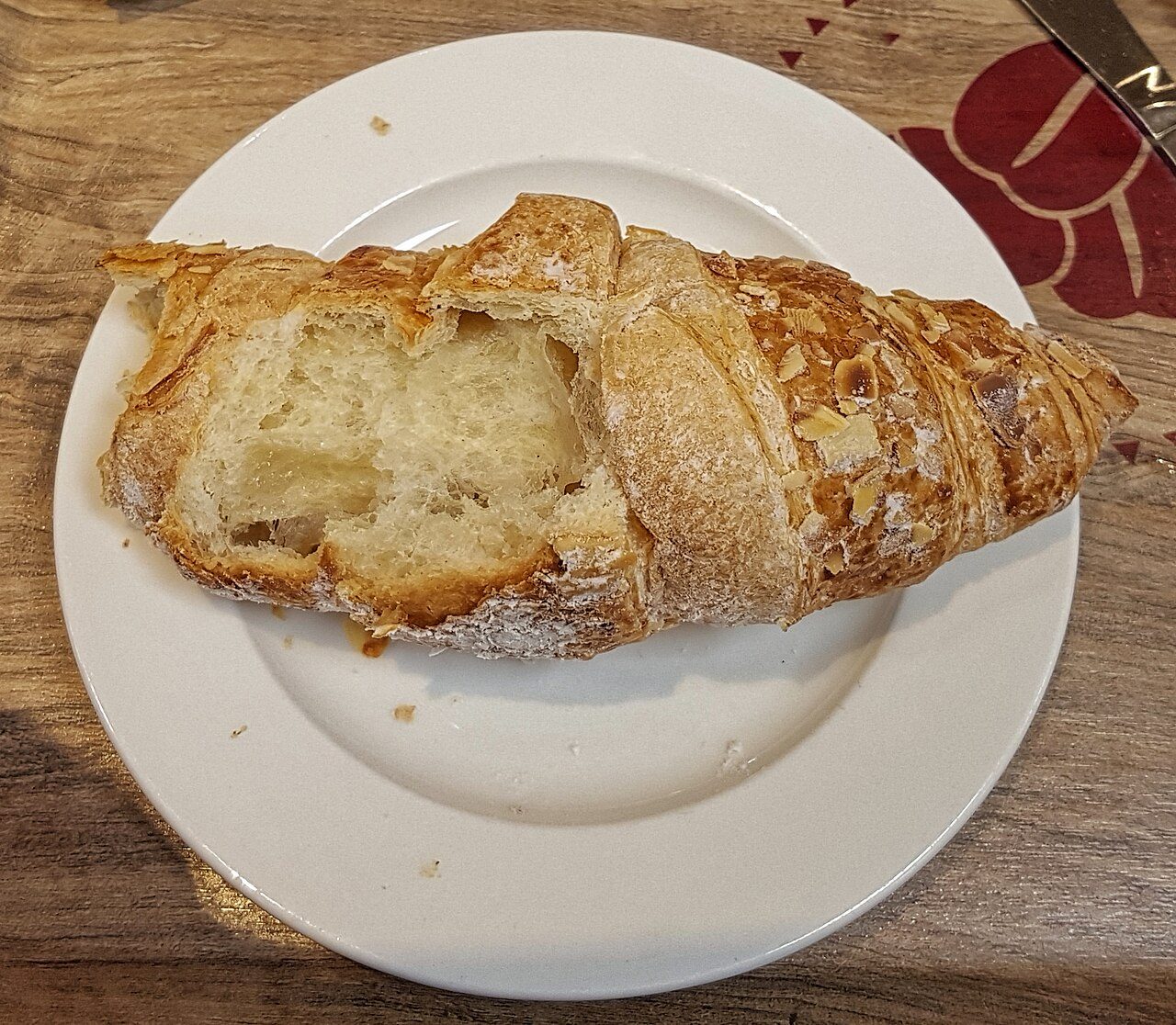
The croissant is a crescent-shaped pastry of butter-layered, yeast-leavened dough. It began as the Austrian kipferl, documented in Vienna centuries before it reached Paris, and became the modern croissant only when French bakers rebuilt it with laminated dough in the early twentieth century. Its most famous origin stories - a siege in 1683 and a homesick Marie Antoinette - are legends, not documented history.
At a Glance
- The ancestor
- The Austrian kipferl, a crescent-shaped baked good documented in Austria from at least the 13th century
- The name
- French for crescent, describing the pastry's curved shape
- Arrival in Paris
- August Zang's Boulangerie Viennoise at 92 Rue de Richelieu, opened in 1838 or 1839
- The French innovation
- Lamination: folding butter into yeast dough in repeated turns to build dozens of separate layers
- First modern recipes
- Printed French recipes for the laminated croissant appear in the early 20th century, including Colombie's encyclopedia of 1906
- The 1683 story
- Legend: no contemporary evidence links the kipferl's shape to the siege of Vienna, and the pastry predates the siege by centuries
Introduction
Few foods announce a country as instantly as the croissant announces France. It is the centrepiece of the Parisian breakfast, sold in thousands of boulangeries, and so thoroughly adopted that its foreign birth is usually forgotten. Yet as recently as the nineteenth century the French treated it as an imported novelty, sold in special Viennese bakeries in the more expensive parts of Paris.
The honest history is a handover between two cities. Vienna supplied the shape and the name's raw material: a crescent roll called the kipferl. Paris supplied the technique that made the pastry famous: lamination, the folding of butter into dough until it bakes into dozens of shattering layers. Neither city can claim the whole story, and the dramatic tales told about sieges and queens belong to legend, as the myths section of this page explains.
Origins: The Kipferl in Austria
The kipferl is documented in Austria from at least the thirteenth century, and it came in many forms: a crescent-shaped baked good made with butter or lard, sometimes sweetened with sugar and almonds, sometimes closer to a plain roll. Smithsonian Magazine notes a poem that mentions the kipferl among the Christmas treats Viennese bakers presented to Duke Leopold in 1227. Crescent-shaped breads and cakes are older still, made in various places since at least the Renaissance.
The crucial point is what the kipferl was not. It was not made from laminated dough. Its texture was denser, nearer to an enriched bread or a cookie, and in Austria and Germany today ordering a kipferl will most likely bring a crescent-shaped biscuit or roll, not the flaky pastry the world calls a croissant. The shape crossed the border first; the pastry itself was invented later, in France.
Paris: August Zang and the Viennese Bakery
The documented route to Paris runs through one businessman. August Zang, an Austrian former artillery officer, opened the Boulangerie Viennoise at 92 Rue de Richelieu in 1838 or 1839. Zang was a gifted promoter: newspaper advertising and elaborate window displays drew crowds for his Vienna bread, kaiser rolls and kipferl, baked with a sheen in his patented steam oven.
Zang sold up within a few years and returned to Austria, where he founded a daily newspaper and made a fortune in banking and mining. Paris, however, kept his pastries. By 1840 there were already at least a dozen makers of Viennese bread in the city, employing about a hundred workers, and the French had renamed the crescent roll with their own word for crescent: croissant. On a visit in 1872-73, Charles Dickens praised the dainty croissant on the Parisian boudoir table and pitied the monotony of English breakfast bread by comparison.
The French Reinvention: Lamination
What turned the kipferl into the croissant was a technique, not an event. Lamination begins with a basic yeast dough, the detrempe. A block of cold butter is enclosed in it, and the package is rolled out and folded, then rested and folded again, multiplying the layers at each turn until dough and butter alternate in dozens of thin sheets. In the oven, water in the butter turns to steam, forcing the layers apart, while the butter fries them crisp. The result is a pastry that shatters outside and opens into a soft honeycomb inside.
Food historian Jim Chevallier, quoted by Smithsonian Magazine, puts the division of credit neatly: the croissant began as the Austrian kipferl but became French the moment people began making it with puffed pastry, which is a French innovation. The paper trail agrees. Alan Davidson found no printed recipe for the present-day croissant in any French cookbook before the early twentieth century; a recipe matching the modern pastry appears in Colombie's Nouvelle Encyclopedie culinaire in 1906, and Sylvain Claudius Goy is often credited with an early laminated recipe soon after.
Timeline
- 1227
A poem mentions the kipferl among Christmas treats presented by Viennese bakers to Duke Leopold.
- 13th century
The kipferl is documented in Austria, in various crescent-shaped forms.
- 1683
Ottoman forces besiege Vienna and are defeated; the later legend attaches the kipferl's invention to this victory, without contemporary evidence.
- 1838 or 1839
August Zang opens the Boulangerie Viennoise at 92 Rue de Richelieu in Paris, selling kipferl to fashionable crowds.
- By 1840
At least a dozen Viennese-style bakeries operate in Paris; the pastry takes the French name croissant.
- 1872-73
Charles Dickens praises the Parisian croissant in print, evidence of its place in French breakfast life.
- 1906
Colombie's Nouvelle Encyclopedie culinaire prints a recipe recognisably matching the modern laminated croissant.
- Early 20th century
French bakers standardise the croissant made from yeast-leavened laminated dough.
- 1981
Sara Lee introduces a frozen croissant in the United States; fast-food chains follow with croissant sandwiches.
- 2013
New York's Dominique Ansel Bakery launches the Cronut, a croissant-dough doughnut that draws queues and worldwide imitations.
Significance
The croissant's significance is partly technical and partly symbolic. Technically, it is the most famous product of viennoiserie, the family of enriched, laminated pastries that French bakers built on Viennese foundations, and a test of bakery skill: temperature, butter quality and timing all show in the finished layers. Symbolically, it became a shorthand for France itself, reproduced on cafe signs and menus worldwide, and a daily ritual defended as heritage. When factory-made frozen dough spread through French bakeries in the late twentieth century, artisan bakers answered with fait maison campaigns, advertising handmade production as a mark of honour.
Myths and disputes
The siege story is the famous one: Viennese bakers, working before dawn, supposedly heard Ottoman troops tunnelling under the walls in 1683, raised the alarm, and celebrated victory with a pastry shaped like the crescent on the Ottoman flag. It is a fine story and an unsupported one. The kipferl existed centuries before 1683, no contemporary source connects it to the siege, and food historians note that the tale surfaces in print only far later - one account traces its appearance to the Larousse Gastronomique of 1938, more than 250 years after the battle.
The second legend credits Marie Antoinette, the Austrian-born queen of France, with importing the kipferl because she was homesick for Vienna. Chevallier finds no evidence for it, and points out the problem of silence: a queen watched as closely as Marie Antoinette left no reference to the pastry, and no mention of the croissant appears in France before about 1850, decades after her death in 1793. The documented importer is not a queen but a shopkeeper: August Zang.
Legacy
The croissant's legacy is a pastry that escaped its category. Filled and topped versions - almond croissants, pain au chocolat in its straight-sided form, ham-and-cheese croissants - share bakery cases worldwide, while hybrids such as the Cronut show the dough itself becoming an ingredient in new inventions. Frozen dough and croissanterie chains made it fast food; master bakers still treat the handmade version as a benchmark, and competitions in Paris award a best butter croissant prize that can lift a small bakery's trade overnight.
Its deeper legacy is the pattern of its making: an Austrian shape, a French technique, and a name that records the journey. The croissant is proof that national dishes are often collaborations that forget their collaborators - and that the documented story, a bakery opening on the Rue de Richelieu in 1839, is better than the legend.
Sources
- Smithsonian Magazine - Is the Croissant Really French?
- Wikipedia - Croissant
- Food Republic - The Origin Of Croissants Isn't What You Might Expect
- Origin Trace - The Origin of the Croissant: From the Siege of Vienna to Parisian Cafes
The facts on this page were checked against these sources on 19 November 2026. The History Trail's permanent pages are researched and written for this site; the live profiles elsewhere on The History Trail are assembled automatically from Wikipedia and Wikidata.
About the Author
Researched and written by the The History Trail Editorial Team — the accountable editorial function behind this site's permanent story pages. The team works from the published sources cited on each page; it does not invent historians, reviewers or credentials, and it corrects errors openly.
Fact Check
Every load-bearing fact on this page traces to one of the sources listed above, and significant claims link to their source in the text. Our checking method is described on the methodology page; errors can be reported via the corrections page.
Sources & Citations
Cite this page as: The History Trail Editorial Team, The History Trail — this article's title, publication and update dates are shown beneath its headline. The full source list appears under Sources above; the site's source standards are on the sources page.