
Things
Curry
Curry is not one dish. The word comes from the Tamil kari, a spiced sauce eaten with rice, but curry as a single category covering thousands of South Asian dishes is largely a British colonial-era construction - a label applied by Portuguese and British outsiders, then carried around the world, where Japan, Goa, Glasgow and others each reinvented what it meant.
At a Glance
- The word
- From the Tamil kari, a spiced sauce or relish, via Portuguese caril into English
- The honest caveat
- Curry as a single category is largely a British colonial-era construction, not a traditional South Asian term for its own dishes
- First English recipe
- Hannah Glasse, To make a Currey the India Way, in The Art of Cookery (1747)
- Curry powder
- A commercial British blend sold for home use from the late 18th century; South Asian cooks traditionally grind blends fresh per dish
- Vindaloo
- Goan descendant of the Portuguese carne de vinha d'alhos, meat in wine and garlic, remade with vinegar and chillies
- Japan
- Curry arrived with the Royal Navy's influence in the Meiji era and became kare raisu, still served in Japan's navy on Fridays
Introduction
That single word does a lot of quiet work. In South Asia, where the dishes come from, there is no traditional dish simply called curry: there are thousands of named preparations, each with its own spices, liquid and technique. Curry is the label outsiders applied to all of them, and the label stuck so firmly that it now names national dishes in countries the word's inventors never imagined, from Japanese kare raisu to Berlin's currywurst.
The story therefore has two strands that must not be confused. One is ancient and real: South Asian cooks have combined spices in cooked dishes for millennia. The other is early modern and colonial: a Tamil word travelled through Portuguese and English mouths and came back as a category, a powder and eventually a global cuisine.
A Word and a Category: Kari Becomes Curry
The word derives from the Tamil kari, a term for a spiced sauce or relish eaten with rice. Portuguese traders on India's coasts in the sixteenth century rendered it as caril, and English speakers, arriving later, turned it into curry. As food historian Lizzie Collingham has shown, the borrowed word was then stretched far beyond its original meaning until it served, in the phrase quoted by Atlas Obscura, as a generic term for any spicy dish with a thick sauce or gravy.
Within South Asia, cooking never needed the umbrella term, because it had precise ones. A masala is a blend of spices, ground fresh for a particular dish; garam masala, the best-known blend, typically warms rather than burns, built on spices such as black pepper, cardamom, cloves, cinnamon and cumin, and varies from region to region and house to house. The colonial category flattened that variety into one menu word - convenient for the coloniser, misleading for everyone since.
Empire's Kitchen: Glasse, Powder and the Voyage Home
Curry entered English print in 1747, when Hannah Glasse published the first English recipe, To make a Currey the India Way, in The Art of Cookery Made Plain and Easy. The Smithsonian Libraries note that her first version used only pepper and coriander seeds, with rice cooked in; ginger and turmeric arrived in the fourth edition of 1751. It was a peppery stew, recognisably an English cook's idea of India - which is exactly the point. Curry in Britain was from the start an adaptation, made by and for people who had encountered the original abroad.
Returning East India Company servants wanted the flavours at home, and commerce obliged. Commercial curry powder - a ready-made, turmeric-heavy blend no Indian cook would have recognised as a kitchen staple, since blends were traditionally made fresh per dish - was sold in Britain from the late eighteenth century; Sake Dean Mahomed advertised himself in 1810 as a manufacturer of the real currie powder when he opened the Hindoostane Coffee House in London, Britain's first Indian restaurant. It closed within a few years, ahead of its time, but the pattern was set: curry would be one of the empire's most durable imports.
Two Reinventions: Vindaloo and the Voyage to Japan
Some dishes under the curry label have precise, traceable biographies. Vindaloo descends from the Portuguese carne de vinha d'alhos - meat marinated in wine and garlic - carried to Goa by Portuguese sailors and officials. In Goa the wine gave way to vinegar, local cooks added dried chillies, themselves an American plant the Portuguese had brought to Asia, and a pork dish of the Goan Catholic community became the fiery vindaloo that British restaurants later turned into a byword for extreme heat.
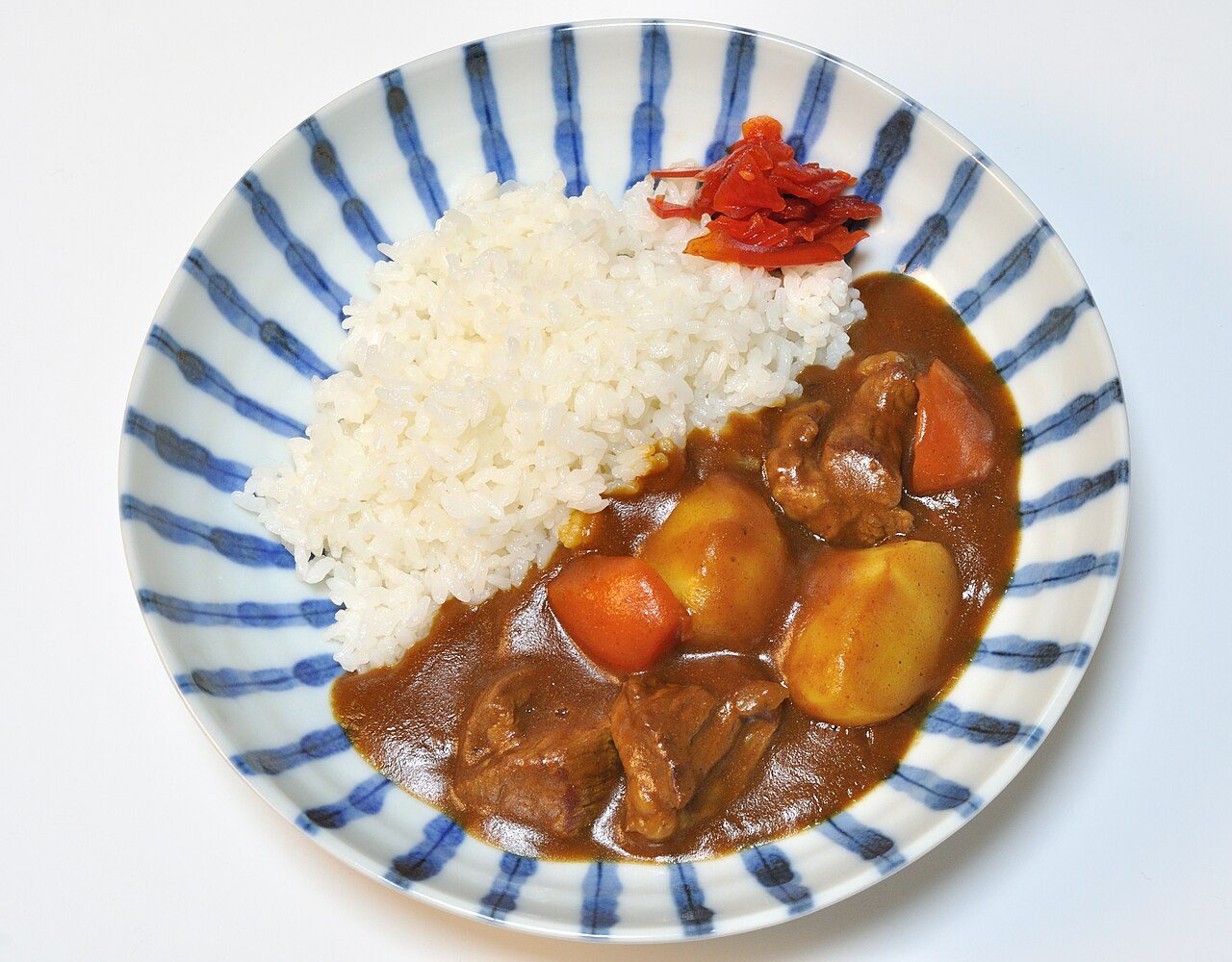
Japan's reinvention was stranger still. British-style curry - tinned powder, meat, root vegetables and a flour-thickened sauce - reached Meiji-era Japan through the Royal Navy, the model for the new Imperial Japanese Navy. The first Japanese curry recipes were published in 1872, and the navy's 1908 cooking manual included curry rice. Atlas Obscura explains the medical logic: sailors eating almost nothing but polished white rice suffered beriberi, a thiamine deficiency, and a meat-and-flour curry was a practical way to get thiamine into them. Japan then made the dish its own - thicker, sweeter, served over rice with pickles - and the Maritime Self-Defense Force still serves curry on Fridays.
Timeline
- 16th century
Portuguese traders render the Tamil word kari as caril; the term begins its journey into European languages.
- Early 1500s onwards
Portuguese carne de vinha d'alhos reaches Goa, where local cooks transform it into vindaloo.
- 1747
Hannah Glasse publishes the first English curry recipe, To make a Currey the India Way.
- 1751
The fourth edition of Glasse's book adds ginger and turmeric to the recipe.
- 1810
Sake Dean Mahomed opens the Hindoostane Coffee House in London, Britain's first Indian restaurant.
- 1872
The first Japanese recipes for curry appear in Western-style cookbooks of the Meiji era.
- 1908
The Imperial Japanese Navy's cooking manual includes curry rice; the dish spreads through the services.
- 1926
Veeraswamy opens in London, the oldest surviving Indian restaurant in Britain.
- 1970s
Chicken tikka masala is said to be created in Glasgow - a claim examined in the myths section below.
- 2001
Foreign Secretary Robin Cook calls chicken tikka masala a true British national dish.
Significance
Curry's significance is that it records, in edible form, how empires move culture. Spices, techniques and cooks travelled along trade and military routes, and each stop rewrote the dish: Portuguese vinegar and American chillies in Goa, an English powder in a bottle, a British naval stew in a Japanese school lunch. After the Second World War, South Asian migration transformed Britain in particular, where curry houses - many run by Sylheti Bangladeshis - became a fixture of nearly every town, and adapted dishes such as the balti and chicken tikka masala entered the national diet. To study curry is to study colonisation, migration and adaptation at the level of the dinner table.
Myths and disputes
The central myth is the category itself: that curry is one ancient Indian dish. It is not. It is a colonial-era umbrella over many distinct cuisines, and curry powder, its supposed essence, is a British commercial product rather than a South Asian tradition. A second myth reverses the first: that because the word is colonial, the dishes are somehow inauthentic. They are not. The cooking traditions are old and real; only the label is imported.
The Glasgow claim needs the same care. Ali Ahmed Aslam, proprietor of the Shish Mahal restaurant, said he invented chicken tikka masala in the 1970s after a customer complained his chicken tikka was too dry, improvising a sauce with a tin of tomato soup, yogurt and spices. His account was widely reported, including at his death in 2022, and Glasgow campaigners sought official recognition for the dish. But other chefs and cities have rival claims, food historians generally describe the dish as a British-South Asian creation of the period rather than one man's provable invention, and no contemporary documentation settles it. The honest verdict: a plausible and beloved claim, not a proven fact.
Legacy
Curry's legacy is visible on every continent: Thai curries built on pounded pastes, Caribbean curry goat carried by indentured labourers, South African bunny chow, German currywurst, coronation chicken invented for a British coronation, and Japan's kare raisu, now comfort food so domestic that its British and Indian ancestry surprises the Japanese themselves. Few food words have travelled so far from their source.
The word also leaves a lesson. Curry shows how a label imposed from outside can flatten a cuisine in description while the cooking itself keeps diversifying in practice. The dishes were never one thing. The name was - and following the name, honestly, through Tamil, Portuguese and English mouths, is the real history.
Sources
- Smithsonian Libraries - Smithson's Cookbook: English Curry
- Sydney Living Museums - Currey the India Way
- Atlas Obscura - How Curry Became a Japanese Naval Tradition
- Scroll - How Indian 'curry' became Japan's favourite dish
- The News (AFP report) - Pakistan-born chicken tikka masala inventor dies aged 77
The facts on this page were checked against these sources on 19 November 2026. The History Trail's permanent pages are researched and written for this site; the live profiles elsewhere on The History Trail are assembled automatically from Wikipedia and Wikidata.
About the Author
Researched and written by the The History Trail Editorial Team — the accountable editorial function behind this site's permanent story pages. The team works from the published sources cited on each page; it does not invent historians, reviewers or credentials, and it corrects errors openly.
Fact Check
Every load-bearing fact on this page traces to one of the sources listed above, and significant claims link to their source in the text. Our checking method is described on the methodology page; errors can be reported via the corrections page.
Sources & Citations
Cite this page as: The History Trail Editorial Team, The History Trail — this article's title, publication and update dates are shown beneath its headline. The full source list appears under Sources above; the site's source standards are on the sources page.