
Things
Musical instrument
A musical instrument is any device made or adapted to produce musical sound - and the oldest undisputed examples, flutes of bird bone and mammoth ivory from caves in southwestern Germany, are around 40,000 years old. One older candidate, the pierced cave bear bone from Divje Babe in Slovenia, remains disputed. From those beginnings instruments multiplied into the families every culture now knows, a story that runs from crane-bone flutes in Neolithic China to Bartolomeo Cristofori's invention of the piano in Florence around 1700.
At a Glance
- What it is
- A device constructed or modified for the purpose of making music, classified by how it produces sound
- Oldest undisputed examples
- Bone and mammoth-ivory flutes from Hohle Fels and Geissenklosterle in Germany's Swabian Jura, dated to roughly 40,000 years ago, with the Geissenklosterle flutes dated in 2012 to about 42,000-43,000 years ago
- The disputed candidate
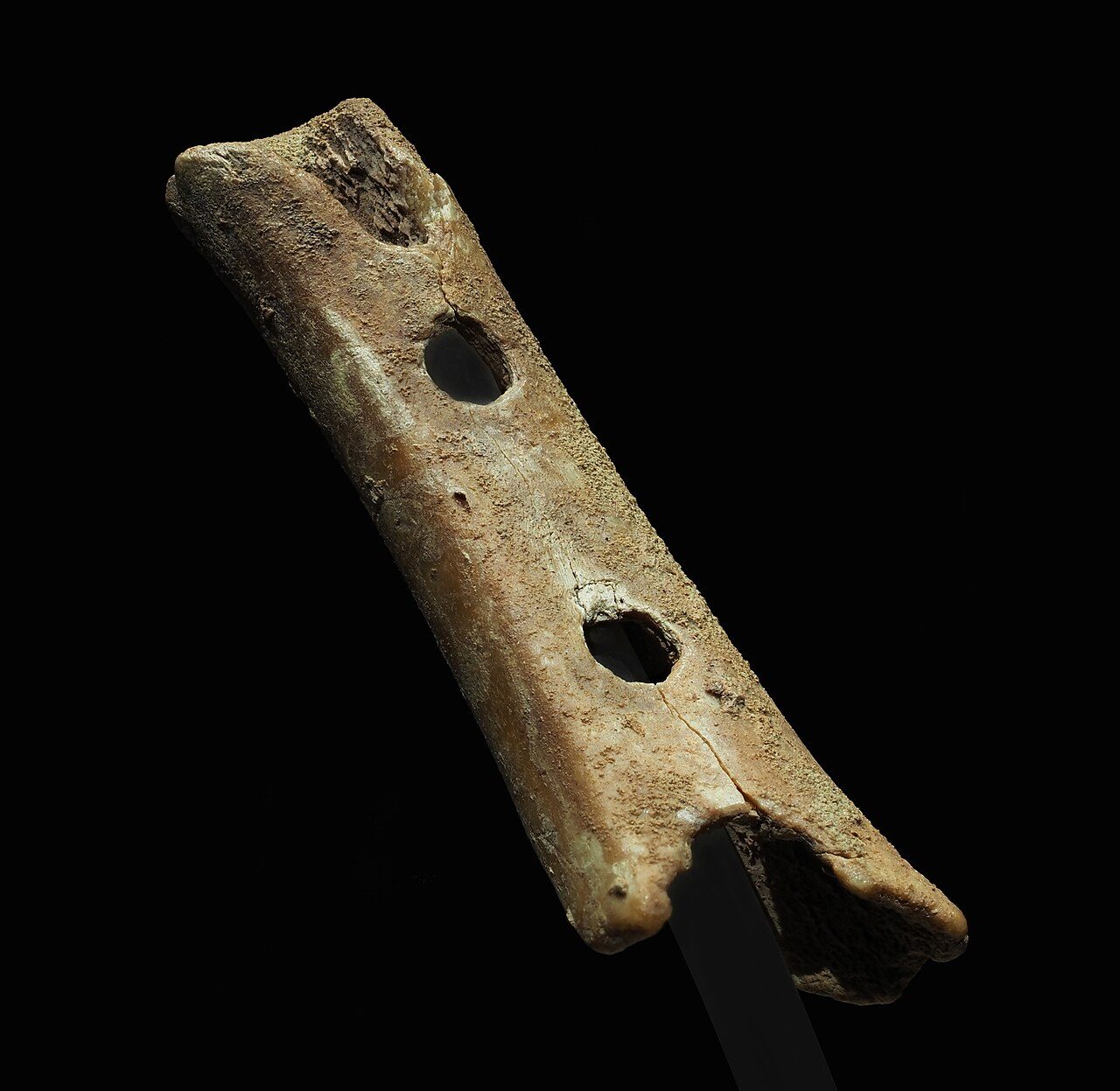
- The Divje Babe bone, a pierced cave bear femur from Slovenia dated to about 50,000-60,000 years ago - claimed as a Neanderthal flute, argued by other researchers to be a carnivore-chewed bone
- Oldest playable instruments
- The crane-bone flutes of Jiahu, China (occupied 7000-5700 BCE); the best preserved has been played and tonally analysed, according to the Nature report of 1999
- The standard classification
- The Hornbostel-Sachs system (1914) groups instruments as idiophones, membranophones, chordophones and aerophones, with electrophones added later
- The piano
- Invented by Bartolomeo Cristofori in Florence around 1700; three of his pianos survive (1720, 1722, 1726), the oldest at the Metropolitan Museum of Art
Introduction
Every known culture makes music, and almost every culture has built objects to make it with. A musical instrument is, in the plainest definition, anything constructed or modified to produce musical sound: a hollowed bone, a stretched skin, a string over a wooden box, a column of air in a tube. Because the earliest instruments were made of perishable materials, most prehistoric music-making has vanished; what survives - bone, ivory, clay, stone and metal - still reaches back tens of thousands of years.
The record also requires care: a hole in an old bone is not automatically a finger hole, and the most famous candidate for the world's oldest instrument is also the most argued over.
The First Instruments: Bone, Ivory and Crane Wing
The oldest undisputed musical instruments come from the caves of the Swabian Jura in southwestern Germany. In 2008, excavators at Hohle Fels cave recovered a nearly complete flute carved from the radius bone of a griffon vulture, with five finger holes, in the earliest Upper Palaeolithic layers of the site. Reporting in Nature in 2009, Nicholas Conard and his colleagues dated the Hohle Fels flutes to at least 35,000 years ago and described them as close to 40,000 years old. In 2012, new carbon dating put flutes from the neighbouring Geissenklosterle cave at about 42,000 to 43,000 years old, making them possibly the oldest of all.
Much later, but remarkable in a different way, are the flutes of Jiahu in Henan Province, China. The early Neolithic site, occupied from 7000 to 5700 BCE, produced six complete flutes made from the wing bones of the red-crowned crane, with five to eight holes, plus fragments of perhaps thirty more. A 1999 report in Nature described them as what may be the earliest complete, playable, tightly dated multi-note instruments, and the best preserved has been played and tonally analysed; Guinness World Records lists it as the oldest playable instrument.
Families: How Instruments Are Grouped
With thousands of instruments worldwide, scholars needed a system based not on appearance or material but on how sound is produced. The system still standard today was published in 1914 by Erich von Hornbostel and Curt Sachs. It sorts instruments into four main groups: idiophones, whose own body vibrates (bells, xylophones, rattles); membranophones, sounded by a stretched membrane (drums); chordophones, sounded by vibrating strings (harps, lutes, violins - and the piano, whose strings are struck); and aerophones, sounded by vibrating air (flutes, oboes, trumpets). A fifth group, electrophones, was added later for instruments that produce sound electrically.
Western orchestral practice uses a looser grouping - strings, woodwind, brass and percussion - based on tradition rather than physics, which is why a brass saxophone sits with the woodwind and the piano is classed apart as a keyboard instrument. The documented development behind both runs from ancient pipes and natural horns to the refined strings of the Cremona violin makers, with percussion - probably the oldest family - present in every culture.
The Piano: Cristofori's Answer, Around 1700
One instrument can be given an inventor and a birth year. The Metropolitan Museum of Art records that the first true piano was invented almost entirely by one man, Bartolomeo Cristofori of Padua, appointed in 1688 to the Florentine court of Grand Prince Ferdinando de' Medici to care for its harpsichords and its whole instrument collection. A Medici inventory of 1700 mentions an instrument resembling a harpsichord, newly invented by Cristofori, with hammers and dampers; a court musician's inscription likewise dates his first piano-and-forte instrument to 1700. In 1711 Scipione Maffei described it as a gravicembalo col piano e forte - a harpsichord with soft and loud - the first use of the name that became pianoforte, then piano.
Cristofori's breakthrough was mechanical. Where the harpsichord plucked its strings at one volume however hard the key was pressed, Cristofori's hammers struck the strings and then fell away instantly through an escapement mechanism, so the string rang freely and loudness followed the player's touch. Three of his pianos survive: the Met's of 1720, the oldest surviving piano, with 54 keys against the modern 88; one of 1722 in Rome; and one of 1726 in Leipzig.
Timeline
- c. 42,000-43,000 years ago
Flutes of bird bone and mammoth ivory are made in the Geissenklosterle cave, Germany - the oldest undisputed musical instruments, on the 2012 redating.
- c. 40,000 years ago
A five-holed flute is carved from a griffon vulture's wing bone at Hohle Fels, Germany; excavated in 2008 and reported in Nature in 2009.
- 7000-5700 BCE
The settlement at Jiahu, China, produces crane-bone flutes with five to eight holes; one survives complete and playable.
- 1995
A pierced cave bear femur is excavated at Divje Babe I, Slovenia, and proposed as a Neanderthal flute; the claim is immediately disputed.
- 1688
Bartolomeo Cristofori is appointed to the Medici court in Florence to care for its keyboard instruments.
- c. 1700
Cristofori's first piano is recorded in a Medici inventory of 1700, described as newly invented, with hammers and dampers.
- 1711
Scipione Maffei publishes his description of Cristofori's gravicembalo col piano e forte, giving the piano its eventual name.
- 1720-1726
The three surviving Cristofori pianos are built; the 1720 instrument, now at the Metropolitan Museum of Art, is the oldest piano in existence.
- 1732
Lodovico Giustini's twelve sonatas, published in Florence, are the earliest music definitely written specifically for the piano, according to the Met.
- 1914
Hornbostel and Sachs publish their classification of instruments by sound production, still the scholarly standard.
Significance
Instruments are evidence. A flute in a 40,000-year-old layer proves organised sound-making - measured hole spacing, chosen materials, practised craft - among the first modern humans in Europe, long before farming or writing. And the piano shows the other end of the process: a single documented inventor, after which the instrument became a fixture of concert halls and middle-class homes.
Myths and disputes
Is the Divje Babe bone a flute? This page presents it as disputed, because it is. The bone is a cave bear femur fragment found in 1995 at Divje Babe I in Slovenia, in a layer dated by electron spin resonance to about 50,000-60,000 years ago, near a hearth associated with Neanderthals. Its excavator, Ivan Turk, argued its aligned holes were deliberately made; the National Museum of Slovenia, which displays it, maintains Neanderthal manufacture is proven, and reconstructions on its spacing can be played. Against that, taphonomists including Francesco d'Errico, and Cajus Diedrich in a 2015 Royal Society Open Science study, have argued the holes match carnivore - probably hyena - tooth punctures in gnawed juvenile bear bone, and many palaeoanthropologists accept the carnivore explanation. If the flute case were proven, Neanderthals made music long before the Swabian flutes; if not, the bone is a chewed femur that resembles an instrument. The evidence does not settle it, and any source stating either answer as certain goes beyond the record.
Two smaller myths deserve the same care. First, no one can name the single oldest instrument: the Swabian flutes are the oldest undisputed ones, but instruments of wood, skin and reed from the same period would simply not survive. Second, Cristofori did not create the piano from nothing: he was a harpsichord maker, and the clavichord already allowed touch-sensitive dynamics, though too quietly for ensemble use. His invention was the hammer action that made those dynamics loud.
Legacy
The legacy of the instrument is the continuity of the craft. The vulture-bone flute and the concert grand are the same idea at different scales: a shaped object, built to measurements, that turns breath, touch or pressure into pitched sound on demand. Museums preserve the milestones - the Met's 1720 Cristofori among them - while the Hornbostel-Sachs families still organise everything from a gamelan gong to an electric guitar. And the argument over one Slovenian bone still forces the essential question on every claim for ancient music: is this an instrument, and how do we know?
Sources
- The Metropolitan Museum of Art - The Piano: The Pianofortes of Bartolomeo Cristofori (1655-1731)
- National Geographic - Bone Flute Is Oldest Instrument, Study Says
- Nature (Zhang et al., via PubMed) - Oldest playable musical instruments found at Jiahu early Neolithic site in China
- Guinness World Records - Oldest playable instrument
- Encyclopaedia Britannica - Percussion instrument
- ZME Science - Listen to This Musician Playing Beethoven on a 50,000-Year-Old Bone Flute Made By Neanderthals
The facts on this page were checked against these sources on 19 November 2026. The History Trail's permanent pages are researched and written for this site; the live profiles elsewhere on The History Trail are assembled automatically from Wikipedia and Wikidata.
About the Author
Researched and written by the The History Trail Editorial Team — the accountable editorial function behind this site's permanent story pages. The team works from the published sources cited on each page; it does not invent historians, reviewers or credentials, and it corrects errors openly.
Fact Check
Every load-bearing fact on this page traces to one of the sources listed above, and significant claims link to their source in the text. Our checking method is described on the methodology page; errors can be reported via the corrections page.
Sources & Citations
Cite this page as: The History Trail Editorial Team, The History Trail — this article's title, publication and update dates are shown beneath its headline. The full source list appears under Sources above; the site's source standards are on the sources page.