
Things
Inverted Jenny
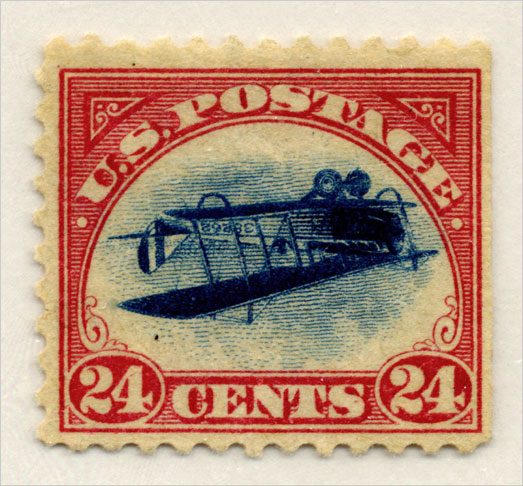
One hurried week of printing in May 1918 produced America's most famous stamp: a 24-cent airmail issue whose blue Curtiss Jenny biplane appeared upside down inside its red frame. Only one sheet of 100 reached the public, and every stamp from it has been treasured ever since.
At a Glance
- Issued
- May 1918, United States
- Denomination
- 24 cents — the first US airmail rate
- The error
- Blue biplane centre printed upside down in its carmine frame
- Printed by
- Bureau of Engraving and Printing, Washington, D.C.
- Error sheets sold
- One sheet of 100 stamps
- Found by
- Collector William T. Robey, 14 May 1918
- Robey's sale price
- $15,000, to dealer Eugene Klein
Introduction
In the second week of May 1918 the United States was about to launch its first regular airmail service, linking Washington, Philadelphia and New York. To pay for it, the Post Office rushed out its first airmail stamp: a bi-coloured 24-cent issue showing a Curtiss JN-4-H biplane — the famous 'Jenny', modified with a mail compartment in place of its front cockpit — in blue, inside a carmine-red frame. Two colours meant two separate printing passes, and two passes meant an opportunity for something to go wrong.
Something did. At the Bureau of Engraving and Printing in Washington, one sheet passed through the hand press with either its frame sheet fed in upside down or its blue vignette plate set in inverted. Nobody noticed. The sheet of 100 stamps, every one showing the little biplane flying on its back, travelled to a Washington post office and was sold over the counter on 14 May 1918 — the day before the first airmail flights it was made to celebrate.
Background
The buyer was William T. Robey, a Washington collector who understood exactly what a two-colour printing could produce and had been watching for the new issue with an error in mind. When the clerk produced the sheet, Robey saw at once that every plane on it was inverted. He paid the $24 face value, kept his composure, and walked out owning what would become the most famous sheet of stamps in American philately. Postal inspectors soon came looking for the sheet, but Robey had already moved it on.
Robey sold the sheet to Eugene Klein, a Philadelphia stamp dealer, for $15,000 — an enormous sum in 1918, earned within days of a $24 purchase. Klein in turn sold it to Colonel H. R. Green, the wealthy collector son of financier Hetty Green. On Klein's advice, Green broke the sheet into blocks of four and single stamps, kept some pieces and sold the rest, scattering the 100 inverts across the collecting world, where each began its own documented life of sales, exhibitions and occasional drama.
Timeline
- Week of 6 May 1918
The Bureau of Engraving and Printing produces the rushed bi-coloured 24-cent Jenny stamp for the new airmail service; somewhere in the run, one sheet is printed with its centre inverted.
- May 1918
Other inverted sheets are caught by inspectors and destroyed; just one sheet of 100 escapes detection and reaches a post office.
- 13 May 1918
The 24-cent Jenny stamp goes on sale, two days before the first scheduled US airmail flights.
- 14 May 1918
Collector William T. Robey buys the undetected error sheet at the New York Avenue post office in Washington, D.C., for its $24 face value.
- May 1918
Robey sells the sheet to Philadelphia dealer Eugene Klein for $15,000; Klein sells it on to Colonel H. R. Green.
- 1918
Green breaks the sheet into blocks of four and singles, keeping some and selling the rest — the form in which the inverts survive today.
- 2006
A fake Inverted Jenny is used to mail an absentee ballot in Florida, making national news nearly ninety years after the error.
- 22 September 2013
The US Postal Service issues a $2 stamp sheet reproducing the Inverted Jenny as the National Postal Museum's Gross Gallery opens with an original block on display.
Significance
The Inverted Jenny matters because it sits at the crossing of two young technologies: airmail and mass stamp production. It was the first United States airmail stamp, created to advertise a service that itself began the day after the error sheet was sold, and its mistake was a direct product of the two-plate, two-pass printing that made early bi-coloured stamps both handsome and risky. The National Postal Museum calls it America's iconic stamp, and it remains the item visitors most often ask to see.
It also fixed the modern idea of the valuable error. Because exactly one sheet was sold and its breaking-up was documented from the start, every genuine Inverted Jenny can be traced by its position in the original sheet. Only six blocks of four survive intact. That closed, fully accounted population of 100 stamps — no more can ever appear — turned a printing accident into a benchmark against which all other stamp rarities are measured.
Legacy
Nearly a century on, the Jenny still anchors American stamp collecting. A block of four loaned by William H. Gross stands on permanent display at the Smithsonian's National Postal Museum, and in 2013 the Postal Service deliberately re-created the error as a $2 issue — an official copy of an accident. Few printing mistakes in any medium have been so carefully preserved, studied and celebrated.
The stamp's afterlife carries a quieter lesson about value. The Jenny was worth 24 cents as postage and a fortune as an error, and the difference was made entirely by scarcity, story and documentation. Robey's sheet shows how an object nobody wanted corrected can outlast the system that produced it: the airmail rate it paid was cut within months, but the upside-down aeroplane flies on.
Sources
- Smithsonian National Postal Museum — Flying Upside Down
- Smithsonian National Postal Museum — US Airmail Stamps / Inverted Jenny
- Smithsonian National Postal Museum — USPS Unveils Inverted Jenny Stamp (2013)
- Smithsonian Magazine — The Inverted Jenny
The facts on this page were checked against these sources on 19 November 2026. The History Trail's permanent pages are researched and written for this site; the live profiles elsewhere on The History Trail are assembled automatically from Wikipedia and Wikidata.
About the Author
Researched and written by the The History Trail Editorial Team — the accountable editorial function behind this site's permanent story pages. The team works from the published sources cited on each page; it does not invent historians, reviewers or credentials, and it corrects errors openly.
Fact Check
Every load-bearing fact on this page traces to one of the sources listed above, and significant claims link to their source in the text. Our checking method is described on the methodology page; errors can be reported via the corrections page.
Sources & Citations
Cite this page as: The History Trail Editorial Team, The History Trail — this article's title, publication and update dates are shown beneath its headline. The full source list appears under Sources above; the site's source standards are on the sources page.