
Things
Eid al-Fitr
Eid al-Fitr, the Festival of Breaking the Fast, is one of Islam's two main festivals. It opens on the first day of Shawwal, immediately after Ramadan, with a communal morning prayer, obligatory alms for the poor, new clothes, visits and feasting — the joyful release after a month of fasting.
At a Glance
- Meaning
- 'Festival of Breaking the Fast'
- Date
- 1 Shawwal, the tenth month of the Islamic calendar
- Duration
- Celebrated during the first three days of Shawwal
- Before the prayer
- Zakat al-fitr — obligatory alms so that the poor can share the feast
- Morning rite
- The congregational Eid prayer, with no call to prayer and additional takbirs
- Greeting
- Eid mubarak — 'Blessed festival'
- Other names
- Lesser Eid, Sweet Eid; Şeker Bayramı in Turkey; Hari Raya Aidilfitri in Malaysia
Introduction
Eid al-Fitr is one of the two main festivals in Islam. It marks the end of Ramadan, the holy month of fasting in which Muslims believe God revealed the Qur'an to Muhammad, and it is celebrated during the first three days of Shawwal, the tenth month of the Islamic calendar. After a month of dawn-to-dusk restraint, its mood is release: official receptions and private visits, presents given, new clothes worn, and tables of sweet food.
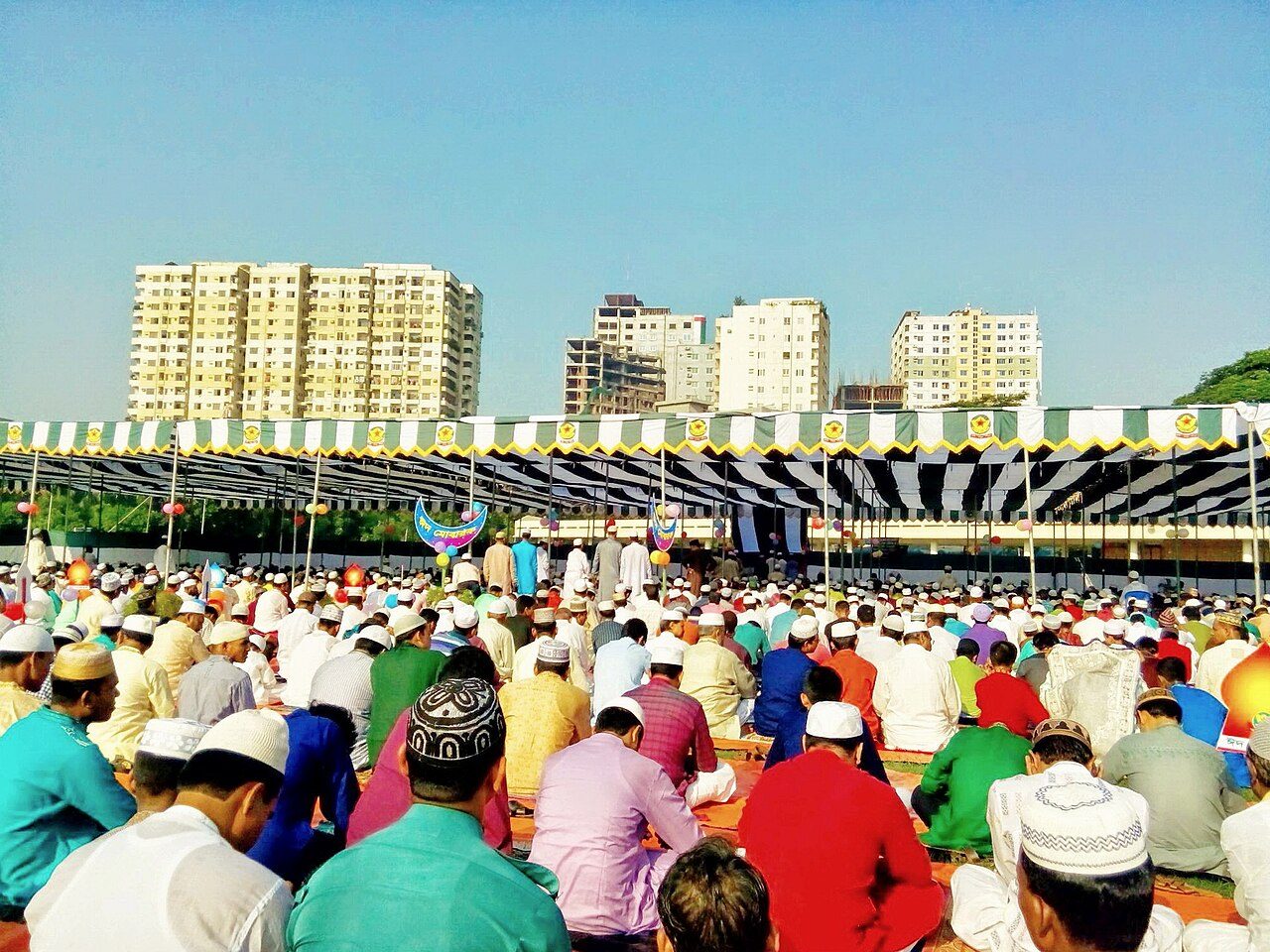
The day is built around a sequence. Before the festival prayer, it is obligatory for Muslims to give alms — zakat al-fitr — so that the poor can share in the feast. At daybreak on the first day, the community gathers for the communal Eid prayer, distinguished from daily prayers by its lack of a call to prayer and its additional takbirs. Then the visiting begins: relatives, friends and neighbours, and the graves of family members.
Origins
According to Muslim tradition, the Prophet Muhammad instituted the celebration of Eid al-Fitr. A hadith narrated by his companion Anas ibn Malik relates that when Muhammad arrived in Medina after the migration from Mecca, he found the people celebrating two specific days with recreation, and remarked that God had fixed two days of festivity instead: Eid al-Fitr and Eid al-Adha. The festival has been kept ever since as the appointed close of the fasting month.
Its timing is governed by the moon. The festival takes place after the crescent of the waxing moon that opens Shawwal is sighted; although some Muslims rely on astronomical calculations, for many others the sighting can be delayed by local weather such as cloud cover, so the exact day on which Eid begins can vary between places. And because the Muslim calendar is lunar, Eid al-Fitr may fall in any season of the year: it arrives some ten to twelve days earlier in each solar year, travelling through summer and winter alike over a cycle of about thirty-three years.
Timeline
- Medina, after the Hijra
Muslim tradition dates the first Eid al-Fitr to the Prophet Muhammad's Medina, where the festival replaced two existing days of recreation.
- The last sunset of Ramadan
The obligation of zakat al-fitr begins. In South Asia, the night of the moon sighting is Chaand Raat — a festive evening of crowded markets, henna-decorated hands and last rounds of shopping.
- Before the prayer
Zakat al-fitr is paid: traditionally one sa', a measure of staple food, for each family member, or the equivalent in money — given in time for the poor to celebrate too.
- Morning, 1 Shawwal
The congregational Eid prayer is performed at daybreak, generally in an open field or a large hall. There is no call to prayer, and the prayer includes several additional takbirs, recitations of 'Allahu akbar'.
- After the prayer
The sermon follows the prayer at Eid — the reverse of Friday prayer. Then come greetings of 'Eid mubarak', embraces, and visits to relatives, friends and family graves.
- 1–3 Shawwal
Days of feasting and visiting: new clothes, presents, and money gifts known as Eidi for children. Fasting is forbidden on the day of Eid itself.
- In Turkey
The festival is Şeker Bayramı, the 'Bayram of Sweets': best clothes bought for the occasion, visits to loved ones and to cemeteries, and children going door to door wishing a happy Bayram in return for candy, baklava or small coins.
- In South Asia
Eid tables centre on sheer khurma — a dessert of vermicelli cooked in milk with butter, dates and dried fruit — served alongside biryani and other regional dishes.
- In Southeast Asia
As Hari Raya Aidilfitri — Lebaran in Indonesia — the festival brings ketupat rice cakes and rendang, and mudik, the great homecoming journey to celebrate with family and ask forgiveness of elders.
Significance
Eid al-Fitr is designed for inclusion. Zakat al-fitr is not ordinary charity but a fixed duty, the same measure for every able Muslim regardless of income, and it must be given before the Eid prayer precisely so that its recipients can join the celebration on the day itself. Britannica notes that the festival and its practices have long played a significant role in strengthening the social bonds of the Islamic community — through the communal gatherings and common fast-breaking, the visits between friends, neighbours and community leaders, and this consideration for underprivileged Muslims.
It is also a festival of repair. After the prayers, Muslims typically decorate their homes and are encouraged to forgive each other and seek forgiveness. In Indonesia, the homecoming journey mudik is made to celebrate with family and to ask forgiveness from parents, in-laws and other elders; in Malaysia, people greet one another with 'maaf zahir dan batin' — forgive my physical and emotional wrongdoings. A month of private discipline ends, deliberately, in public reconciliation.
Questions readers ask
Why does Eid fall on a different date each year? Because the Islamic calendar is lunar, and its year is shorter than the solar Gregorian year. The first of Shawwal therefore arrives about ten to twelve days earlier each year, and across a cycle of roughly thirty-three years Eid al-Fitr is celebrated in every season.
Why do some places celebrate a day later than others? Because Eid begins at the sighting of the new crescent moon. Communities that rely on a local visual sighting can be delayed by cloud cover or a still-bright western sky, while those that use astronomical calculation may begin a day sooner. The exact start of Eid can therefore differ by location and tradition.
Can Muslims fast on Eid? No — fasting on the day of Eid al-Fitr is forbidden. The festival is by design a break in fasting, and it is recommended to eat something, commonly dates, before setting out for the morning prayer, in deliberate contrast to the mornings of Ramadan.
Why is it called the Sweet Eid? Because, after a month of fasting, food is a central theme of the celebration, and sweet dishes are prepared and consumed everywhere: Turkey calls the festival Şeker Bayramı, the Bayram of Sweets, and in South Asia the day is unthinkable without sheer khurma. Hence its English nicknames, 'Sweet Eid' and 'Sugar Feast'.
Legacy
Eid al-Fitr is a public holiday in countries with large Muslim populations across the world, and its greeting — Eid mubarak, 'Blessed festival' — is recognised across languages. Its homecomings are vast: Indonesia's mudik moves families across the archipelago, Turkey's bayram fills the roads with visiting families, and South Asia's Chaand Raat markets stay open late into the night before. For a festival of three days, it organises travel, trade and family life on a global scale.
And because its date never sits still, Eid also displays the character of the Islamic calendar itself: a year measured by the moon, in which the great feast of gratitude and release visits every season in turn — a winter Eid of short days and long feasts, a summer Eid at the end of the longest fasts, each generation keeping both.
Sources
- Encyclopaedia Britannica — Eid al-Fitr
- Wikipedia — Eid al-Fitr
- Wikipedia — Zakat al-Fitr
- Wikipedia — Chaand Raat
The facts on this page were checked against these sources on 19 November 2026. The History Trail's permanent pages are researched and written for this site; the live profiles elsewhere on The History Trail are assembled automatically from Wikipedia and Wikidata.
About the Author
Researched and written by the The History Trail Editorial Team — the accountable editorial function behind this site's permanent story pages. The team works from the published sources cited on each page; it does not invent historians, reviewers or credentials, and it corrects errors openly.
Fact Check
Every load-bearing fact on this page traces to one of the sources listed above, and significant claims link to their source in the text. Our checking method is described on the methodology page; errors can be reported via the corrections page.
Sources & Citations
Cite this page as: The History Trail Editorial Team, The History Trail — this article's title, publication and update dates are shown beneath its headline. The full source list appears under Sources above; the site's source standards are on the sources page.