
Things
Diwali
Diwali, the festival of lights, is a five-day celebration observed by Hindus, Jains, Sikhs and some Buddhists each autumn. Rows of small oil lamps are lit against the darkness of the new moon, homes are opened to the goddess Lakshmi, and different faiths mark different liberations on the same glowing nights.
At a Glance
- Name
- From the Sanskrit dipavali, 'row of lights'
- Length
- Five days
- When
- Late October–November; the main day falls on the new moon of the month of Karttika
- Observed by
- Hindu, Jain, Sikh and some Buddhist communities
- Central rite
- Lighting diyas, small earthenware oil lamps
- Main day
- The third day — Lakshmi Puja
- Sikh name
- Bandi Chhor Divas, 'Prisoner Release Day'
Introduction
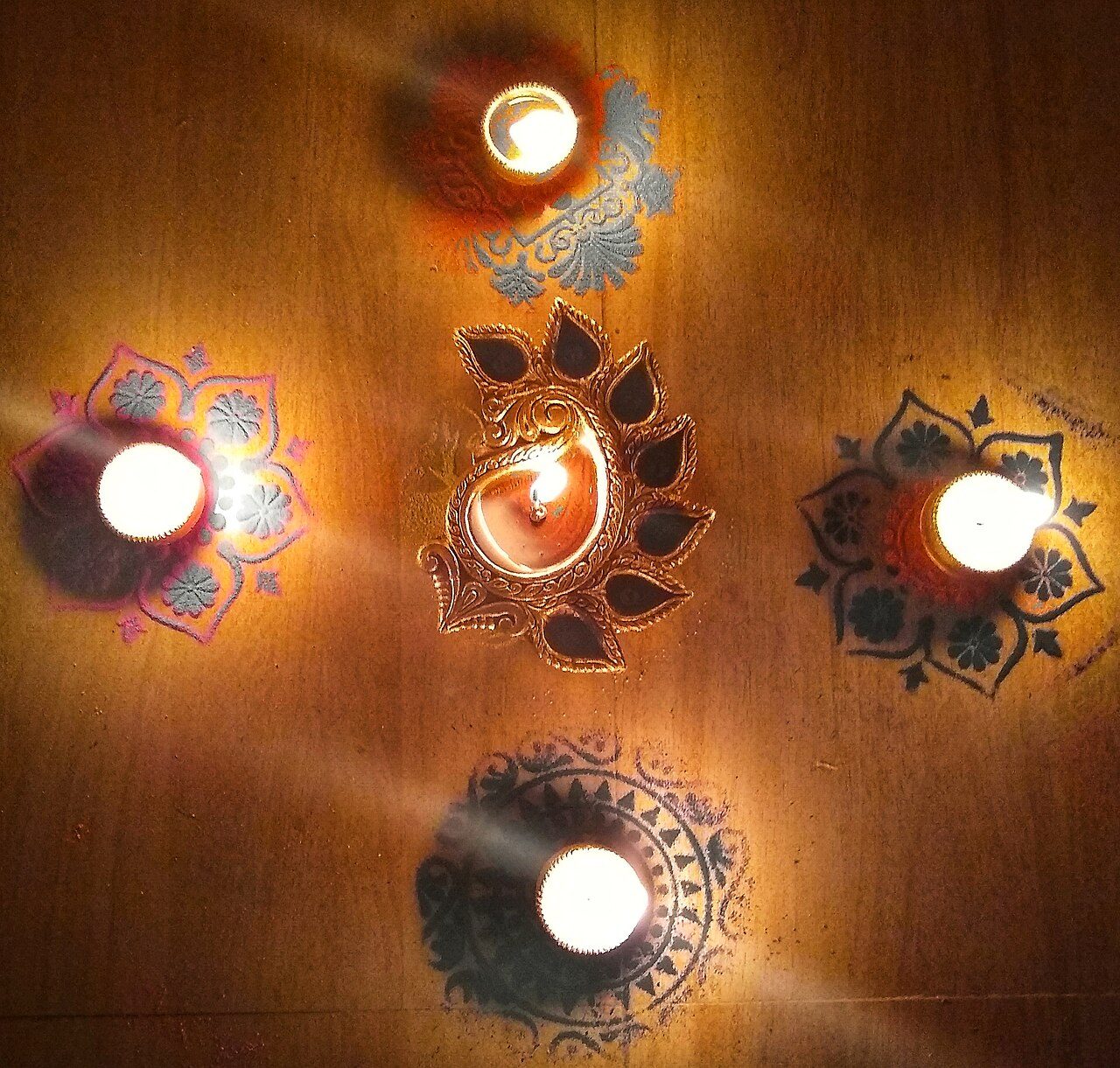
Diwali is one of the major religious festivals in Hinduism, Jainism and Sikhism, and is also kept by some Buddhists: a five-day festival of lights held each year in late October and November, spanning the end of the lunar month of Ashvina and the start of Karttika. Its name is derived from the Sanskrit term dipavali, meaning 'row of lights', and its central act is the lighting of diyas, small earthenware lamps filled with oil, set in rows along the parapets of temples and houses and set adrift on rivers and streams.
The festival generally symbolises the victory of light over darkness — and, by extension, of good over evil and knowledge over ignorance. Homes are cleaned and decorated, floors inside and out are covered with rangoli designs made of coloured rice, sand or flower petals, and doors and windows are kept open in the hope that Lakshmi, the goddess of wealth, will find her way inside and bless the residents with wealth and success.
Origins
Diwali developed over centuries from local traditions that occur on the days surrounding the new moon day of Karttika. The most ancient mention of the holiday is found in the Kamasutra of Vatsyayana, from the 3rd century CE, where it is called Yaksharatri, the night of the yakshas — nature spirits led by Kubera, the god of wealth. The Puranas, composed between about 400 and 1500, provide the most comprehensive early picture of the festival, and a local Purana from Kashmir and Jain and Persian accounts add further glimpses.
Those early texts already contain the festival's layered meanings. Several Puranas suggest that lamps are lit in worship of Yama, god of the dead, on the day preceding the new moon — a day some scholars link with the story of Krishna's defeat of the demon Narakasura. On the new moon night itself, women are said to drive out the goddess Alakshmi, Misfortune, and propitiate Lakshmi, Fortune. A harvest-season rite for the dead and a welcome to prosperity were fused, early on, into a single festival of light.
Timeline
- 3rd century BCE
Some Buddhist communities commemorate at this season the conversion of the emperor Ashoka to Buddhism; the Newar Buddhists of Nepal keep Diwali by lighting lamps, decorating temples and monasteries and worshipping the Buddha.
- 3rd century CE
The Kamasutra mentions a lamp festival called Yaksharatri, the night of the yakshas — the most ancient mention of the holiday known.
- Day 1 — Dhanteras
Homes are cleaned and small items of gold are purchased; the day's worship is dedicated to Lakshmi and to Kubera, the god of wealth.
- Day 2 — Naraka Chaturdashi
Also called Choti Diwali, the day commemorates Krishna's destruction of the demon Narakasura; prayers are also offered for the souls of ancestors.
- Day 3 — Lakshmi Puja
The main day of the festival, on the new moon. Families seek blessings from Lakshmi to ensure their prosperity, light diyas, candles and fireworks, and visit temples.
- Day 3 — in northern India
The same night celebrates the royal homecoming of Rama, with Sita, Lakshmana and Hanuman, to the city of Ayodhya after the defeat of Ravana, the ten-headed king of the demons.
- Day 3 — in Jain tradition
Jains commemorate the enlightenment and liberation (moksha) of Mahavira, the most recent of the Jain Tirthankaras; the lamps celebrate the light of Mahavira's holy knowledge.
- Day 3 — in Sikh tradition
Sikhs celebrate Bandi Chhor Divas, the return of Guru Hargobind to Amritsar from captivity in Gwalior Fort — from which, Sikh tradition holds, he also freed fifty-two imprisoned princes. Amritsar was lit with lamps for his return.
- Day 4 — Govardhan Puja
The day commemorates Krishna lifting Govardhan Hill to protect the cowherds from a torrential rain sent by Indra. It is also the first day of Karttika, the start of the new year in the Vikrama calendar, when merchants open new account books.
- Day 5 — Bhai Dooj
The festival closes by celebrating the bond between brothers and sisters, on a day when sisters pray for the success and well-being of their brothers.
Significance
Diwali's distinctiveness is that several faiths keep the same festival for their own reasons. For Hindus of northern India it is Rama's return from exile and his victory over Ravana; in southern India it marks Krishna's defeat of Narakasura; in Bengal the goddess Kali is worshipped instead. Jains mark Mahavira's final liberation from the cycle of life and death. Sikhs mark Guru Hargobind's release from captivity. Some Buddhists mark Ashoka's turning to Buddhism. One set of nights carries all of these stories at once, without any of them cancelling the others.
The shared language is light, and the shared setting is the home and the street. The Smithsonian's National Museum of Asian Art notes that lights are important because Lakshmi is believed unable to enter a dark space, and that the festival marks the beginning of the new year in the Hindu calendar, traditionally celebrated after the year's last harvest. Around the worship sit the social rites: visiting, exchanging gifts, wearing new clothes, feasting and feeding the poor. Fireworks are traditional too, though such displays have been restricted in many places to limit noise and other pollution.
Legacy
Diwali is celebrated wherever South Asian communities have settled. The Smithsonian's National Museum of Asian Art, which holds its own Diwali celebration in Washington, DC, lists vibrant festivities in cities from New Delhi, Bengaluru, Chennai, Mumbai and Singapore to Doha, Houston and Washington itself. In many countries the festival is a public holiday, and its greetings, sweets and imagery are recognised far beyond the faiths that keep it.
Its endurance lies in its layering: one set of nights, several sacred stories, and a single image — a row of small flames lit against the darkest night of the month — that each community can read in its own way. Light over darkness is a meaning capacious enough for a prince's homecoming, a prophet's liberation, a guru's release and a goddess's visit, all at once.
Sources
- Encyclopaedia Britannica — Diwali
- Smithsonian National Museum of Asian Art — Diwali
- Wikipedia — Diwali
- Wikipedia — Bandi Chhor Divas
The facts on this page were checked against these sources on 19 November 2026. The History Trail's permanent pages are researched and written for this site; the live profiles elsewhere on The History Trail are assembled automatically from Wikipedia and Wikidata.
About the Author
Researched and written by the The History Trail Editorial Team — the accountable editorial function behind this site's permanent story pages. The team works from the published sources cited on each page; it does not invent historians, reviewers or credentials, and it corrects errors openly.
Fact Check
Every load-bearing fact on this page traces to one of the sources listed above, and significant claims link to their source in the text. Our checking method is described on the methodology page; errors can be reported via the corrections page.
Sources & Citations
Cite this page as: The History Trail Editorial Team, The History Trail — this article's title, publication and update dates are shown beneath its headline. The full source list appears under Sources above; the site's source standards are on the sources page.