
Things
Cricket
Cricket is a bat-and-ball game between two teams of eleven, and it began in the Weald of south-east England, where children are believed to have devised it in Saxon or Norman times. Its Laws were first written in 1744, the Marylebone Cricket Club took charge of them in 1787, and from England it spread worldwide - to the first Test match in 1877, the Ashes in 1882, and reinvention as one-day and Twenty20 cricket in the modern era.
At a Glance
- What it is
- A bat-and-ball game between two teams of eleven, played around a 22-yard pitch with a three-stump wicket at each end
- Where it began
- The Weald of Kent and Sussex, south-east England, where children are believed to have devised it in Saxon or Norman times
- First definite reference
- A 1598 Guildford court case recalling a game of creckett played by schoolboys around 1550
- The Laws
- Earliest known code drawn up in 1744; the Marylebone Cricket Club, founded 1787, adopted its first code on 30 May 1788 and remains the Laws' custodian
- First Test match
- Melbourne, March 1877 - Australia beat England by 45 runs in a match recognised retrospectively as the first Test
- The Ashes
- Named from the Sporting Times mock obituary of English cricket after Australia's 1882 win at The Oval; the little urn stays at Lord's
- Three formats
- Test cricket (from 1877), One-Day Internationals (from 1971) and Twenty20 (from 2003)
Introduction
Cricket is played between two teams of eleven on a grass field, around a 22-yard pitch with a set of three stumps - the wicket - at each end. One side bats, in pairs, and scores runs; the other bowls and fields and tries to dismiss the batters. That simple frame has carried village games finished in an afternoon, Test matches lasting five days, and Twenty20 internationals over in three hours.
The game's documented history is unusually long for a sport. A written code of Laws exists from 1744, an organising club from 1787, and international matches from 1877. Cricket travelled with the British Empire and then outgrew it: today its biggest audiences are in South Asia, and its governing body, the International Cricket Council (ICC), counts more than a hundred members, though only twelve play Test cricket.
Origins in the Weald
Expert opinion generally holds that cricket was devised during Saxon or Norman times by children living in the Weald, the wooded country across Kent and Sussex in south-east England, and survived for centuries as a children's game before adults took it up around 1600. Britannica suggests a start possibly as early as the 13th century, with country boys bowling at a tree stump or the hurdle gate into a sheep pen.
The first definite written reference comes from the end of the 16th century: a Guildford court case of 1598, in which John Derrick testified that he and his school friends had played creckett on the land in dispute some fifty years earlier, around 1550. By 1611 cricket appears as an adult pastime - two Sussex men were prosecuted that year for playing it on a Sunday instead of attending church - and the earliest reference to an eleven-a-side match, played in Sussex for 50 guineas, dates from 1697.
The Laws, the MCC and Lord's
As aristocratic patrons began staking money on matches, agreed rules became essential. The earliest known code of Laws was drawn up in 1744 by the noblemen and gentlemen of the London Cricket Club, who played at the Artillery Ground; it fixed the pitch at 22 yards. A revision in 1774 added the leg-before-wicket law, a third stump and a maximum bat width of four and a quarter inches - a response to a batter who had appeared with a bat as wide as the wicket.
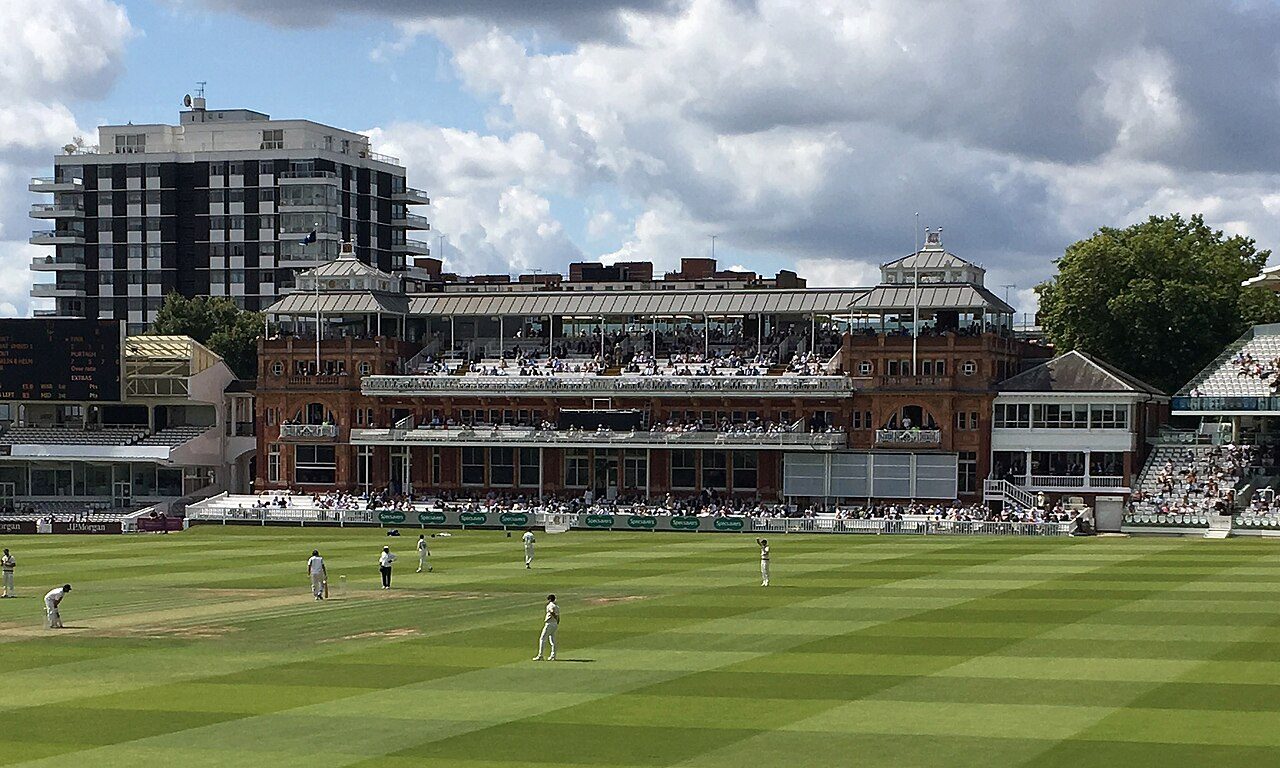
In 1787 members of that circle founded the Marylebone Cricket Club, based at Thomas Lord's ground in London. The MCC adopted its first code of Laws on 30 May 1788 and has been their custodian ever since: it still holds the copyright in the Laws and is the only body that may change them, although the ICC now governs the world game. The present Lord's, the club's third home, dates from 1814 and is known worldwide as the home of cricket.
Timeline
- c. 1550
Schoolboys play creckett at Guildford, Surrey - the game later recalled in the 1598 court case that gives cricket its first definite written reference.
- 1697
The earliest reference to an eleven-a-side match, played in Sussex for a stake of 50 guineas.
- 1744
The earliest known Laws of Cricket are drawn up by the London Cricket Club, fixing the pitch at 22 yards.
- 1774
A revised code adds the lbw law, the third stump and a maximum bat width.
- 1787
The Marylebone Cricket Club is founded at Lord's; its first code of Laws follows on 30 May 1788.
- March 1877
Australia beat England by 45 runs at Melbourne in the match now recognised as the first Test match.
- 1882
Australia's seven-run win at The Oval prompts the Sporting Times mock obituary of English cricket - and the Ashes are born.
- 1909
England, Australia and South Africa found the Imperial Cricket Conference, the body that becomes the ICC.
- 5 January 1971
The first One-Day International is played at Melbourne, improvised after rain abandons a Test match.
- 1975
England host the first Cricket World Cup, won by the West Indies.
- 2003
Twenty20 cricket is launched in England's county game; the first T20 World Cup follows in South Africa in 2007, won by India.
The Ashes and the Test Era
International cricket began in earnest when an England touring team played two matches against full Australian XIs at Melbourne in March 1877, now regarded as the first Tests; Australia won the first by 45 runs. In August 1882 Australia won at The Oval by seven runs - their first victory on English soil - and the Sporting Times responded with a mock obituary by Reginald Shirley Brooks: English cricket had died, its body would be cremated and the ashes taken to Australia.
England's captain on the return tour, Ivo Bligh, vowed to recover those ashes, and after England won the 1882-83 series a group of Melbourne women presented him with a small terracotta urn said to contain the ashes of a burnt bail. The urn was a personal gift, not a trophy; on Bligh's death in 1927 it passed to the MCC and stays at Lord's whatever the result. Test cricket widened slowly - South Africa joined England and Australia, then the West Indies, New Zealand and India - and the three founders set up the Imperial Cricket Conference in 1909.
One-Day and Twenty20: The Game Remade Twice
For nearly a century international cricket meant Tests alone. The break came by accident: when rain washed out the Melbourne Test of the 1970-71 Ashes, officials arranged a one-day limited-overs match on the spare day, 5 January 1971, and the first One-Day International drew a large crowd. England staged the first World Cup in 1975, played at 60 overs a side; Kerry Packer's breakaway World Series Cricket of 1977-79 then dragged the one-day game into coloured clothing, white balls and floodlights, and the 50-over World Cup became cricket's global showpiece.
The second remaking was deliberate. The England and Wales Cricket Board launched Twenty20 in the county game in 2003 - twenty overs a side, a match in about three hours - to win back falling crowds. The first T20 World Cup, in South Africa in 2007, was won by India, and franchise leagues led by the Indian Premier League made the shortest format the game's economic engine, even as five-day Tests kept their prestige.
Significance
Cricket's significance is its double life. It is one of the world's oldest codified sports - its Laws continuously maintained since 1744 - and one of its most reinvented, having generated three distinct international formats from a single code. It is also a map of history: spread by empire in the 19th century, it became a defining passion of the Caribbean and South Asia, and the financial centre of the modern game sits in India, not at Lord's.
Myths and disputes
What is actually in the Ashes urn? Tradition says the ashes of a wooden bail burned after the 1882-83 series. Britannica states it more cautiously - ashes supposed to be those of a bail burned on that tour. Other candidates have been proposed, including a ball, and in 1998 Lord Darnley's daughter-in-law said they were the remains of her mother-in-law's veil. The honest position is that the contents are not certainly known; the urn's power is symbolic, and it was never the series' official trophy.
Cricket's own beginnings carry similar cautions. Claims that the future Edward II played a game called crekag in 1300, or that cricket came from France or Flanders, are speculative and treated by historians as unproven; the documented chain starts with the Guildford case of 1598. Even the first Test is a retrospective title - nobody in 1877 called the Melbourne match a Test; the label was applied later.
Legacy
Cricket's legacy is a set of Laws older than most nations, still revised by the club that adopted them in 1788, governing a sport that now runs from five-day Tests to hundred-ball experiments. The Weald children's game became an aristocratic gambling sport, an imperial export and a South Asian mass spectacle - keeping throughout the essentials Derrick's school friends would recognise: a bat, a ball, two wickets, and eleven a side.
Sources
- Marylebone Cricket Club (Lord's) - The Laws of Cricket, 2017 Code (preface and significant dates)
- Encyclopaedia Britannica - Cricket
- Encyclopaedia Britannica - Ashes
- Wisden / Bloomsbury - Chronology of Cricket
The facts on this page were checked against these sources on 19 November 2026. The History Trail's permanent pages are researched and written for this site; the live profiles elsewhere on The History Trail are assembled automatically from Wikipedia and Wikidata.
About the Author
Researched and written by the The History Trail Editorial Team — the accountable editorial function behind this site's permanent story pages. The team works from the published sources cited on each page; it does not invent historians, reviewers or credentials, and it corrects errors openly.
Fact Check
Every load-bearing fact on this page traces to one of the sources listed above, and significant claims link to their source in the text. Our checking method is described on the methodology page; errors can be reported via the corrections page.
Sources & Citations
Cite this page as: The History Trail Editorial Team, The History Trail — this article's title, publication and update dates are shown beneath its headline. The full source list appears under Sources above; the site's source standards are on the sources page.